Sunday, October 26, 2014

The Abode of Nana Phadnavis

- Aishwarya Pramod

Nana Wada is the residence of Nana Phadnavis, who was Prime Minister to the Peshwas in the second half of the 1700's. This was a period of political instability as one Peshwa was rapidly succeeded by another, and there were many controversial transfers of power. Nana Phadnavis played a pivotal role in holding the Maratha Confederacy together in the midst of internal dissension and the growing power of the British East India Company.
Entrance to Nana Wada
At the turn of the twentieth century, the Deccan Education Society began operating the New English School in this Wada. A new building was built for this school. The addition of this new structure with its colonial influences is another interesting layer over the Maratha architecture from Nana Phadnavis' time.
Nana Wada

Monday, October 20, 2014

"My name is Gauhar Jaan" - the beginnings of the recorded music industry in India

Gramophone recording came to India towards the end of the 1900s. The Indian elite had been importing them as a luxury item already. But there were no local recordings. In fact, many leading male artistes of Indian musical traditions rejected the gramophone. Perhaps they feared that this new-fangled device would make their music too easily accessible, and thus compromise their ability to command high prices for live performances. Or perhaps they balked at the idea of condensing a long classical music performance to meet the restrictions of this new format.

However, several female courtesans came forward to record their voices; I am really not sure why. Maybe it was a chance to become more widely known; maybe they were already very wealthy and didn't have to worry about financials. Or maybe they were attracted by the potential of this new device. Whatever the reason, it was these "nautch-women" who became pioneers of the music industry in India.

India's first commercial 78rpm disc was recorded in 1902 by Fredrerick William Gaisberg of The Gramophone Company. The singer was Gauhar Jaan, Kolkata's most famous courtesan. The recording was done in a makeshift studio in two large rooms of a hotel in Kolkata. 

Traditionally Hindustani music performances were long affairs, but Gauhar Jaan devised a unique template for presenting it in just 3 minutes, which was all that a single disc could record at the time. 

At the end of each recording, she would announce in English "My name is Gauhar Jaan". In those days, there were no facilities in India to cut the the master disk (acetate). So the master tape of the recording was sent to The Gramophone Company's pressing plan in Hanover (Germany). The announcement of the name at the end of the song helped the technician identify the singer. 

By 1903, Gauhar Jaan's records started appearing in Indian markets and were in great demand. She recorded over 600 records in 10 languages. She became very famous; so much so that when King George visited India for the Delhi Durbar, Gauhar Jaan was invited to Delhi to sing for him. She sang a special song congratulating the emperor on his coronation She was accompanied by Allahabad's famous courtesan, Janaki Bai (pictured here).

In 1908, a record pressing plant was set up at Sealdah, Calcutta (availability of plenty of lac/shellac was one of the reasons). With this plant, there was no need to send the wax masters to Germany, and as a result, the name announcements at the end of the song also disappeared. The workers at this plant called it "Baaja-Khana", the Music House. The harmonium or baaja was the most commonly used musical instrument accompanying vocalists.

P. S. Technically speaking, Gauhar Jaan was not the first recording that the Gramophone Company did. Three days before recording Gauhar Jaan, Fredrerick William Gaisberg recorded two other girls, Shoshimukhi and Fani Bala. He was not impressed with their voices. It was Gauhar Jaan who went on to achieve stardom, while the two singers before her remained unknown.

Friday, October 17, 2014

The gorgeous Noor of Ranthambhore - sighting in October 2014

I got these photos of Noor aka Mala (T-39) from Robert and Katie Cowan. They were in Ranthambhore last week. Isn't Noor just gorgeous?
Here's another photo: you can clearly see the "beads" on her back. This characteristic pattern is what gives her the name "Mala", which means garland. Noor and her two cubs have been among the star attractions of Ranthambhore this season.
Noor is the daughter of the Sultanpur tigress T-13 (Chhoti), and the granddaughter of the legendary Machhli (T-16). Noor's first cub is a male called Sultan (T-72); born a couple of years ago when she mated with Ustad (T-24).  This year she has had two more cubs with Ustad. 

The grass has started to dry up in Ranthambhore in many places, although many places are also still very green.  In this photo below, you can see that Noor looks well-fed and healthy; and there are reports that she has been having good hunting success.
In my previous trip to Ranthambhore, I had excellent sightings of Noor; but that was just a few days after Sultan was born, and she was super skinny and hungry at that time. Take a look at my previous encounter with Noor here. http://delhimagic.blogspot.in/2012/06/tiger-sighting-at-ranthambhore-may-2012.html

Sunday, October 12, 2014

Rickshawallahs in Varanasi

I could not resist posting this photo of two cycle-rickshawallahs in Chowk, Varanasi. See the difference between them; one is old and experienced, the other is young and seems to be just starting out with a newish rickshaw.
As per the records of licensing department of Varanasi Municipal Corporation (VMC), there are around 10000 registered rickshaws in the city. There are far more rickshaw pullers than there are rickshaws. Some rickshawallahs own their own rickshaws, but most rent them from others. Rental is around Rs 35 per day. Typical earnings in a day are around Rs 250, and after accounting for living expenses, the rickshaw puller may save around Rs 5000 a month. 

But there are many problems. Harassment by the traffic police is one of the biggest ones; and the rickshawallahs pay bribes routinely. Sometimes rickshaws are confiscated, resulting in loss of income. If the rickshawallah falls ill, he has no earning on that day. Often during festivals, weddings, deaths and other family occassions, they go back to the villages surrounding Varanasi; and they have no earnings at that time either. During harvest season also, they go home to provide labour for their family farm, and there is no earning from the rickshaw at that time. 

With this kind of low income, the rickshawallah has no money to spare for any event in the family - a medical emergency, the birth of a child, or a death. For meeting these needs, the rickshawallah has to take a loan. With no access to formal credit, loans are obtained at crazily high rates from local moneylenders. The interest piles up and often older rickshawallahs are struggling under a heavy debt burden.

All these thoughts ran through my head as I saw these two men, one old, one young. I wondered what life had been like for the older one. I wondered what was in store in the future for the young one.

Monday, October 6, 2014

Triumph of Labour, Marina Beach, Chennai

This is the earliest statue put up on Marina Beach for beautifying the promenade.
It is called the Triumph of Labour, and represents four men working hard, trying to move a rock. In 1923, the first ever May Day rally for workers' rights was held in nearby Triplicane. The Triumph of Labour commemorates that rally. It was erected in 1959.

The sculptor is Debi Prasad Ray Choudhury, who was born in what is now Bangladesh; he moved to Madras as the Superintendent of the Madras School of Art.

Friday, October 3, 2014

Why the British were wary of Sadhus

Saffron-clad itinerant sadhus are a standard feature of Indian pilgrimage towns today. However, the British were uncomfortable with these sadhus (and with with nomadic people in general).

As early as the 1830's, William Henry Sleeman (who created the Department of Thugee and Dacoity), argued that "Three-fourths of these religious mendicants, whether Hindoos or Muhammadans, rob and steal, and a very great portion of them murder their victims before they rob them...There is hardly any species of crime that is not throughout India perpetrated by men in the disguise of these religious mendicants".

In medieval India, Sadhu akharas (sects) were not just loose bands of itinerant ascetics. They were an important component of the military labor market. Sadhus carried tradeable items on behalf of merchants and developed fighting skills to protect their cargo. Some sadhus, such as the well known Anup Giri became military adventurers and warlords. The kumbh melas became staging grounds for the mobilization, recruitment, and mercenary employment of the armed akharas. These martial characteristics of the sadhus made them dangerous from the British point of view.

Sadhus could move freely through the countryside, and had easy access to villages. They were usually constantly on the move, staying in temporary camps. This made it impossible for the British to police them. They had no permanent home, no land, no family, and no material possessions using which any pressure could be brought upon them. The were part of esoteric sects, and loyal only to their sect leaders. Many myths and super-natural powers were often attributed to sadhus in popular imagination; because of which they enjoyed the support of the local populace. 

During the Sepoy Mutiny of 1857, the British record of events in Kanpur speaks of significant numbers of gosains, or Saiva soldier ascetics, taking part in the insurgency. The leader of the Kanpur gosains was named Lalpuri Gosain, and the records say that he appeared during the hostilities on elephant-back with a military banner on display.

In the first half of the 1900's, with the World Wars, and the increasing anti-colonial movement in India, the British were worried that sadhus were preaching sedition. In fact, British fears in this regard were not unfounded. In 1920, Naga sadhus came in considerable numbers to the Nagpur Indian National Congress conference, to see and listen to Gandhi, as he launched the Non-Cooperation Movement. British intelligence reports say that Gandhi spoke to the sadhus, advising them to visit military cantonments, to spread the message of non-cooperation.

During the first half of the 1900's  there were also several stories of freedom fighters dressing up as sadhus in order to be able to move freely. For example, the noted freedom fighter Chandrashekhar Azad (1906 - 1931) is said to have disguised himself as a sadhu and a temple priest, to evade capture.

There are several interesting books and articles on the sadhus and their role in history. However, nothing about sadhus is taught in Indian history books. Children grow up knowing nothing about them. We see sadhus today only as strange relics of a past era, or as practitioners of arcane rituals, or as godmen with eerie powers.

Wednesday, September 24, 2014

Malik Amber: Founder of Aurangabad

- By Deepa Krishnan

Have you heard the name of Malik Amber?

He is the founder of the city of Aurangabad.
Painting of Malik Amber by Mughal painter Hashim, currently in Victoria and Albert Museum
Malik Ambar was born in Ethopia in 1548 with the name Chapu and was sold into slavery. He was eventually bought by a leading member of the Nizam Shahi court of Ahmadnagar, one of the Deccan sultanates. He rose through sheer personal capability to became a commander of the Nizam Shahi army. By 1600 he had become Regent of the Kingdom, effectively ruling Ahmadnagar until his death in 1626.
Malik Amber's tomb in Khuldabad
He originally founded the city of Khadki in 1610. After his death in 1626, the name was changed to Fatehpur by his son and heir Fateh Khan. When Aurangzeb, the Mughal Emperor invaded Deccan in the year 1653, he made Fatehpur his capital and renamed it as Aurangabad. Since then it is known as Aurangabad.

Saturday, September 20, 2014

Narottama Dasa - poet-saint of the Gaudiya Vaishnavism tradition, Bengal

Today I have been listening to the wonderful music of the Bengali Gaudiya Vaishnavas. The golden raspy voice of Srila Prabhupada has been working its magic on me. What a great tradition of poetry and song! Truly India responds to music. Whether Kabir, Nanak, Khusro or Chaitanya, poetry set to music is the underlying unifier that carries complex philosophical messages straight to our hearts.

In search of more information about the Gaudiya Vaishnava philosophy, I came across the work done by the Bhaktivedanta Research Centre in Kolkata. They are researching and documenting the Sanskrit and Bengali literature of Vaishnavism.  The latest document they have recorded and saved is a manuscript published in 1724. It is a copy Prema Bhakti Chandrika by Narottama Dasa Thakur, a 15th Century poet-saint. Narottama Dasa was a contemporary and follower of Chaitanya Mahaprabhu. Composed in Bengali, Prema Bhakti Chandrika consists of devotional songs. 

Prema Bhakti Chandrika
Narottama Dasa Thakur is credited with popularising the Gaudiya Vaishanava teachings in Bengal. Born in the mid-1400's to a zamindar family in Bangladesh, he was an unusual person in many ways. He was blessed with an eidetic memory - the ability to memorize and recall anything he heard. Drawn to religion, Narottama Dasa travelled to Vrindavan, the birthplace of Lord Krishna. There he met the brothers Rupa Goswami and Sanatana Goswami. They had been sent to Vrindavan by Chaitanya Mahaprabhu to locate and preserve the lost sacred spots of Krishna's mythological birthplace. Rupa Goswami had composed several beautiful works. After visiting Vrindavan, studying the works of Rupa Goswami, and being initiated into Vaishnavism, Narottama Dasa returned to Bengal. 
Narottama Dasa Thakur
The book Prema Bhakti Chandrika is actually based on Rupa Goswami's writings. It contains the essence of Rupa Goswami's works. The book is also therefore called Sri Rupaanuga-Gita.

Narottama Dasa travelled the length and breadth of Bengal, popularising Gaudiya Vaishnavism. He composed many works in Bengali, and initiated a great annual gathering of Vaishnavite followers, called the Kheturi Mahotsava (which continues to be a major festival even today).

The founder of the popular ISKCON movement, Prabhupada, traces his spiritual lineage (guruparampara) to Narottama Dasa. Narottama Dasa's songs are sung even today at the ISCKON centres all over India. Here's a beautiful song of Narottama Dasa, sung by Swami Prabhupada: Just listen to it! It combines the beauty of Bengali folk music with the ecstatic Bhakti of Vaishnavism. Prabhupada says about the songs of Narottama Dasa Thakur, "This sound is above the material platform. It is directly from the spiritual platform. And there is no need of understanding the language. It is just like a thunderburst. Everyone can hear the sound of thunder - there is no misunderstanding. Similarly, these songs are above the material platform, and they crack like thunder within your heart."

Sunday, September 14, 2014

Tribal Terracotta figurines of Gujarat

Gujarat is home to many tribal societies. The Bhils, Choudharies, Dhodias, Konkanas, Halpatis, Garasias etc. follow the custom of offering a 'ghodo' or horse to the gods, on sucessful completion of a milestone, or for prayers answered, or to appease a spirit. 

This custom is seen especially in the Surat district, the Chhotaudaipur area, and the Poshina belt of the Sabarkantha area. 

In the tribal culture, each object has a spirit or essence which may be benevolent or malevolent. Daily occurrences, both good and bad, are often attributed to such spirits. The appeasement of these spirits is sometimes an annual feature or festival, or in some cases, it is based on a specific situation, for example, if a child falls ill, it may be attributed to a spirit. Tribal custom often requires the sacrifice of an animal or bird for such occassions, but these are often too expensive, so these terracotta offerings are used as a substitute. 

Apart from horses, there is also the custom of keeping other things, such as elephants, cows, birds, pots, human figurines etc. There is a wide range, depending on the skill of the craftsman in each tribe's area.

Such offerings - especially dome-shaped figures called dhabu - are also kept near the graves of departed ancestors, in the belief that they will be useful in the afterlife. Offerings can be very small in size, or sometimes large and life-size. 

The process of making the offering is also quite elaborate. First, the family decides that they want to make the offering. Then they contact the kumhar (potter community) to discuss the design, type of offering and the cost. It is not necessary that the potter is in the same villlage or neighbourhood, so people may travel to nearby areas to seek out the potter. 

Once the offering is ready, a band is arranged, and with music playing the procession goes to the potter's house to collect the offering. Certain songs are also sung for these types of occassions. Payment is made to the potter (sometimes cash, sometimes in food or other articles). 

Along with the terracotta offering, the family proceeds to the shrine. They make an offering of fowl, rice, coconuts, local liquor etc at the shrine. For larger occassions, the larger community may also be invited and given a feast. 

Many practices of the tribal cultures of Gujarat have been assimilated into mainstream Hinduism. Similarly, many mainstream Hindu practices are now found in tribal societies. The propitiation and veneration of spirits residing in trees, rivers etc, the prayers to snake-gods, various animal and bird gods, are found both in tribal societies and mainstream Hinduism.

Wednesday, September 10, 2014

Gujarati architecture - What is an Otla?

On one of my visits to Ahmedabad, I photographed the entrance of a Gujarati merchant house in a traditional neighbourhood. This type of entrance area is called an otla or otta, and it consists of a narrow raised plinth with steps.
The otla acts as a sort of communication zone between outsiders and the residents of the house. Typically in an otla, there is a row of columns supporting a wooden facade. The otla is often carved and decorated profusely, to show the social and economic standing of the household.
The American artist Edwin Lord Weeks painted a lot of otlas when he visited Ahmedabad in the 1890's. Here's a lovely one. The Gujarati love for ornamentation is visible beautifully in this painting. This type of architecture is characterised not only by the profuse nature of the abharana (ornamentation), but also by the continuity - meaning, there is no break in the design, we go from carving to carving and the entire area leaves the mind reeling with the overall impact of the design. There is no time to look at the details....we only see that later, when we come closer to it, and then we marvel even more.
Here is another painting by Lord Edwin Weeks: here also, you can see the profuse ornamentation. But also here we see another feature, a plain lintel beam. Beams are bulky and difficult to hoist, so often they were left uncarved, because they could otherwise be damaged in the process. In such cases, either the beam was left open, or ornamentation was later added using thin carved wooden strips, which were fixed by nails.
By the way, when I walking in one of the pols, I found a house that looks exactly like this one painted by Lord Edwin Weeks :) :) See the similarlity below. I was convinced it was the same house!! Edwin Weeks used to photograph the areas first, and then paint later. So his paintings are quite accurate. 
I have lots of photos of different houses in the pols of Ahmedabad, with otla of different types and colours, carved doors, pillars, beautiful woodwork designs etc. In some houses, the beautiful carved woodwork has been painted over, maybe to make it look well-maintained. But actually the paint obscures the carving. See this once-beautiful house below, now the stairs are crumbling, and the windows have been boarded up with metal sheets. But it still retains its old beauty. There is some fine fern-shaped carving over the doorway.
The otla need not always be such a traditional carved affair. For example, this small house is in a corner, and the otla is about 10 feet wide. However, all the typical architectural and functional characteristics of the otla are there: it is a well-demarcated area, with pillars, serving as a sort of interaction zone between outsiders and insiders. A more modern, art-decoish interpretation of the brackets has been done.
The otla is one of my favourite subjects to photograph and to marvel at. It is a place where in the evening the women of the household sit down and watch the world go by. They chat with neighbours and keep an eye on the children playing. In the past maybe the women of the house stayed inside, but these days we see them often sitting outside and enjoying the evening with family and friends. Next time you walk anywhere, look for the otla and see how it is being used!

With many thanks to Jay Thakkar, whose article on Naqsh helped me find out a lot about Gujarati architecture. 

Wednesday, September 3, 2014

A Recipe for Sanketi Chutni-Pudi

The Sanketis are a small community of Brahmins who supposedly migrated from Tirunelveli district of Tamil Nadu as well as from Trichur district of Kerala, to finally settle in the Mysore province of Karnataka (today they reside in Bangalore, Mysore, Chikmaglur, Hassan and Shimoga). They speak Kannada-infused Tamil in a sweet sing-song style. Since Sanketi names sound more or less like Tamilian or Kannadiga names, you cannot find this community unless you happen to ask someone. They are hidden.

The ingredients for chutni-pudi
This community was reputed for its intellectuals in the traditional vedic learning and produced many experts in Carnatic music, Sanskrit language, etc. Naturally some of them ended up as advisors to the Mysore rulers including Tipu and the Wodeyars. Other Sanketis cultivated arecanut, coconut, betelnut, and banana. More recently, they have taken to English education, with many of them migrating abroad to work as scientists, doctors, researchers etc.

Sanketis are keen eaters  and are said to be fond of competitive eating at weddings! There are folk tales of a favourite character called "Hotte-Baka" who is known for his appetite. 

Here is a recipe for a Sanketi version of that Karnataka favourite, chutni-pudi. Chutni-pudi can be eaten with dosa, idli etc, but also goes fantastically with akki-roti.

Ingredients:
  • Kadala bele (chana dal or Bengal gram split and skinned) - 1 cup
  • Uddina bele (urad dal or black gram) - 1/2 cup
  • Togari bele (tuvar dal or pigeon pea splits and skinned) - 1/2 cup
  • Ona menasinakai (dry red chillies) - 6-7
  • Ingu (hing or asafoetida) - a small bit
  • Kari bevu (kadi patta or curry leaves) - one handful
  • Hunase (imli or tamarind) - marble size
  • Ellu (sesame) - 1 teaspoon
  • Copra - as much as you like
  • Oil - 2 tablespoons
With the kadhai (cooking pot) on a low flame, dry roast the kadala bele.
When it is a little roasted, add uddina bele.
After a minute or so, add togari bele.
Now roast all 3 beles together, until you get the nice roasted smell. Keep flame low and be patient, do not over-roast.
Next step, take oil in kadhai, roast the other ingredients except copra (red chillies, curry leaves, tamarind, asafoetida, sesame).
You need to scrape or cut the coconut into smaller bits and fry it in the end for a very little time, just to get the rawness out.
After this, powder all the ingredients, and add salt to taste.
Can use more chillies if you like it spicy.

Ta-da! Mix with oil/ghee and enjoy with idlis, dosas and akki-rotis.

Ekam Sat: One Reality, Many Forms

"Ekam sat vipra bahudha vadanti" says the Rig Veda. "That which exists is One: sages call it by various names." This photo, taken in Varanasi, reminded me of that.

Banaras is Shiva's city, he is everywhere you look. At the souvenir stalls, Shiva is represented in colourful popular art as Gangadhara, bearing the Ganges in his hair. But the stalls also sell pictures of a host of other deities - Kuber the God of Wealth, Hanuman, Rama, Krishna, Durga, Kali, Ganesh, Lakshmi ... there are pictures also of objects such as the Sri Yantra, and there are pictures of godmen and gurus - Sai Baba, Ravidas, and many others. 

Why are there so many deities, gurus, and other pictures? Because Hinduism allows its practitioners to choose whichever form of God that inspires and resonates with them the most. This is the concept of "Ishta Devata" or "Chosen Deity". Here the form itself is not as important as the ultimate goal. While all Hindus agree there is only one Eternal Brahman, or Cosmic Truth, they reach this Brahman through different routes. That route is the Ishta Devata. 

It is difficult to meditate upon an abstract concept. So teachers of meditation tell their pupils to select an Ishta Devata in order to do "Saguna Dhyana" - in this type of meditation the practitioner focuses on the visible aspects of the Ishta Devata. For example, Saguna Dhyana of Vishnu could include meditating one by one on his face, his golden ornaments, his yellow robes etc. You can see this form of meditation being practised by many Bhaktimarga followers. 

For Ramakrishna Paramahamsa, the Goddess Kali was his Ishta Devata. He saw her everywhere and meditated solely upon her. Such meditation - usually also done with a specific mantra chanting (involving the name or the characteristics of the Ishta Devata) - can have powerful effects on the mind. 

From this type of Saguna Dhyana, the practitioner can eventually move to "Nirguna Dhyana", meditation on the abstract. The Ishta Devata provides a sort of gateway, almost. Obviously, it is important to choose an Ishta Devata that resonates most with you. Many families use the concept of kula-devata or family deity as their Ishta Devata. Many people use the face of their spiritual guru as their ishta-devata. There are really no rules or restrictions. Sincerity is important.

The term Ishta Devata should also be understood as a way to define a chosen ideal or goal. For example, in the Yogasutra, Patanjali says: "svadhyayad ishta devata sanprayogah" meaning that self-study and reflection brings you into contact with the desired ideal.

Monday, September 1, 2014

Making the idols for Durga Pooja

Every year, thousands of artisans are involved in making idols of Goddess Durga for Maha Pujo (Durga Puja) in the Hindu month of Ashwin (September to October).

The hay used to create the body
Basic structure of the goddess created with hay on a wooden frame
The hay-body is covered with a mixture of mud-, clay and rice husks, and allowed to dry.

The mud mixture being prepared to coat the hay-bodies
After drying
As this basic structure, dries, the artisans create fingertips, toes, noses and other fine parts. These are fixed onto the dried body, and finally the idol is painted.

The first coat of paint for a beautiful idol
Article written by: Aishwarya Pramod
Photos by: Lavanya Shanbhogue-Arvind

Merchant mansion in Varanasi


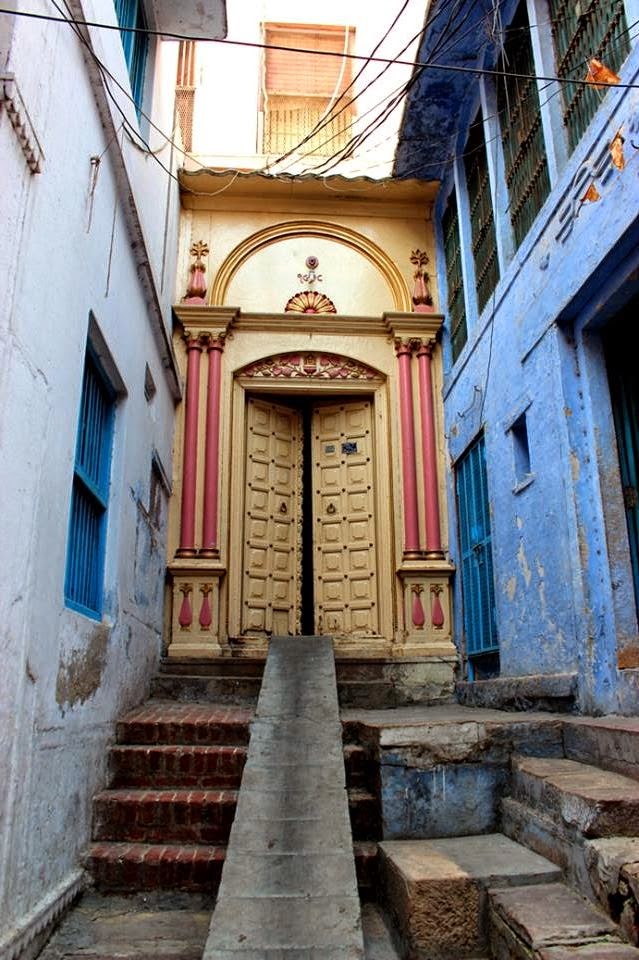
While walking from Manikarnika Ghat towards Vishwanath Temple, I saw this lovely house. It has made such beautiful use of maroon, cream-yellow, gold and pink. I went closer and spotted the stylized numeral lettering on the house, which says "1978" in Gujarati script. The house must belong to a Jain or Hindu Gujarati merchant.


Here is a closeup of the previous picture. Notice the half-lotus design on the top centre, which has been highlighted in gold and maroon. The semi-circle arch stucco work has a very Art-Deco feel to it. On the left and right, there is a depiction of a mashaal (torch). On the mashaal too there are lotus designs. There is a small Ganesh idol on top of the doorway, surrounded by carved grape vines: this reflects either Gandhara influence or British influence. European influence can definitely be seen in the capitals: they seem sort of Ionic or Corinthian or something!

The City Palace at Jaipur

City Palace is a complex of palaces, pavillions, gardens and temples spread over several acres, located to the northeast of central Jaipur. It was commissioned by Maharaja Sawai Jai Singh II in 1729, who wished to shift his capital from Amer to Jaipur, due to water problems and an increase in the population. The City Palace, and in fact the entire city of Jaipur, was planned by an architect from Bengal, Vidyadhar Bhattacharya.

Bhattacharya was guided by the Vaastu Shastra and the Shilpa Shaastras (ancient Hindu treatises on architecture, arts and crafts). But the Palace is also a fusion of Mughal and European styles with Rajput architecture.

Today, part of the Palace is a museum, as well as the residence of the current royal family. The most prominent structures in the complex are the Chandra Mahal, Mubarak Mahal, Mukut Mahal, Maharani's Palace, Shri Govind Dev Temple and the City Palace Museum.