Showing posts with label Temples of India. Show all posts

Friday, October 7, 2022

Best way to visit the city of Madurai

 
Madurai has long been the cultural epicentre of Tamil Nadu. Records of the city from the 3rd century BC depict a thriving trading centre, with links not only to other cities in India, but also to Rome and Greece. Under the Pandya kings, the city flourished and became a great centre of literature and learning. From the Pandyas, the city passed into the hands of many conquerors, including the Cholas, the Delhi Sultanate and the Vijayanagara Kingdom.

When the Vijayanagara kingdom collapsed, the Nayaks of Madurai, who had been appointed as local governors, became powerful and independent. It was the Nayaks who in the 17th century, expanded the Meenakshi Temple and brought it to the pinnacle of its glory. In the 18th century, the Nayaks lost control of Madurai to the Nawabs of Arcot, who in turn ceded power to the British East India Company. British control over Madurai endured for 150 years, until Indian independence in 1947.

Here is a beautiful video showing some of the highlights of Madurai. Do reach out if you need help planning a trip to this vibrant city which is the cultural and food capital of Tamil Nadu. We have heritage walk, food tour, crafts tour... everything to help you really enjoy a trip to Madurai.  www.maduraimagic.com

Saturday, December 29, 2018

The Portuguese Church Bells of Maharashtra

This week I read a story in Hindustan Times about Portuguese church bells, which are being used all over temples in Maharashtra.
Temple bell at Naroshankar, Nashik. Photo Credit: Hindustan Times
The bells were acquired by the Marathas from various churches, during their conflicts with the Portuguese. The 17th and 18th century were full of many conflicts, with the Marathas, Siddis, the French, the English and the Portuguese, all jostling for supremacy on the Western coast of India.

Fr. Francis Correa, a priest based in Vasai (Bassein) says discovering the bells has broadened his view of India. He says: “Seeing the bells for the first time, I initially felt like it was my community’s property and that I should work on restoring them to the church. But over time I’ve realised that in Hindu temples, they’ve been given a new life, with new missions to perform. They are our shared heritage.”

When I read this quote I couldn't help thinking that if more of us had such enlightened views we would be living in a much happier world!

For many years now, we have been sitting on this Ayodhya mandir-masjid controversy. Was it originally a temple or a mosque? Now that the mosque is broken, what should we build there? Whose monument is it now? ... All these questions could be more easily resolved if we thought of it as our country's shared heritage!

Whether we like it or not, we cannot wish away history; nor can we turn back the clock. If more politicians had the guts to celebrate the Ganga-Jamuna tehzeeb (cultural diversity) of this land, India would be a different place. Come to think of it, every time we eat a biryani, it is a Ganga-Jamuna celebration. Every time we wear a salwar-kameez, it is the same celebration. The notion of India as belonging only to only one community is really impractical, not to mention immoral.

Magar yeh ghanti kisi ke dimaag mein bajti hi nahi!
(but this bell does not ring clear to anyone!)

Friday, January 12, 2018

Vintage poster, Sarnath

I was looking for vintage posters on travel to India, when I came across this one:

It's from the 1930's, for travel to Varanasi (to the holy Buddhist site of Sarnath). Commissioned by the Railways, it is part of a series designed by the artist Dorothy Newsome. She signs her name as D. Newsome, so of course, true to stereotype, I assumed it was a male artist. You think you're a feminist, and then this sort of thing comes along and trips you. I live and learn. Printed at the Calcutta Chromotype Ltd at Bowbazaar in Calcutta.

The word the poster uses for Sarnath is "Isipatana", the ancient name for the Deer Park where the Buddha preached his first sermon and set in motion the Wheel of Dharma (Dhamma Chakka).

Isipatana is an open space near Varanasi; it is the site of the famous Migadāya or Deer Park. After his Enlightenment, the Buddha joined his friends, the Pañcavaggiya monks, who were in Isipatana. To them he preached his first sermon, the Dhammacakkappavattana Sutta, on a full-moon day.

The name "Isipatana" is derived from the belief that sages and divine beings, as they fly to/from the Himalayas, alight here. In the Pali canon, the phrase "isayo ettha nipatanti uppatanti cāti-Isipatanam", means, "the place where the divine beings fly down to and alight/stay, that is known as Isipatana".

Isipatana is not just where the first sermon was preached. It is also the place where the Buddha spent many rainy seasons. Thus, many sermons originated here.

Isipatana was a very large and thriving Buddhist centre. We know from written records that there was a large community of monks at Isipatana in the second century B.C, when at the foundation ceremony of the Stupa in Anurādhapura, Sri Lanka, twelve thousand monks went from Isipatana,  led by the Elder Dhammasena. The Chinese traveller Huen Tsang, in the 7th century AD, recorded that 1500 monks were studying the Hinayana form of Buddhism in Isipatana.

Tuesday, September 19, 2017

On visiting the Mahakaal Temple at Ujjain

I'm going through an interesting experience, I am writing a sales brochure for a tour called "Pilgrimage tour to Ujjain". I have never written brochures for any purely pilgrimage tours so far. So this is a new thing for me.

Ram Ghat after sunset, on the Kshipra River, Ujjain
As some of you probably know, Ujjain is an ancient city which used to be the capital of Avanti, one of the Mahajanapadas, the great 16 Republics of India (6 BCE). The poet Kalidasa talked about the beauty of Ujjain (in his famous poem Meghadoota, The Cloud Messenger).

But now I need to write about Ujjain from a purely religious angle, and I find myself a little stumped.

You see, I cannot bring myself to write religious "facts". In India all major temples have a 'sthala-mahima' or story associated with that place. For example, so and so maharishi did penance here, such and such God automatically manifested here, so and so Goddess sat right upon this very spot... These stories are not historical, they are legends, and I can't help thinking that no doubt some clever temple priest made them up at some point. And I simply don't have the necessary religious belief to make a sales-pitch extolling some imaginary sthala-mahima!

How do I write a convincing spiel for something that I don't quite believe in? Naturally, I'm going to have to write this in the third person, for example, I've got to say something like, "Legend has it that..." or "It is believed that ...". A cop out, really :-)

And yet, when I went to the main temple in Ujjain, the Mahakaal temple, dedicated to the Shiva the Destroyer of Time, and heard the chanting, it affected me immediately. I was crying and had goosebumps. They were decorating the lingam with a thick paste of bhaang leaves. Never seen anything like that, so fascinating. People were shouting Mahadev! Mahadev! and Om Namah Shivay! And I heard many powerful descriptions of Shiva's name, Neelkanth, He of the Blue Throat and Gangadhara, He Who Holds the Ganges. One man would shout it out, and others would pick up the chant...I sat there with goosebumps and tears, perhaps it was the faith of the people that moved me, and perhaps it was the energy around me.

One thing I know for sure - whether I'm religious or not - this country has got me in its grip. I am connected viscerally to the people, the temples, the stories, the words, the sound of Sanskrit. The very soil of Bharatavarsha talks to me.

Now - off to write that brochure.

Monday, August 8, 2016

Padayani: The spirit of central Travancore

- By Aishwarya Javalgekar and Deepa Krishnan

Kerala is famous for its rich cultural heritage, and has many popular art forms to its name. But an art form that is perhaps not yet widely known is Padayani; the worship of Mother Goddess, practiced in the Bhagavathy temples of the central Travancore region.
http://pathanamthittatourism.com/destinations/heritage/padayani.php
Padayani is not just an art form. It is a community gathering to ensure the physical and mental well-being of the entire village. It is a set of rituals that transcends the boundaries of caste and religion, generating a sense of unity.

The legend says that Padayani originated as a form of prayer to pacify the goddess Kali, after she killed the demon Darika. This art form has several important cultural aspects:
  • Kolamezhuthu - These are beautiful and elaborate coloured drawings of folk deities. Kolams individually embody a certain character associated with spirits and deities. They are made from natural materials which comprise spathes (paalas) of the areca nut palm tree. Natural colours are painted on these paalas using a brush made from the stem of a coconut leaf. 
  • Kolappattu - Folk songs with traditional lyrics that include the exaltation of the deities, as well as requests to obtain their grace
  • Thappumelam - Musical performance specially featuring a Thappu, a drum made by covering a jackfruit hardwood piece with buffalohide
  • Kolamthullal - A dance form that accompanies the festival
  • Vinodam - Satire, an essential part of Padayani! This is performed making fun of petty vanities of people, as well as to target areas for social reform.

In this outstanding video below, you can see entire cultural process explained with English sub-titles. The first 3 minutes are an excellent introduction in Malayalam, without sub-titles, but the rest of the video has wonderful sub-titles.

Some practical information:
Padayani performances at temples are easily accessible from Cochin, Kumarakom or Alleppey. They are performed at night outside Bhadrakali temples, during the Padayani festival, typically between March and April. If you are visiting India this September, you can attend the padayani at the Neelamperoor Bhagavathy Temple at Kottayam on 29 Sep (photo below). It's only a 2hr drive from Cochin, and a 1hr drive from Kumarakom or Alleppey. 
http://babuscamera.blogspot.in/2008/09/pooram-padayani-at-neelamperoor.html
You can stay overnight in Kottayam if you prefer. The Athreya Ayurvedic Resort in Kottayam provides excellent therapies, so you can combine a detox stay with a festival visit. They also have yoga practitioners who can teach you yoga. 

If you'd like more information about a tour that incorporates the Padayani festival, please send an email to deepa@magictoursofindia.com. Or you can also look up the Kerala Festival Calendar (search for "patayani") to see the schedule. 

Saturday, June 4, 2016

Gyan-Vapi, the Well of Knowledge, Varanasi

- By Aishwarya Javaglekar

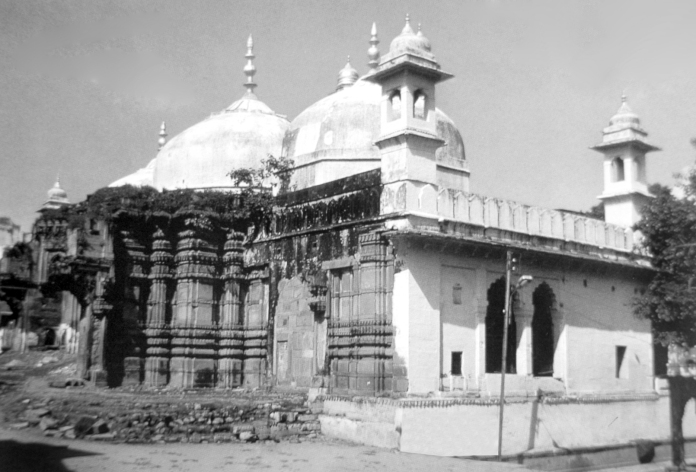
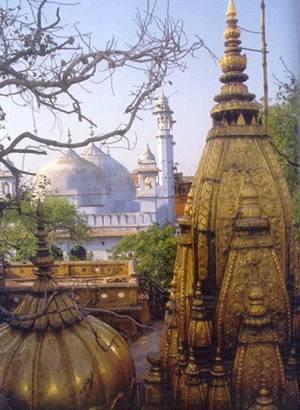
The Gyan-Vapi (Well of Knowledge) in Varanasi lies near the Great Mosque of Aurangzeb and the present Vishwanath temple, the Golden Temple of Varanasi.
An old photograph of the Gyan-Vapi
The land around Gyan-Vapi has been considered sacred since historical times, and has had an eventful past. The original Vishwanath temple was destroyed by Qutb ud-din-Aibek in 1194 during a raid of Varanasi. In its place, he built the Razia Mosque. The temple was rebuilt in 1585 by Todar Mal from Akbar's Court, and was destroyed once again by Aurangzeb in 1669. He used the materials from the temple to build a mosque, calling it the Great Mosque of Aurangzeb. The Vishwanath temple, built once again under the patronage of Queen Ahilya Bai Holkar in 1776, still stands next to Aurangzeb's mosque.
Incorporation of the second Vishwanath temple in Aurangzeb's mosque
While the Gyan-Vapi lies in the mosque precincts, legend says that the original Vishwanath Shiva Linga (an object of worship personifying the god Shiva) is hidden inside the well. During the British period, the Gyan-Vapi was a pilgrimage destination for many Hindus, who believed the well water to be more sacred than the Ganges itself.
A view of the Gyan-Vapi mosque (left) and Vishwanath temple (right)
While some consider the well to be a testament to the tumultuous relations between Hindus and Muslims, standing on ground sacred for both religions and surrounded by Hindu, Muslim, Jain and Buddhist iconography, the well manifests the diversity of Indian culture and the city of Varanasi.

Tuesday, May 17, 2016

Thrissur Pooram

One of Kerala's biggest festivals is the 'elephant festival' at Thrissur. The festivities, dedicated to the Hindu God Shiva, last for over 36 hours. They start when small elephant processions carry deities from various villages across Thrissur and culminate at the grounds of the Vadukunathan Temple.

The festival is marked by fireworks, and a display of umbrellas, as well as caparisons that adorn the elephants. Typically, the festival takes place during April-May.
See the crowds!
Mahouts have trained themselves to stand atop the elephants.
It's amazing how these elephants remain calm even when faced with hordes of people. 

There is increasing awareness in Kerala these days regarding the need for better treatment of elephants. A movement against the training and use of elephants is slowly taking shape. However, elephants have been an integral part of Kerala culture for hundreds of years and in fact, many of the majestic elephants have fan clubs of their own. You can find these fan clubs on facebook these days. Fans eagerly await the festivals and the processions.


Sunday, January 10, 2016

Suprabhatam – The Dawn Prayer

- by Deepa Krishnan

This morning I listened to Suprabhatam - the Dawn Prayer - as sung in the Tirumala temple in Andhra Pradesh. This is the prayer sung to wake up the sleeping Lord Vishnu. To me, there has always been something mesmerising and calming about the sound of this morning chant. 

Perhaps the sound of Sanskrit appeals to me; or perhaps it is the cadence itself, or perhaps it is the knowledge that I am listening to something very old.

On an impulse, I looked up the Tirumala website for a translation of the Dawn Prayer - and found myself captivated by the beauty of the lyrics.

Wake up, Lord, the song says, wake up! See the beauty of the Dawn! 
The breeze carries the scent of half-opened blue lotuses; it blows gently through coconut and arecanut trees. 
Green parrots in beautiful cages open their eyes; they eat bananas and sweet payasam, and sing gracefully. 
The black bees hum loudly, declaring themselves more beautiful than the flowers! 
Wake up, Lord, and with your waking, render the three worlds auspicious!

For me, the imagery these words conjure up is very "South Indian". In my mind, I can see a green prosperous fertile country, with rice fields and coconut groves, where the morning brings with it gentle breezes and calm beauty. 

Dark-skinned beautiful women walk in the fields, their sarees brilliant with colour. Temple spires – tall, colorful gopurams - rise above the trees. White oxen are being yoked to the plough. Everything is green and beautiful…and somehow blessed. (It is just me or does anyone else see these things? I don’t know!) 

Other than descriptions of the land, the Dawn Prayer also contains poetic descriptions of Vishnu:
Darling child of Kausalya! Lord with the Eagle Banner! 
Lord of the Seshachala Hills! Padmanabha, he of the Lotus Navel! 
Purushottama, ideal among Men! Madhava! Janardana! Chakrapani, Holder of the Divine Discus! Lord of the ten incarnations! He whose body is marked by the sacred Srivatsa sign!

The names go on, each bringing with it more and more rich visual images, until the whole Dawn Prayer is infused with a divine grace where God and Nature intertwine, where lines blur, where all you can see is the glory of the Universal Truth manifested in everything around you. 

Dawn sighting of the Lord of Tirumala!
Is it not fitting, then, that the dawn darshanam (sighting of the Lord) in the Tirumala temple is also called “Viswarupa Sarva darshanam”? (For those who do not know, the Viswarupa is the Cosmic Form of the Lord, said to contain the entire Universe in itself).

I am not religious, but I tell you, the Suprabhatam with its full meaning is enough to give me goosebumps.

My only regret is that my knowledge of Sanskrit is still half-baked, that three years of learning it is nowhere near enough to appreciate its depth and grace.

Truly, when you do not know the languages of your ancestors, you have lost half the world.

Thursday, June 4, 2015

The "Hoy" in Hoysala

- By Deepa Krishnan

Ever since I heard how the Hoysalas got their name, I keep saying their name differently in my head. Here, join me, try saying it the way I do. "Hoy! Sala" And put the emphasis on that Hoy! There you go. Hoy!

Those who have visited Belur will know that in Haley Kannada (the old form of the language), the word Hoy means Strike! That that is what Sala, the young man in the statue is doing, striking at the lion which threatened a Jain guru. 
It led to the naming of the Hoysala dynasty, which he founded. The dynasty ruled for 300 years, from 1026 to 1343 CE. The legend of Sala is immortalised in stone in Belur. This is the royal emblem of the Hoysala dynasty, and it is depicted in different artistic forms. Just see the photo above. Look at the variations the artists have come up with. Stunning. The lion, the weapon, the stance, the tail....simply outstanding. It is not for nothing that Hoysala architecture is considered among the world's masterpieces. Go on. Play the "spot the differences" game.

Hoy! Sala. Hoy!

Wednesday, May 20, 2015

The Lingaraj Temple in Bhubaneshwar

- Aishwarya Javalgekar

Bhubaneshwar is called the city of temples. And rightly so, since it is said to be home to ten million Shiva Lingas! It is one of the most celebrated pilgrimage centers in India.  

The Bramha Purana, a Hindu text refers to Bhubaneshwar as the 'Ekamra Kshetra'. A 13th century inscription by Paramardideva (the Chandela king who ruled Central India), describes Ekamra as a sacred area “...adorned with hundreds of mango-groves, wherein exists a single Devakula [temple] surrounded by numerous temples.”  

The single temple, of course, refers to the Lingaraj temple, which is the largest and most renowned amongst all of Bhubaneshwar's temples. It was first built by Yayati Kesari, a 7th century king, who shifted his capital from Jajpur to Bhubaneshwar. Bhubaneshwar remained the capital of the Kesari kingdom till 10th century CE. 

This temple has a spacious courtyard bounded by fortified walls. Its elaborately carved tower rises up to 180 feet. Built in the Kalinga style of architecture, it has four main components: the vimana (the structure which contains the sanctum), the bhoga-mandapa (the hall of offerings), the natamandira (the festival hall) and the jagamohana (the assembly hall). 
The temple displays impressive carvings of humans and animals. Inscriptions dating back to 13th century, CE of the Kalinga ruler Anangabhima III have been found here. It also houses some important Sanskrit scripts from the 6th and 7th centuries. 

Tuesday, April 21, 2015

Kailash Temple in Ellora

Kailash Temple in Ellora is is the world's largest monolithic structure carved from a single rock.It is noted for its vertical excavation—carvers started at the top of the original rock, and excavated downward. It is nearly one a half times taller than the Parthenon in Athens and occupies almost twice its area. That's not all - it also contains the largest cantilevered rock ceiling in the world.
The construction of this temple was sponsored by King Krishna I of the Rashtrakuta dynasty, and took almost a century to complete.It contains several mythical creatures from the Puranas (Hindu text) and entire panels showing scenes from the epics Ramayana and Mahabharata.

Kailash Temple is a Hindu temple dedicated to Lord Shiva. It has been named after the Kailash mountain, which is the abode of Shiva.
Kailasa temple, according to the UNESCO world heritage site, is remarkable "on account of its striking proportion; elaborate workmanship architectural content and sculptural ornamentation."

Monday, March 9, 2015

Annamayya: The Vaishnavite Song-writer

Annamāchārya (also called Annamayya) is a 15th century Vaishnavite saint, known for his devotional songs (sankeertanas) in Telugu. Written in a very personal and evocative tone, Annamayya's compositions epitomise the feeling of bhakti. In his sankeertanas, he addresses Vishnu as one would a real person. He quarrels affectionately with Vishnu, implores Vishnu, glorifies Vishnu, and surrenders completely to Vishnu. This intensely personal experience of bhakti makes Annamayya's compositions very moving.
Statue of Annamayya at Tallapaka in Andhra Pradesh, his birthplace. Photo taken from Wikipedia.
Annamayya's beautiful compositions lay forgotten for over three centuries, and were discovered concealed in a small room inside the Sri Venkateshwara temple at Tirumala in the mid-1800s. Since then, the Tirumala Devasthana Trust has been preserving these compositions. The well known Dr. Balamuralikrishna has set over 800 compositions of Annamacharya to music, and these are very popular among devotees of Tirupati. The temple trust is also making a lot of efforts to popularize these sankeertanas.
Tirumala Devasthana Temple
In 1997 a Telugu movie was released depicting the life story of Annamayya. In the initial scene, the movie depicts Vishnu and his two consorts (Bhu and Shri) in Vaikuntha, listening to prayers offered on earth in Sanskrit, Tamil and Kannada. Bhu and Shri comment that although Vishnu presides over the Telugu land, there are no songs or prayers in Telugu. In response, Vishnu's sword (Nandaka) is reincarnated as the poet Annamaya. 

Thursday, December 11, 2014

Somnath Temple: a place of pilgrimage

Somnath is one of the holiest pilgrimage destinations in India - one of the "Char Dham" and the "Sapta Puri". Here, Lord Shiva is worshipped as Somnath, "the lord/protector of the Moon". The temple is beautiful and lies on the shore of the Arabian Sea.

View of Somnath temple
Here are a couple of legends associated with the temple, and the history of the temple:

HISTORY
Somnath temple was first built in ancient times (in the era before Christ, exact date unknown). This ancient temple was rebuilt c.650 CE by the Yadava king.

In subsequent years, the temple was ransacked and destroyed multiple times (in 725 by the Arab governor Junayd; in 1024 by Mahmud of Ghazni; in 1296 by Alauddin Khilji; in 1451 by the Sultan of Gujarat; and in 1665 by Aurangzeb). Each time it was rebuilt (in 815 by king Nagabhata II; from 1026-1172 by king Bhoj of Malwa, and Solanki kings Bhimdev I and Kumarpal; in 1308 by Chudasama king Mahipala Deva; in 1783 by the Peshwa of Pune, Raja Bhonsle of Nagpur, Chhatrapati Bhonsle of Kolhapur, Ahilyabai Holkar of Indore and Shrimant Patilbuwa Shinde of Gwalior). In 1947, it was reconstructed under the orders of Sardar Vallabhbhai Patel.

An 1869 photo of Somnath temple. It had fallen into disrepair once again before being rebuilt by Sardar Patel in 1947.

Saadi's story about Somnath
On a side note, in the 13th century, Iranian poet Saadi Shirazi visited India and wrote the following tale about Somnath. Saadi came to the temple to debate the Hindu priests. First he put forth his points about the merits of Islam. In response, the priests prayed to the temple idol, which opened its arms. Shocked, Saadi came back later at night, inspected the idol secretly, and found a mechanism which controlled it arms! Must be a fake story but interesting nonetheless.

Here is a Mughal-era illustration of Saadi's Somnath story. Saadi's book Bustan (Garden), in which he recorded this tale, remained popular for centuries after his death. Many illustrated copies of the book were made.

Saadi at Somnath

THE JYOTIRLINGA LEGEND
A jyotirlinga (jyoti = light) is a linga where Lord Shiva appears in the form of a blinding column of light. What is the origin of jyotirlinga? Legend has it that once, Brahma and Vishnu challenged each other as to who was supreme. Shiva stepped in to arbitrate. He took the form of a column of light and told them to find the end of the column.

Leaving aside the results of the challenge (Vishnu honestly admitted defeat, Brahma lied and was cursed by Shiva), the places on earth where Shiva had manifested as a column of light are known as "jyotirlinga".

THE SOMNATH LEGEND
The Puranic king Daksha married his twenty-seven daughters to the Moon (Soma). But the Moon showered only one of the daughters with affection and ignored the others, and so they complained to their father Daksha. Daksha cursed the Moon, saying that his beauty and brightness would fade. Soon enough, the Moon began to wane, lost radiance, and all but disappeared.

Panicked, the Moon prayed to Lord Shiva for help. Shiva undid the curse partially - the Moon would not disappear completely, but would now have a waxing phase and a waning phase.

The grateful Moon built a great temple where Shiva would forever be worshipped as Somnath, "the lord of the Moon".
Statue of Somnath near the temple
Images from Wikimedia Commons

Sunday, July 13, 2014

The Sikh connection to Varanasi

Everyone knows that Varanasi is an important place for Hindus and Buddhists, but did you know that it is of importance for Sikhs too?

The holy book Guru Granth Sahib contains the writings of 36 saints, four of whom lived in Varanasi - Sant Ramanand, Sant Kabir, Sant Ravidas and Sant Surdas.

Guru Nanak visited Varanasi in 1506 and collected the writings of Kabir, Ravidas and other saints, which were incorporated into the teachings of the Sikh faith.

The Gurubagh Gurudwara was built at the place where Nanak stayed in Varanasi. You can visit it if interested, it is a small gurdwara but important to the Sikhs because it is the location where Nanak had discussions with orthodox pandits explaining the beliefs of Sikhism.

Photos of the gurudwara are here, on the Historical Gurudwaras website.

Friday, June 6, 2014

The Churning of the Ocean, carving at Meenakshi Temple, Madurai

These carvings are only a small section of the gopuram of the famous Meenakshi Temple in Tamil Nadu. See how richly detailed they are!

The top panel depicts the Hindu legend of the churning of the Ocean of Milk (paal kadal) and in the lower panel you can see Lord Shiva and his wife Parvati riding their mount, Nandi the bull.

Legend has it that the Gods and the asuras (demons) once began their search for amritam (ambrosia) by churning the Ocean of Milk (the Milky Way galaxy). They used the serpent-king Vasuki, for rope and the mountain Mandara as the churning pole. As the churning continued, either the snake’s head started to spew venom. The Gods fearfully rushed to Lord Shiva asking him to save them. He drank the poison. Fearing for his life, his wife Parvati squeezed his neck to prevent the poison from spreading to the rest of his body. The potent venom turned Shiva’s throat blue, thus giving him his name, Neelakantha (The Blue-Throated One).

The Meenakhshi Temple at Madurai is full of such carvings. At every nook and corner one is likely to find some interesting mythological depiction or reference. What a heaven for a mythology buff!

Photo credit: Vandita Parashar

Tuesday, May 13, 2014

The ruins of the Kakatiya Empire, at Warangal Fort near Hyderabad

These are the ruins of the grand Swayambhu Temple at Warangal Fort. Simply fabulous. Poetry in dolerite.

The Archaeological Survey of India has tried to reconstruct / reimagine the original temple partially; in addition, they have also placed other artefacts found nearby, to make a sort of grand open-air architectural ruin. 

The Kakatiyas were Jains originally, but converted to Saivism (worship of the Hindu god Siva). In Warangal, we see the worship of Harihara; half-Siva and half-Vishnu. In the Harihara statue in the photo above, you can see the damru of Shiva in the right hand, and the conch of Vishnu in the other.

The Kakatiyas were Telugu-speaking and they ruled Andhra Pradesh for 300 years, from 12th to 14th century. The Kakatiyas were defeated by the armies of the Tughlaqs of Delhi, and their kingdom at Warangal was ruined. But even what little remains is very impressive. Here is one section of the ruins. You can click on it for a larger view.
On each of the four sides of the temple, there is a grand square gateway, a torana, which is typical of Kakatiya architecture. They have beautiful carved swans mounted on top. The toranas have survived, making me wonder why the temples and palaces were destroyed but the toranas left intact. Perhaps some belief or superstition?

To imagine the size of the torana, see the garden bench at the bottom right of the photo, that will give you a sense of proportion. I was really saddened to see the headless swans on the ground. Such destruction!
The Kakatiya torana is famous in Andhra Pradesh. It is represented in state tourism brochures, and copied and used in many forms and variations by many institutions. Here is the entry road from the highway into Kazipet, see the grand torana that they have made, this one is of course, not dolerite rock, it is just concrete, but it is still attractive! Of course, the local bill stickers have not spared it!!

Tuesday, May 6, 2014

Visiting Kalighat Temple, Calcutta

The Kalighat Kali Temple is one of the four 'Adi Shakti Peethas' of India.

The Shakti Peethas are places in the sub-continent where the Goddess is worshipped.

Kalighat Temple, 1887
All major temples in India have sthala-purana or sthala-mahima, which explains the legend behind the temple. For the Kalighat temple, the legend is here: 

King Daksha was one of Brahma's sons. One of his daughters was Sati or Dakshayani, who wished to marry Shiva. Daksha forbade it, but Sati married Shiva anyway. Daksha disliked Shiva intensely, calling him a dirty, roaming ascetic with a cohort of goblins and ghouls. Once Daksha announced a great yagna (religious sacrifice) and invited all the Gods. Although she was not invited, Sati visited her father, only to have him ignore her and insult Shiva. In great sorrow and rage, Sati immolated herself in the sacrificial fire. 

When Shiva learnt the news, he let loose his goblin armies and they wreaked havoc on the yagna and killed Daksha. Later Shiva revived Daksha, by attaching a goat's head to his lifeless body. He then picked up Sati's body and in his grief began to wander the world. Another version of the story is that Shiva took Sati's corpse and began to dance the Tandava. To relieve Shiva and to end the grief, Vishnu spun the Sudarshana chakra (a discus) and sliced the body of Sati into many parts. These parts fell to the earth, forming the Shakti Peethas.

The right toe of Dakshayani is said to have fallen here, at Kalighat, imbuing the ground with the sacred presence of the Goddess. Originally Kalighat was a ghat (landing stage) on the old course of the Hooghly river. It is believed that the name Calcutta is derived from the word Kalighat. The Hooghly river has moved away from the temple, and the temple is now on the banks of a small canal called Adi Ganga which connects to the Hoogly.

Pilgrims bathing at the ghat, about 60 years ago. Source: http://en.wikipedia.org/wiki/File:Kalighat_1947.jpg
Here are three photos of the temple which I clicked a couple of years ago. The bazaar below has many shops selling religious items and souvenirs. The path to the temple is lined with flower-sellers, offering hibiscus garlands.

Visiting the temple is rewarding for anyone who is culturally and spiritually curious. However the experience is marred by the aggressive hardsell that you experience from the priests (pandas). There are often long queues for darshan at the temple. While the pandas offer short-cut queues for a fee, they will also insist you purchase puja offerings from shops that they recommend, and they will also ask for fees for doing some instant pujas and mutterings. It is really a pity that such a sacred site is abused by the priests, making it impossible to visit it in a peaceful state of mind. To add to the priests, there are also beggars who come up asking for alms. Overall, unless the state of things improves, this is not a temple I would recommend for a first time overseas visitor to Calcutta. The Kali temple at Dakshineshwar is a much better experience.

Saturday, February 22, 2014

Nine River Goddesses at the Kumbakonam Temple in Tamil Nadu

Photo: One of the Navakannikas, the nine river goddesses, at their famous temple at Kumbakonam. She is represented with her attendants. Look at the beautiful play of texture and colour!!

There is a very major Mahamaham festival that happens once in 12 years at this temple. About 5 million people showed up for the last one in 2004 (!!). It is believed that all the nine goddesses come with Lord Siva to bathe in the temple tank at this time. The next festival is Feb 2016, in case you're planning that far ahead.

Three of Tamil Nadu's outstanding crafts came together to create this simple but dazzlingly stunning visual of a river Goddess. Stone carvers, textile weavers, and bronze artisans, all worked on it. The temple architects designed the layout. The priests expressed their devotion through decoration. Truly, such beauty is divine. Without such aesthetics, the Indian soul would be dead.

Photo credit: Ronni Hendel-Giller

One of the Navakannikas, the nine river goddesses, at their famous temple at Kumbakonam. She is represented with her attendants. Look at the beautiful play of texture and colour!!

There is a very major Mahamaham festival that happens once in 12 years at this temple. About 5 million people showed up for the last one in 2004 (!!). It is believed that all the nine goddesses come with Lord Siva to bathe in the temple tank at this time. The next festival is Feb 2016, in case you're planning that far ahead.

Three of Tamil Nadu's outstanding crafts came together to create this simple but dazzlingly stunning visual of a river Goddess. Stone carvers, textile weavers, and bronze artisans, all worked on it. The temple architects designed the layout. The priests expressed their devotion through decoration. Truly, such beauty is divine. Without such aesthetics, the Indian soul would be dead.

Photo credit: Ronni Hendel-Giller

Tuesday, February 18, 2014

The cave-temple, Govardhana in Banglore

The statue you see, is of Lord Krishna, in the Govardhana Temple at Basavangudi, Bangalore.


The temple falls under the of the Madhava sect of Hinduism. Acharya Madhva (1238-1317) was the founder Philosopher of Tattvavada, more popularly known as the Dvaita School of Vedanta.

The 'cave temple' was built in 2004 by a lady named Dr. Nalini Rao, as a devotional offering. It is built in a unique architectural style to recreate the legendary mountain Govardhana.

It is believed that Lord Krishna once held up the mountain, on his little finger, for seven days to shield his village from torrential rains. Some Vaishnavites even believe that this mountain is an extension of Krishna, thus making it a holy site. The event, popularly known as 'Govardhana-shila' is often represented in religious art, but this temple is a whole different level of devotion!
A watercolour depicting Gowardhan Sila. circa 1640. Source: V&A Museum.
You can wander inside a mountain labyrinth to see beautiful scenes from Krishna's life carved on the walls. Instead of a closed sanctum, this idol of Krishna is at the heart of the temple.

In the background of this photo you can see Krishna conquering the poisonous serpent Kalia who terrorized the people of Brindavan. Krishna merely had to dance on the serpent's head for it to start dying. Legend's about Krishna always have a playful air to them, don't they?

This temple is quite unusual, for more than one reason. Firstly its focus on story-telling is commendable and makes for such an interesting visit. Secondly, how often do we see a modern-day Indian woman financing a whole temple?

Wednesday, August 1, 2012

Glory of Modhera and Patan

-By Deepa Krishnan

These are images from a long day trip to two major cultural centres, Modhera and Patan. 
Modhera is about 2.5hrs northwest from Ahmedabad. It is famous for its spectacular Sun Temple, built in the early 11th century by the Solanki dynasty. Solanki rule is said to be the golden period of Gujarati architecture. 
Patan is much older than Modhera, having been founded in 746 AD. It is one of the largest structures of it's kind, majestic with statues of gods and apsaras adorning its pillars. 
The spectacular Rani ni Vav stepwell is entirely an underground structure, with seven storeys, each carved with amazing sculptures. 

(Photos courtesy Vandita Pant and Gujarat Tourism)

If you'd like to check out more pictures of this excursion, check out our Facebook page at the link below:

https://www.facebook.com/media/set/?set=a.344094102337053.82695.344085065671290&type=3