Showing posts with label Shopping. Show all posts

Saturday, March 3, 2018

CCIE at Temple Towers, Nandanam, Chennai

The government run Central Cottage Industries Emporium (CCIE) is a great place to buy crafts and textiles from all over India. Service is excellent and prices are fixed and fair. 


Bought a lot of block print textiles. Loved their small collection of Bengal kantha work and tant. A very nice ikat section also. Bought couple of sarees. Applique, block printed and embroidered section of bedsheets, bedcovers, pillows also nice; bought white and blue bedspread for daughter. Their section of kalamkari artwork is lovely and they have handpainted kalamkari sarees and dupattas also. A good place to visit if you are in Chennai. Posters of Gandhi and many nowadays "old fashioned" quotes are there.

How to identify CCIE: The logo is the Bankura horse. See website. http://www.cottageemporium.in/ Beware of similar sounding fake names. Too many of those trying to fool tourists and locals! 

Wednesday, October 19, 2016

New Market Walk: Food and Shopping in Hogg Saheb's Bazaar

Here's the latest addition to our bouquet; a new tour in Calcutta designed exclusively for eating and shopping!

The tour takes you through the lanes of New Market, one of the most popular bazaars in Calcutta. 


 Built in 1874 as a posh “Whites Only" shopping complex, New Market today spills chaotically over to the adjoining streets, selling everything under the sun.


You can sample delicacies from the most iconic bakeries in the city (among other things).


And shop to your heart's content. 


Find out more about the tour on our website
See more photos of the tour on our Facebook page.

Wednesday, May 13, 2015

The Red and White Bridal Bangles of Punjab

- By Mansi Shanbag

It’s not uncommon to come across many stores selling red and white bangles in Amritsar, so much so that the wave of red and white is overwhelming.

The warren of lanes in the Chudi Bazaar, specializing entirely in the sale of bangles, is a hit with locals as well as guests.
Bangles can be traced back to 2600 BC, when a figurine of a dancing girl with bangles on her arm was excavated from the Mohenjo-daro ruins. Apart from this, numerous excavations of Indus Valley sites in Sind, Punjab and Gujarat have yielded bangles of shellac, clay and metal.
In Hindu and Sikh weddings in Punjab, the bride is gifted red-and-white bangles to wear on her wedding day. There is a ceremony, the chuda ceremony, which is on the day before the wedding, or on the actual wedding day itself. Traditionally, 21 bangles are gifted, although these days brides sometimes wear fewer bangles. 

Originally ivory-made, white bangles are now made in plastic. There are few things more picturesque than an Indian bride dressed up to her eyes in the traditional shades of red and white. And the red and white choora (bangles) do much to compliment the bride.
The bride wears the bangles as a sign of being newly married. The bangles are made of delicate materials, so that the bride is exempt from any heavy household chores. After the wedding, the bangles are traditionally worn for a year. In modern times, this too has reduced to 40 days.  Nevertheless, the tradition of bangle-wearing lives on and is quite delightful to behold. 

Sunday, May 10, 2015

Puppet Making in Rajasthan

- By Deepa Krishnan

I was walking in Jaisalmer, when I came upon a man making  string puppets (marionettes).
The puppeteers are Bhats of the Rajasthani Nat community, who are storytellers in the bardic tradition. The Bhats not only make puppets, but also use them to perform folk tales set to music and song.
Rajasthan's puppetry tradition is very old. The Bhats trace their history back to the legendary king Vikramaditya of Ujjain, who is said to have ruled central India in the 1st century BCE. Vikramaditya's famous Throne of Wisdom, called the Sinhasan Battisi, had 32 talking dolls, which (according to this book) are possibly the earliest account of puppets made by this community in India.

In olden times, the Bhats went from village to village with their puppets, enacting much beloved legends. Royalty and noblemen patronised specific Bhat families, and in return, the puppeteers composed ballads in praise of their patrons. In other words, the Bhats were to kings, what PR agencies are to corporates :)

Prithiviraj Chauhan, who ruled Ajmer and Delhi in the 12th century, was a major patron of the Bhats. Ballads celebrating his daring elopement with Samyukta, and his battlefield exploits against Muhammad Ghor, were performed by the Bhats all over north India. Prithviraj was routed, captured and put to death by Ghor, but balladeers and puppeteers went on to construct an elaborate myth about an archery competition, where a blind Prithviraj shoots an arrow unerringly at Ghor and strikes him dead. The legend of Prithviraj Chauhan's revenge on Muhammad Ghor has endured for more than 800 years, and is a widely accepted version of the truth.
Scene from Prithviraj Raso: Samyuka is love-struck by Kama's arrows

The revenge of Prithviraj against Ghor, Phad Painting
Another major patron of the Rajasthani Nat community was Amar Singh Rathore, a hot-headed 17th century nobleman from the house of Marwar (Jodhpur). He was exiled by his father after a fight; and found employment in the Mughal court, where he became the subedar of Nagaur under Shah Jahan. In this new employment, he squabbled with another courtier, and stabbed him right in Shah Jahan's court. In the melee that ensued, he narrowly escaped from Agra Fort with his life, after jumping across the moat on a horse. Later, one of Amar Singh's clansmen inveigled him back to Agra Fort and stabbed him.

I do not see Amar Singh's life as particularly heroic; in fact, I only see a quarrelsome guy with a strong instinct for self presevation! :) :) But that is not how the bards sing it. The puppeteers of Nagaur tell a stirring tale of what a dashing hero he was, and what a martyr his horse was. They sympathetically present his terrible betrayal and stabbing, and tell a grand tale of how his body was rescued from Agra Fort. The puppeteers of Nagaur have made Amar Singh Rathore into a Rajasthani legend. His story is popular in the desert regions of Rajasthan and performed with much dramatic flair at religious fairs even today.
Scene from Shah Jahan's court: Amar Singh Rathore is insulted by Salabat Khan
In spite of the popularity, influence and wide geographical spread of Rajsthani puppet shows, puppetry as a craft is dying today. The reasons are easy to find. Today, there are no royal patrons (in fact, the decline in patronage set in right from Mughal times). With the advent of radio and television, traditional rural performances have competition from modern entertainment channels. The wide availability of mobile phones has brought a lot of new music within the reach of audiences in remote locations. Old themes / folk tales do not appeal as much to the new generation as Bollywood. 

The Bhat community has adapted themselves to modern times. Some performers have incorporated tunes from popular Bollywood movie songs into their repertoire. Instead of long ballads, they have produced short-duration performances aimed at tourists (who typically have very short attention spans).

But many have given up their oral performances, and morphed simply into makers of colourful wood-and-cloth puppets. They are often seen in the bigger cities of Rajasthan, where tourists buy their attractive products. Rajasthani puppets are typically about 2 feet tall, but many are smaller as well. The local word for them is kathputhli. The word kath means wood, and puthli is a doll.
Beautifully decorated kathputli
Puppets are made out of soft wood, usually something like mango wood. While the carving of the wood is usually done by men, women make the decorative fabrics and clothes for the puppets. Puppets used for performances are usually never destroyed; even when they are broken. Instead, they are consigned to the river, to float away.
Puppeteers live in Nagaur, Bikaner, Ajmer, Udaipur and Jaipur, but wander all through Rajasthan performing and selling their dolls. If you are visiting any major city in Rajasthan, you will definitely be able to see a show.  And do stop to buy some of these colourful dolls - they make great souvenirs from Rajasthan to take back home!

Monday, December 8, 2014

Bangles of Bengal

- By Deepa Krishnan

In Bengal, married women wear red and white bangles. Called ‘Sannkha pola’, the white bangle is crafted from conch-shell while the red is made either of coral or lac.

These days with modernization of the traditional conch shell bangles craftsmen have started using gold on these bangles. Of course, those who cannot afford real gold can buy these popular red and while bangles in plastic.

I photographed this set of bangles in a small streetside shop in Kalighat.

Tuesday, December 2, 2014

The Art of Folding Sarees in Bengal

- By Deepa Krishnan

The word for folding of sarees is "bhaaj". In West Bengal the "guti bhaaj" folding system is typically used. In this system, the saree length is halved, then quartered, then made into one-eighth. After this, it is folded width-wise in such a way that the border design is displayed when opened. Then again folded length-wise.
Sarees folded and displayed for sale
Often the whole piece is then knotted with a string (you can see the string in the red saree which the seller is holding). There is also a different flat-folding system, this is used in Dhonekali sarees. It is a broader flat fold, you can see it on the far right in this photo.

Wednesday, May 7, 2014

Patola Silk Weaving

-By Aishwarya Pramod

Patola is the name of the silk saris unique to Patan. One version of the Patola legend is that King Kumarpal (12th century) commissioned Patola robes from Jaina (South Maharashtra), a new one for every daily puja. When he learned the King of Jaina was sending him used clothes, he went to the south to attack and defeat the southern ruler. He brought back 700 Patola weaver families to Patan. Of those families, only the Salvis continue the craft today.
Patola is one of the most difficult forms of weaving in the world. It uses a double ikkat style where the warp and weft threads are dyed meticulously before weaving, according to a pre-designed pattern. The weaver then aligns them perfectly on the loom, which naturally creates a unique combination of geometric delineation with soft hazy outlines. It is said that an Indonesian king visited India, was awed by the Patola craft, and took it back to his land saying that only Indonesian royalty would be allowed to wear it.
The saris take 4-6 months to make, with more than 70 days for the coloring of the silk threads, and about 25 days for the weaving. They come in four styles: 1) for the Jains and Hindus, with flowers, parrots, elephants, and dancing figures, 2) for the Muslim Bohras, with geometric and floral design, to be used at weddings, 3) for Maharashtrian Brahmins, in solid dark colors bordered with designs of women and birds, called Nari Kunj, and 4) for traditional export markets in the Far East. Immense dexterity is required of the dyer, for visualizing the pattern of dyeing, especially for the weft threads which are woven in zigzag, and also of the weaver, for working at an even pace, so that the warp and weft meet at precisely the right place without breaking the silk threads. These extreme levels of craftsmanship give Patola artists enough reason to put a high price on their work, and to guard closely their patterns as a trade secret.

To watch the masters of the craft at work, or order your own piece, visit Vinayak and Bharat Salvi at Patan Patola Heritage +91 2766 231369, Patolawala Salvivado, Patolawala St. or Ashok Salvi at Patolawala Farm House +91 2766 232172, outside Phatipal Gate. The price of saris start at Rs. 90,000. There are also smaller scarves available, starting at Rs. 5000.

Friday, April 18, 2014

Aluminium trunks for sale in Jaipur

Aluminum trunks for sale in the market. These are very popular for storing a wide range of things - clothes, bedding, books, household implements etc. May be gifted along with a bride's trousseau. Some vendors such as biscuit-wallas also use aluminum trunks.

Photo: Aluminum trunks for sale in the market. These are very popular for storing a wide range of things - clothes, bedding, books, household implements etc. May be gifted along with a bride's trousseau. Some vendors such as biscuit-wallas also use aluminum trunks.

Tuesday, March 18, 2014

Silver shopping in Mylapore, Chennai

Sukra Jewellery, near Rasi Silks, Mylapore. This is my sister's haul, she was wearing it today and I photographed it. Totally drool-worthy!

If you haven't already seen it, do take a look at the CHENNAI MAGIC SHOPPING GUIDE.

Suba and I have suggested shops for fabrics, jewellery, curios, and all sorts of other things. I'm sure you'll love it! We are updating it every now and then with new items, so please pop in regularly and take a look.

If you have not been to this area of Chennai before, try our Mylapore Walk. It offers a great introduction to this religious and cultural epicenter of the people of Chennai.

During this walk, you will visit the Kapaleeswara temple in the company of our knowledgeable guide. You can also walk through the surrounding areas, where you can see Mylapore in all its crowded chaos. The jewellers, silk merchants, fruit and vegetable sellers and the flower vendors in the bazaars provide a colourful backdrop to the temple. The walk takes you through small lanes with old-style homes, through silk shops, stores selling music and religious memorablia, ‘kutcheri’ auditoriums, etc.

At the end of the tour, we stop at the popular Saravana Bhavan for snacks and coffee. More details here.

Sunday, February 23, 2014

Balaji's Antiques, Bangalore

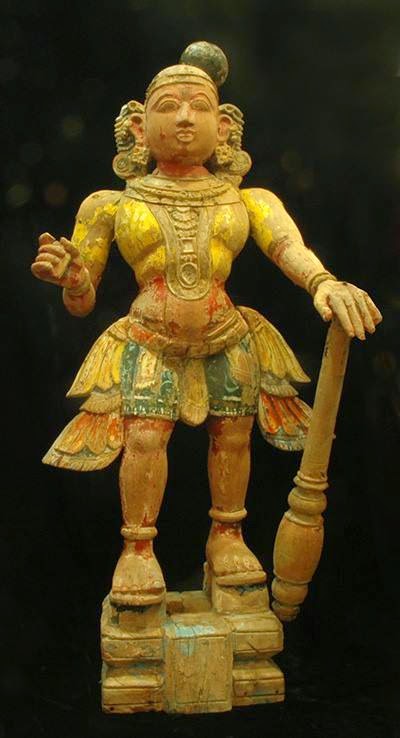
If you want to shop for souveniers in Banglore, Balaji's Antiques is a great place to check out! They have some pretty awesome stuff, collected from all over South India. I loved this door guardian figure that they posted on their website.
The dhoti (loincloth) is vaguely similar to a Roman gladiators skirt, isn't it?
Dwarapalakas (‘Guardian of the door’ traditionally appear in pairs in Hindu architecture outside the temple door or/and sanctum as gatekeepers or guardians of the deity. These guardians are fearsome warriors or giants and are often seen holding a mace, as this one is. This dwarapalaka’s tongue is sticking slightly out which is a warning mudra, ‘be careful I am here.’

Some sources believe that the Dwarapalakas represent a stage in the spiritual progress of the soul. They represent the devotee who can think of only God and no one else.

You can check out their collection here http://balajiantiques.com/ 

Wednesday, April 17, 2013

Crafts of Rajasthan - Kundan and Meenakari

In 1735, the Surana family of jewellers came from Delhi to Jaipur, at the invitation of Maharajah Sawai Jai Singh II. They remain one of Jaipur's most renowned jewellers, offering both traditional and modern styles of jewellery. Today they are the 7th generation of jewellers!
A typical combination of meenakari (enamelling) and jadai/ kundan (embedding) work.
What you see above is a restored, traditional piece, called 'Aad' (neck choker). It would require inputs of 5 skilled specialists:
- the designer (chitera)
- the goldsmith (sunar)
- the engraver and enameller (meenakar)
- the gemsetter (jadiya)
- the stringer (patua)
 

Often, opposite sides of a piece of jewellery will be decorated with Meenakari work and Kundan work respectively. The ornament then can be worn either way.

The art of "kundan" or "jadai", i.e. the art of embedding, was introduced into India by the Mughals. Gold foil is used as the base, and precious stones (diamonds, rubies, emeralds etc) are embedded into it. The glittering effect is fabulous, because the foil enables more light to reflect off and through the stone. Try wearing kundan and standing near candle-light or any kind of lights. It looks brilliant.

Meenakari (enamelling) is the art of decorating a metal surface by fusing colourful mineral substances to it. The technique also came to India from Persia during Mughal times. The salai (pattern) is engraved/carved onto the gold object with a steel stylus, creating walls or grooves that will hold colour. The meenakar then fills colourful enamel powder into the grooves - cobalt oxide for blue, copper oxide for green, etc. They apply each colour seprately and melt the powder in the heat of a furnace, so that it becomes liquid and spreads evenly in the groove.The heat-resistant white is applied first, and red is applied last. Finally, the object is cleaned in a tamarind solution and polished.

In the 16th century, Raja Man Singh of Amber invited master enamellers from the Mughal palace at Lahore to Jaipur. Today Jaipur is the center of Meenakari production. Flower, foliage and animals are the most popular motifs, and traditional Mughal colours like red, green and white are dominant in Jaipur's meenakari work. Meenakari work though is not limited to jewellery. You will find it being used in everything from palace decoration to regular shoe-pieces. These beautiful meenakari elephants are a great option to take home.