Showing posts with label Bangalore. Show all posts

Monday, December 16, 2019

Curry Leaves chutney (Karuvepallai Thuvaiyal)

The problem with ordering curry leaves online is that you have more leaves than you know what to do with. Meenakshi Ammal came to my rescue with "Cook and See" (Samaithu Paar), the go-to recipe book for all Tamil kitchens.


I made Karuveppalai Thuvaiyal, a thick coarsely ground chutney of curry leaves, tamarind, red chillies, urad dal, mustard and asafoetida. Curry leaves pack a wallop in terms of nutrition. They contain calcium, phosphorous, irons and vitamins (C, A, B, E). But the damn thing can be bitter, so Meenakshi Ammal advises using tender leaves and enough spices to offset it. The asafoetida, tamarind and mustard give it a kick, the red chillies and salt give it bite. I didn't have tender leaves, so I cheated and added a teeny bit of sugar. Shhhhh. No one will know! 


- 4 big handfuls of leaves (only one handful is on the plate in the photo) 
-Marble sized tamarind 8 red chillies 
- 2 teaspoons urad dal 
- 3/4 teaspoon mustard 
- Hing (asafoetida to taste) 

 Wash leaves. Fry chillies, mustard and lentils in oil. Grind with tamarind, salt, hing. 

Pro tip: grind masalas coarsely and then add the leaves to grinder. This one works best if ground by hand on a stone, the old fashioned way. The mixer doesn't quite help with the sort of coarse consistency you want. I ended up doubling the urad dal because I wanted more of that lentil feel. I also added sugar like I said, and a twist of lime because I thought the tamarind was not tamarindy enough. 

If you'd like to learn how to make a range of pickles, preserves and chutneys, we have workshops in Mumbai, Bangalore  and Chennai.

Monday, July 27, 2015

Puffed rice seller, Bangalore

- By Deepa Krishnan

Spicy puffed rice is one of the delights of Bangalore. I was starving at the end of our Vidhana Soudha Walk yesterday, but had no time for a meal. I thought this was the perfect snack to tide me over.
The puffed rice (puri) is spicy. It is called churumuri puri or khara kadele puri. It is sold in paper cones at Rs 10 for a cone. The vendor uses the glowing coals to keep the rice crisp even in the soggy monsoon season. If it rains, he's got an emergency solution - a blue pastic wrap (see photo below).
I reckon he sells about 30-50 of these in a day, so his daily income is around Rs 300 to 500. After expenses (raw material, travel, food), I think he probably earns Rs 200 to Rs 300 a day. I don't think he works every day. Weather, illness, family responsibilities, festivals and other social requirements probably cut into his work time and impact his earning capacity. I would have liked to stop and ask about his family, and where they live, what they are doing, etc. But I was late for a flight, so I dashed off. 

The churmuri was delicious. In many parts of Karnataka it is also served along with other garnishes, like finely chopped tomatoes, onions, green mango, coriander etc.

Wednesday, September 3, 2014

A Recipe for Sanketi Chutni-Pudi

The Sanketis are a small community of Brahmins who supposedly migrated from Tirunelveli district of Tamil Nadu as well as from Trichur district of Kerala, to finally settle in the Mysore province of Karnataka (today they reside in Bangalore, Mysore, Chikmaglur, Hassan and Shimoga). They speak Kannada-infused Tamil in a sweet sing-song style. Since Sanketi names sound more or less like Tamilian or Kannadiga names, you cannot find this community unless you happen to ask someone. They are hidden.

The ingredients for chutni-pudi
This community was reputed for its intellectuals in the traditional vedic learning and produced many experts in Carnatic music, Sanskrit language, etc. Naturally some of them ended up as advisors to the Mysore rulers including Tipu and the Wodeyars. Other Sanketis cultivated arecanut, coconut, betelnut, and banana. More recently, they have taken to English education, with many of them migrating abroad to work as scientists, doctors, researchers etc.

Sanketis are keen eaters  and are said to be fond of competitive eating at weddings! There are folk tales of a favourite character called "Hotte-Baka" who is known for his appetite. 

Here is a recipe for a Sanketi version of that Karnataka favourite, chutni-pudi. Chutni-pudi can be eaten with dosa, idli etc, but also goes fantastically with akki-roti.

Ingredients:
  • Kadala bele (chana dal or Bengal gram split and skinned) - 1 cup
  • Uddina bele (urad dal or black gram) - 1/2 cup
  • Togari bele (tuvar dal or pigeon pea splits and skinned) - 1/2 cup
  • Ona menasinakai (dry red chillies) - 6-7
  • Ingu (hing or asafoetida) - a small bit
  • Kari bevu (kadi patta or curry leaves) - one handful
  • Hunase (imli or tamarind) - marble size
  • Ellu (sesame) - 1 teaspoon
  • Copra - as much as you like
  • Oil - 2 tablespoons
With the kadhai (cooking pot) on a low flame, dry roast the kadala bele.
When it is a little roasted, add uddina bele.
After a minute or so, add togari bele.
Now roast all 3 beles together, until you get the nice roasted smell. Keep flame low and be patient, do not over-roast.
Next step, take oil in kadhai, roast the other ingredients except copra (red chillies, curry leaves, tamarind, asafoetida, sesame).
You need to scrape or cut the coconut into smaller bits and fry it in the end for a very little time, just to get the rawness out.
After this, powder all the ingredients, and add salt to taste.
Can use more chillies if you like it spicy.

Ta-da! Mix with oil/ghee and enjoy with idlis, dosas and akki-rotis.

Friday, June 6, 2014

Kannada language - history and script

The Kannada language is very old and it is of Dravidian origin. It is believed that there originally existed a Tamil-Kannada proto-language, which split into Tamil and Kannada between 8 to 6 BC.

The photo below is an example of the Kannada Script, from a 6th Century cave-rock carving at Badami, 500 kms northwest of Bangalore.
Badami Rock Carving, Photo Credit : Wikipedia
 From what I have read, there seem to be several eras/types in Kannada language: the proto-Kannada tongue which I listed above, then after that ancient Kannada (Halekannada), middle (Nadukannada) and modern Kannada.
Different historians attribute different years to these terms but broadly they all agree that ancient or Halekannada absorbed various vernaculars (various types of Prakrits) as and when Kannada-speaking people came into contact with them. HaleKannada also absorbed Sanskrit influences, including Panini (4 BC) and other non-Panini versions of Sanskrit.

The Kannada language has been constantly evolving due to political changes, as each new dynasty which ruled the area spoke different languages. The Karnataka region as we know it today was under Nandas (5th & 4th century BC, capital in Bihar), then Ashoka (Maurya empire, also from Bihar); then the Satavahanas (capital in Paithan Maharashtra), then briefly the Pallavas of Kanchipuram (Tamil Nadu), then the Western Ganga dyasty (capital in Talakad near Mysore), then Kadambas (North Canara), Rashtrakutas (Gulbarga) and Chalukyas of Badami (6th to 12th century AD).

With all these shifting centres of power (and language) the hale-Kannada language had ample opportunity to absorb many vernacular Prakrits. With the advent of Muslim rule in the Indian continent, and later the formation of the Deccan Sultanates, Arabic words became part of Kannada. With British rule, English words also crept into the language.

As a result of all these changes, modern Kannada is very different from the original proto-Kannada-Tamil.

As for written Kannada, well the script is descended from the Brahmi script (the earliest known record of Brahmi is Ashoka's edicts, 3rd century BC). The Kadambas and Chalukyas used a form of Brahmi. During the hale-Kannada phase, the script underwent many changes especially because of the need to be able to write new loan words from Sanskrit and other Prakrits. By the 13th century, this script had split into two similar but different calligraphic styles, Kannada and Telugu. In the 1800s, the Kannada script that we see today was recorded by British missionaries.

Tuesday, April 29, 2014

Attara Katcheri, Bangalore

The Attara Katcheri building originally housed the Secretariat of the Mysore kingdom, before the Vidhana Soudha building came into being. From 1956 onwards, the Attara Katcheri is being used as the Karnataka High Court Building.

I clicked this photo of a lady who alighted from an auto and was walking towards the building; probably an employee:
This is one of the entry gates to Attara Katcheri.
Attara Katcheri (Eighteen Departments) refers to the division of administrative departments into 18 specialised parts. Each part is called a chavadi or a katcheri, both words mean 'public assembly', referring to traditional systems of gathering together to discuss public matters.

The division into 18 administrative departments was originally done in Mysore by Chikkadevaraja Wodeyar in the early 1700's, in a manner similar to that followed in the Mughal court. The word Attara is not of Mysore origin; it is a corruption of the Hindustani / Khariboli word atthaarah.

The system of administering the kingdom through these 18 departments was followed during Tipu’s reign as well as during the subsequent British reign. While Tipu ruled from Srirangapatana, and the Wodeyars from Mysore, the British wanted to bring the seat of administration to Bangalore, close to their own cantonment. Therefore the Attara Katcheri building was commissioned in the mid-1800's.

It was designed by Major Gen Richard Hieram Sankey, the Chief Engineer of the Mysore government. He picked what is called the Graeco-Roman style, and you can see how he has used Greek temple and public building architecture concepts, such as columns and pediments. 
High Court by http://en.wikipedia.org/wiki/User:Muhammad_Mahdi_Karim
The Attara Katcheri was completed in 1869 by the construction company of Arcot Narayanswamy Mudaliar and Rai Bahadur Bansilal Ramnathan. The public offices included the revenue collection arm, the secretariat, the judiciary and several others.

In 1956, when the Vidhana Soudha building was constructed, the Mysore High Court occupied the entire Attara Kacheri building. In 1973, the Mysore state was renamed as Karnataka, so Attara Katcheri is now the High Court of Karnataka.

Sunday, February 23, 2014

Balaji's Antiques, Bangalore

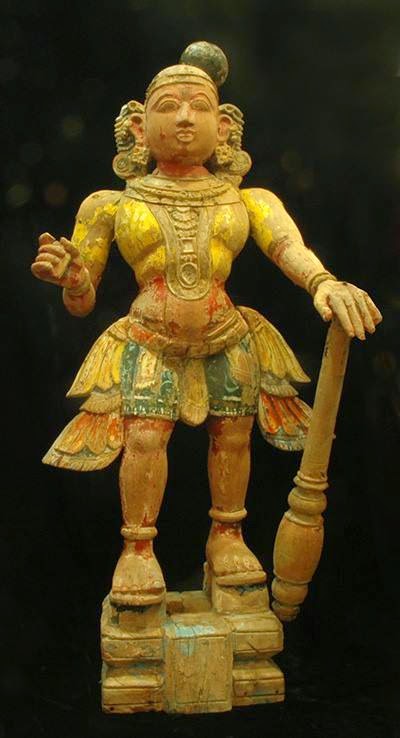
If you want to shop for souveniers in Banglore, Balaji's Antiques is a great place to check out! They have some pretty awesome stuff, collected from all over South India. I loved this door guardian figure that they posted on their website.
The dhoti (loincloth) is vaguely similar to a Roman gladiators skirt, isn't it?
Dwarapalakas (‘Guardian of the door’ traditionally appear in pairs in Hindu architecture outside the temple door or/and sanctum as gatekeepers or guardians of the deity. These guardians are fearsome warriors or giants and are often seen holding a mace, as this one is. This dwarapalaka’s tongue is sticking slightly out which is a warning mudra, ‘be careful I am here.’

Some sources believe that the Dwarapalakas represent a stage in the spiritual progress of the soul. They represent the devotee who can think of only God and no one else.

You can check out their collection here http://balajiantiques.com/ 

Tuesday, February 18, 2014

The cave-temple, Govardhana in Banglore

The statue you see, is of Lord Krishna, in the Govardhana Temple at Basavangudi, Bangalore.


The temple falls under the of the Madhava sect of Hinduism. Acharya Madhva (1238-1317) was the founder Philosopher of Tattvavada, more popularly known as the Dvaita School of Vedanta.

The 'cave temple' was built in 2004 by a lady named Dr. Nalini Rao, as a devotional offering. It is built in a unique architectural style to recreate the legendary mountain Govardhana.

It is believed that Lord Krishna once held up the mountain, on his little finger, for seven days to shield his village from torrential rains. Some Vaishnavites even believe that this mountain is an extension of Krishna, thus making it a holy site. The event, popularly known as 'Govardhana-shila' is often represented in religious art, but this temple is a whole different level of devotion!
A watercolour depicting Gowardhan Sila. circa 1640. Source: V&A Museum.
You can wander inside a mountain labyrinth to see beautiful scenes from Krishna's life carved on the walls. Instead of a closed sanctum, this idol of Krishna is at the heart of the temple.

In the background of this photo you can see Krishna conquering the poisonous serpent Kalia who terrorized the people of Brindavan. Krishna merely had to dance on the serpent's head for it to start dying. Legend's about Krishna always have a playful air to them, don't they?

This temple is quite unusual, for more than one reason. Firstly its focus on story-telling is commendable and makes for such an interesting visit. Secondly, how often do we see a modern-day Indian woman financing a whole temple?

Sunday, February 2, 2014

Sunday, December 8, 2013

Karnataka's Bellada Acchu

Sweets play an important part in Indian life, and Karnataka is no exception. Many of our sweets are used in religious ceremonies as well.
"Bellada Acchu" is one such sweet. It’s basically made up of jaggery, moulded into squarish shapes. The jaggery is made from sugarcane, which is a major crop in Karnataka. Around 30 million tonnes of sugarcane is produced annually. In Karnataka sugarcane is planted and harvested in three different seasons. In addition, after harvest, generally a "ratoon" crop is cultivated from the regrowth.

Traditionally, the Mandya district is described as the sugar bowl of Karnataka, but in recent years, Belgaum and Bagalkot districts have become leaders in terms of sugar factories.

This particular batch was clicked in Jayanagar 4th block market. It's one of the local shopping hubs where everything from vegetables, house-hold items to other knick-knacks, are available.

Tuesday, November 5, 2013

Sparrows in K R Market, Bangalore

When I went to K R Market, I saw a sparrow visiting a heap of peas.
There were many chirps and when I looked around, I found many more sparrows nearby.

I wondered why there were so many sparrows and then I saw that the vegetable vendors have placed old cardboard boxes with hay to provide nesting for the birds.
Life is strange. Sometimes it is cruel, but sometimes you find kindness when you least expect it.

Friday, October 18, 2013

Banglore's Seshadari Iyer Memorial Hall

This is the Seshadri Iyer Memorial Hall. Its foundation stone was laid in 1903 by the British Resident of Mysore, Donald Robertson. Notice the classic European style; supported by Tuscan columns, and porticoes.
Since 1915 it has been a library, and in 1966 it became the State Central Library. There are 265,000 books in the library.

Another view of the Hall; from the back
The hall is named after Sir K. Seshadari Iyer, who was the Diwan of the State of Mysore from 1883 to 1902. He is credited with numerous initiatives like the electrification of KGF and Bangalore from the Shivanasamudra Hydro-Electric power project (first in Asia), critical measures taken to save plague-afflicted Bangalore (in 1898) and starting off Victoria Hospital in 1900. 

Seshadri Iyer came from a family of lawyers (both his father and his brother were vakils in Calicut). Strangely, Seshadri Iyer did not attend school until the age of 11. Maybe to make up for lost time, he went to mutiple schools at Calicut, Cochin and Trivandrum, passing his exams with distinction. He enrolled in Presidency College Madras, and obtained a Bachelor of Law degree from Madras University.

He joined the Mysore kingdom's administrative service in 1868, and rose quickly through various appointments, to become the dewan in 1883. He administered Mysore for a span of eighteen years. He focused on building infrastructure for transport, irrigation and mining. It was Seshadri Iyer who developed the residential extensions of Malleswaram and Basavanagudi in Bangalore. He constructed the famous Glass House at Lalbagh and set up the Victoria Hospital in 1900. He drew up plans to establish what is now called the Indian Institute of Science (although he did not live to see this plan fructify).

When he died in 1901, Lord Curzon, the viceroy and governor-general, supported the move to build a memorial to him (The Seshadri Iyer Memoria Hall at Cubbon Park). There is also a statue of Seshadri Iyer in the garden.

Monday, August 19, 2013

Doddapatre Tambuli Chutney

This is a traditional chutney made from the leaves of Plectranthus amboinicus, often called ‘Indian Oregano’. The leaves have many traditional medicinal uses, and have been used for treatment of everything from malarial fever to epilepsy. In many Indian households it is commonly used to treat cough and colds.

I have a small potted plant in which I grew these leaves; they are very aromatic.


For the Doddapatre Tambuli Chutney, the leaves have to be roasted until they wilt completely, otherwise they irritate the mouth. In the bottom left photo you can see the wilted leaves mixed with coconut and green chillies.

There's a traditional recipe here, which you can follow: http://www.manethindi.com/2011/03/doddapatre-tambuli-chutney.html