Showing posts with label Bazaars. Show all posts

Saturday, March 3, 2018

CCIE at Temple Towers, Nandanam, Chennai

The government run Central Cottage Industries Emporium (CCIE) is a great place to buy crafts and textiles from all over India. Service is excellent and prices are fixed and fair. 


Bought a lot of block print textiles. Loved their small collection of Bengal kantha work and tant. A very nice ikat section also. Bought couple of sarees. Applique, block printed and embroidered section of bedsheets, bedcovers, pillows also nice; bought white and blue bedspread for daughter. Their section of kalamkari artwork is lovely and they have handpainted kalamkari sarees and dupattas also. A good place to visit if you are in Chennai. Posters of Gandhi and many nowadays "old fashioned" quotes are there.

How to identify CCIE: The logo is the Bankura horse. See website. http://www.cottageemporium.in/ Beware of similar sounding fake names. Too many of those trying to fool tourists and locals! 

Thursday, December 29, 2016

Adyar Food Walk - Filter Coffee

In large parts of south India, the best part of the day is the early morning cup of filter coffee :) 

It is drunk in a 'tumbler and davarah'. The tumbler is the glass, and the davarah the bottom container. An important part of the process is pouring the coffee back and forth, between the tumbler and davarah. This helps to mix the sugar, milk and coffee decoction; while also cooling it to the right temperature. More importantly, it aerates the coffee to produce froth, without introducing any additional water into it (Western-style espresso machines use a steam wand to produce froth). 

Coffee is not native to India. It came from Yemen, smuggled into south India by a Sufi mystic named Baba Budan. He planted them in the Chandragiri hills of Karnataka (in the Chikmaglur district). The hills have since then been renamed in his honour.

The southern Indian states of Karnataka, Kerala, and Tamilnadu account for most of the coffee grown. Coffee is usually inter-cropped with pepper, cardamom, banana, arecanut, orange and vanilla. 

Saturday, February 13, 2016

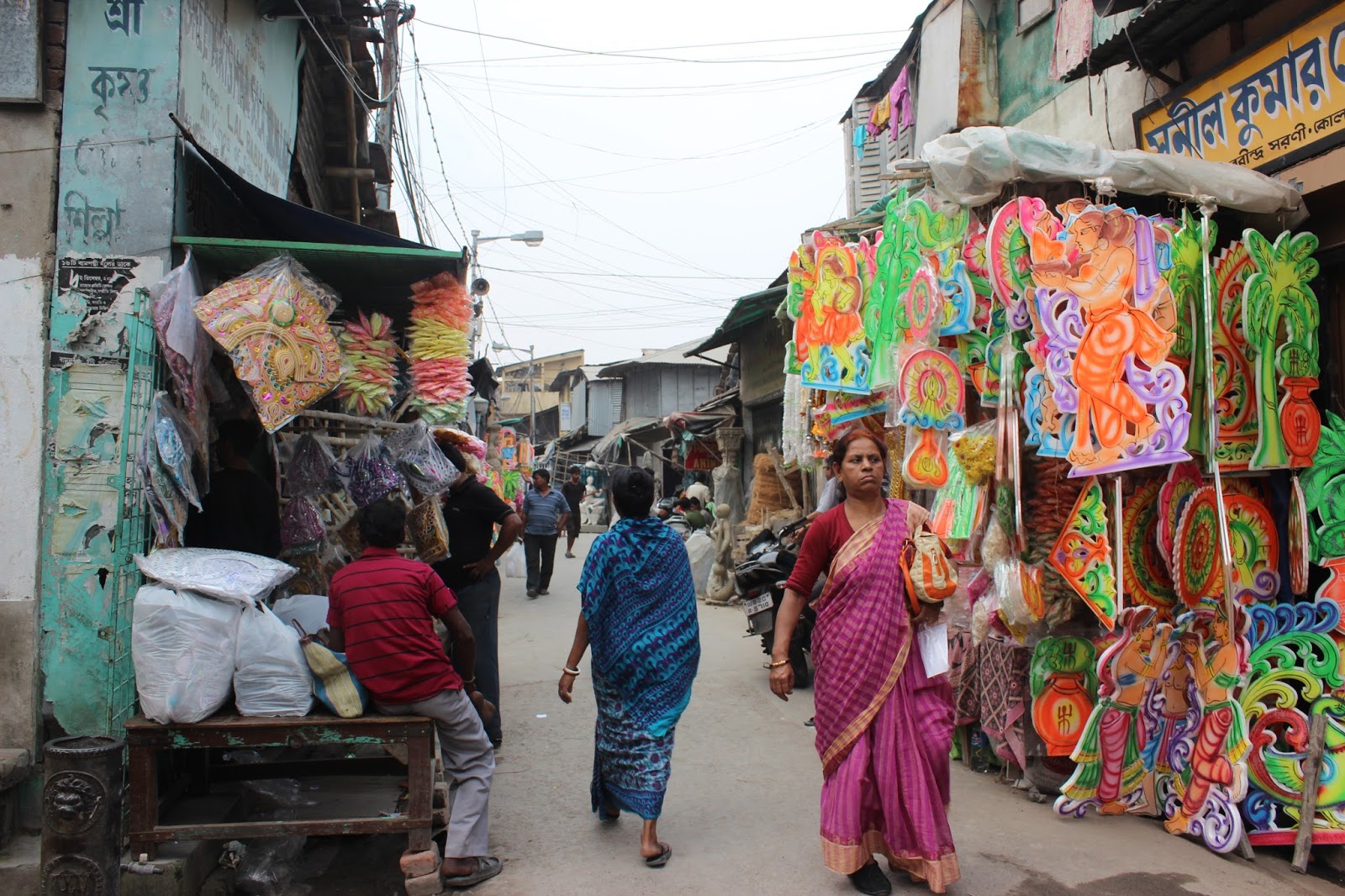
Saraswati idols at Kumartuli, Calcutta

Basant Panchami was celebrated yesterday in Calcutta, heralding the arrival of spring.  Homes, shops, schools and colleges, all celebrate Basant Panchami by worshipping Saraswati, the Goddess of Learning and of the Arts.

For several weeks before the festival, the potters at Kumartuli work hard to create beautiful idols of the goddess. I love the unfinished look of the statues, when they have no paint. Pure magic with clay and straw and water.
Saraswati is always depicted with a veena, a plucked stringed instrument that is mentioned in the natyashastra. In the photo below you can see how the hands are a different colour. That's because the hands are made separately, and attached after the base structure dries.
After the basic structure is completed, details are added. Crown, wavy hair, jewellery, these add beauty to the figures.
Here are some of the idols, being painted: in this one, the saree is the only part that is painted; only a first coat has been done. It will be further finished with more details and shading.
 Here's another one, see the curl of hair near the ears, on the cheek :) :) It is a traditional way of depicting beauty.
This one is also very beautiful, and waiting for more work to be done.
The entire area is busy at work. Some of the statues are very big, like the ones in this photo which the two men are working on.
There are decorations and embellishments also being sold.
I wanted to spend more time, but I had lots of other things to do. I hope you enjoyed this small glimpse!

Saturday, January 9, 2016

The colourful bazaars of Udaipur

If you start walking past the Jagdish Temple, into the little lanes, you will come across a wealth of colour: Udaipur's market for fresh vegetables.

Here's a glimpse of the market, from Steve and Wendy Johnston who visited this week.
Many of the stalls are run by women. Right now the market is full of fresh winter veggies.
Indian gooseberry (amla), waiting to be pickled
Chukandar (beetroot); both the tuber as well as the greens are used in Rajasthani curry recipes
There is a community of basket makers in Udaipur, who supply these bamboo baskets
The namkeen shops sell very popular savouries
And the sweet shops are especially enticing!
More namkeen (savoury snacks) and sweets
And what's a bazaar without a couple of cows!!
If you'd like to explore the market, check out the Ghat and Bazaar Walk on the Udaipur Magic website: http://udaipurmagic.net/udaipur-bazaar-ghatwalk.html

Wednesday, May 13, 2015

The Red and White Bridal Bangles of Punjab

- By Mansi Shanbag

It’s not uncommon to come across many stores selling red and white bangles in Amritsar, so much so that the wave of red and white is overwhelming.

The warren of lanes in the Chudi Bazaar, specializing entirely in the sale of bangles, is a hit with locals as well as guests.
Bangles can be traced back to 2600 BC, when a figurine of a dancing girl with bangles on her arm was excavated from the Mohenjo-daro ruins. Apart from this, numerous excavations of Indus Valley sites in Sind, Punjab and Gujarat have yielded bangles of shellac, clay and metal.
In Hindu and Sikh weddings in Punjab, the bride is gifted red-and-white bangles to wear on her wedding day. There is a ceremony, the chuda ceremony, which is on the day before the wedding, or on the actual wedding day itself. Traditionally, 21 bangles are gifted, although these days brides sometimes wear fewer bangles. 

Originally ivory-made, white bangles are now made in plastic. There are few things more picturesque than an Indian bride dressed up to her eyes in the traditional shades of red and white. And the red and white choora (bangles) do much to compliment the bride.
The bride wears the bangles as a sign of being newly married. The bangles are made of delicate materials, so that the bride is exempt from any heavy household chores. After the wedding, the bangles are traditionally worn for a year. In modern times, this too has reduced to 40 days.  Nevertheless, the tradition of bangle-wearing lives on and is quite delightful to behold. 

Sunday, April 19, 2015

On seeing a fakir near Charminar, Hyderabad

I clicked this photo of a man asking for alms near Charminar. Yet, his clothes were not those of a beggar. They were neat and clean, and his demeanour was calm. He seemed unperturbed by all the chaos around him.

I felt that he was not just someone trying to make money from begging. He was probably a fakir in the original sense of the word.

The term fakir has its roots in the Arabic word faqr which means poverty. A fakir is one who is required to renounce all worldly riches and ties; and is required to live by seeking alms. A true fakir rejects the trappings of the world in exchange for spiritual riches.
In India, fakirs usually follow the Sufi spiritual path. They trace their roots to one of the many Sufi orders (tariqah) that were established in India beginning in the 10th century under the Delhi Sultanate. The Sufi tariqahs spread into the Deccan along with the Tughlaq dynasty. Sufi teachings of simplicity, spirituality, love and care for humanity were attractive values that made the common people revere Sufi fakirs. They were often credited with miraculous powers. 

While many fakirs are wandering mendicants, others have specific khanqah or establishments which are centres of Sufi gathering and discourse. At the khanqah, the master (sheikh) and his disciples would read scriptures together, engage in debate and discussion, and offer blessings and assistance to all who came for help. Khanqah's also had free kitchens, where food was provided to all who asked. Through service to the poor, combined with personal austerity, Sufi fakirs established strong credentials and were responsible for the spread of Islam in India.

Saturday, November 8, 2014

Bazaars of Hyderabad: Moazaam Jahi Market, then and now

Built in the 1930's at a major crossroad of the city, Moazzam Jahi Market even today remains a busy and important market. 
After the Musi floods of 1908 and the plague of 1911, Mir Osman Ali, the Last Nizam of Hyderabad, undertook measures for improving water management, sanitation and urban planning in Hyderabad. The famous Sri Visveswaraiya from Mysore state, who had engineered many marvels there, was invited to Hyderabad. A City Improvement Trust was formed, and many new buildings were erected. These included the Osmania General Hospital, Unani Hospital, High Court, City College, Patherghati Complex and Moazzam Jahi Market.

Both Pathaghatti and Moazaam Jahi are bazaar areas, intended for business. In Moazzam Jahi market, there are more than 100 shops, selling fruits, vegetables, flowers, meat, paan, attar, metalwork and of course, the famous ice-creams! There's a shop called FAMOUS ICECREAM at this market, and there is another one called BILAL. Some time ago, I wrote about the ice-creams at Bilals, inside this market. You can see how the inside of this market looks in this ice-cream story here: http://magictoursblog.blogspot.in/2014/08/bilal-ice-cream-at-moazzam-jahi-market.html

Wednesday, September 3, 2014

Ekam Sat: One Reality, Many Forms

"Ekam sat vipra bahudha vadanti" says the Rig Veda. "That which exists is One: sages call it by various names." This photo, taken in Varanasi, reminded me of that.

Banaras is Shiva's city, he is everywhere you look. At the souvenir stalls, Shiva is represented in colourful popular art as Gangadhara, bearing the Ganges in his hair. But the stalls also sell pictures of a host of other deities - Kuber the God of Wealth, Hanuman, Rama, Krishna, Durga, Kali, Ganesh, Lakshmi ... there are pictures also of objects such as the Sri Yantra, and there are pictures of godmen and gurus - Sai Baba, Ravidas, and many others. 

Why are there so many deities, gurus, and other pictures? Because Hinduism allows its practitioners to choose whichever form of God that inspires and resonates with them the most. This is the concept of "Ishta Devata" or "Chosen Deity". Here the form itself is not as important as the ultimate goal. While all Hindus agree there is only one Eternal Brahman, or Cosmic Truth, they reach this Brahman through different routes. That route is the Ishta Devata. 

It is difficult to meditate upon an abstract concept. So teachers of meditation tell their pupils to select an Ishta Devata in order to do "Saguna Dhyana" - in this type of meditation the practitioner focuses on the visible aspects of the Ishta Devata. For example, Saguna Dhyana of Vishnu could include meditating one by one on his face, his golden ornaments, his yellow robes etc. You can see this form of meditation being practised by many Bhaktimarga followers. 

For Ramakrishna Paramahamsa, the Goddess Kali was his Ishta Devata. He saw her everywhere and meditated solely upon her. Such meditation - usually also done with a specific mantra chanting (involving the name or the characteristics of the Ishta Devata) - can have powerful effects on the mind. 

From this type of Saguna Dhyana, the practitioner can eventually move to "Nirguna Dhyana", meditation on the abstract. The Ishta Devata provides a sort of gateway, almost. Obviously, it is important to choose an Ishta Devata that resonates most with you. Many families use the concept of kula-devata or family deity as their Ishta Devata. Many people use the face of their spiritual guru as their ishta-devata. There are really no rules or restrictions. Sincerity is important.

The term Ishta Devata should also be understood as a way to define a chosen ideal or goal. For example, in the Yogasutra, Patanjali says: "svadhyayad ishta devata sanprayogah" meaning that self-study and reflection brings you into contact with the desired ideal.

Wednesday, May 7, 2014

Patola Silk Weaving

-By Aishwarya Pramod

Patola is the name of the silk saris unique to Patan. One version of the Patola legend is that King Kumarpal (12th century) commissioned Patola robes from Jaina (South Maharashtra), a new one for every daily puja. When he learned the King of Jaina was sending him used clothes, he went to the south to attack and defeat the southern ruler. He brought back 700 Patola weaver families to Patan. Of those families, only the Salvis continue the craft today.
Patola is one of the most difficult forms of weaving in the world. It uses a double ikkat style where the warp and weft threads are dyed meticulously before weaving, according to a pre-designed pattern. The weaver then aligns them perfectly on the loom, which naturally creates a unique combination of geometric delineation with soft hazy outlines. It is said that an Indonesian king visited India, was awed by the Patola craft, and took it back to his land saying that only Indonesian royalty would be allowed to wear it.
The saris take 4-6 months to make, with more than 70 days for the coloring of the silk threads, and about 25 days for the weaving. They come in four styles: 1) for the Jains and Hindus, with flowers, parrots, elephants, and dancing figures, 2) for the Muslim Bohras, with geometric and floral design, to be used at weddings, 3) for Maharashtrian Brahmins, in solid dark colors bordered with designs of women and birds, called Nari Kunj, and 4) for traditional export markets in the Far East. Immense dexterity is required of the dyer, for visualizing the pattern of dyeing, especially for the weft threads which are woven in zigzag, and also of the weaver, for working at an even pace, so that the warp and weft meet at precisely the right place without breaking the silk threads. These extreme levels of craftsmanship give Patola artists enough reason to put a high price on their work, and to guard closely their patterns as a trade secret.

To watch the masters of the craft at work, or order your own piece, visit Vinayak and Bharat Salvi at Patan Patola Heritage +91 2766 231369, Patolawala Salvivado, Patolawala St. or Ashok Salvi at Patolawala Farm House +91 2766 232172, outside Phatipal Gate. The price of saris start at Rs. 90,000. There are also smaller scarves available, starting at Rs. 5000.

Tuesday, November 5, 2013

Sparrows in K R Market, Bangalore

When I went to K R Market, I saw a sparrow visiting a heap of peas.
There were many chirps and when I looked around, I found many more sparrows nearby.

I wondered why there were so many sparrows and then I saw that the vegetable vendors have placed old cardboard boxes with hay to provide nesting for the birds.
Life is strange. Sometimes it is cruel, but sometimes you find kindness when you least expect it.