Showing posts with label Crafts of India. Show all posts

Thursday, December 26, 2019

Garuda Purana and the democratization of knowledge production

The Garuda Purana, composed in Sanskrit, contains 16000 verses, dealing with an incredibly diverse collection of topics.

It covers cosmology, mythology, salvation theory, ethics, Hindu philosophical schools, theory of Yoga, ancestral rites, rivers and geography, types of minerals and stones, testing methods for gems for their quality, listing of plants and herbs, disease symptoms and medicines, astronomy, astrology, architecture, grammar, literature classification etc.

It also includes statecraft and more practical matters such as charity and gift making, economy, thrift, duties of a king, politics, state officials and their roles, and how to appoint officials. Lastly, it also covers personal development and self awareness through Sankhya and Advaita Yoga.

The text is attributed to the legendary sage Vyasa, in the absence of clear authorship. It is believed to have been first composed at least a thousand years ago, with the core being even older. The versions that survive today contain different lengths and different sets of scriptures, pointing to diverse authorship over time as it gained popularity.

Garuda Vahana, at Chennai airport, a beautiful wooden sculpture 
used for temple processions. It is likely from Tanjore.
One of India's unique features is the way in which many of our scriptures co-opt and include multiple authors. Imagine a book, with many chapters by different writers, all of whom help to grow the book continuously over centuries. As it spreads, more chapters appear, more commentaries and discussions take place, and diverse versions grow and become popular in different parts of the land. The closest parallel is a river, with a single origin but which branches into thousands of tributaries, ending in many lakes and ponds, and watering many fertile lands as it goes along. One could also draw a parallel to the way the internet functions, democratizing the production and dissemination of knowledge. In the case of scriptures, the dissemination takes place in thousands of sabhas and temples, where readings and recitations bring different versions to the people. Confusing? Yes. That is the nature of a cooperative effort at knowledge production. But it is also very appealing, that there is no "one book", no single authority.

#hinduliterature
#magictoursofindia
#chennaimagic

Monday, November 18, 2019

Karaikkal Ammaiyar - The Mother from Karaikkal

Karaikkal Ammaiyar (The Mother from Karaikkal) lived in Tamil Nadu in 6th century. She was a poet-saint, one of the 63 Shaivite Nayanmars. This sculpture is a copper alloy, about 9 inches high, dated during the Chola period (880–1279). . It is now at the Metropolitan Museum.


Karaikkal Ammaiyar belonged to the Chettiar (Nagarathar) community. She was a devotee of Lord Shiva, and said to be very beautiful. On seeing her perform miracles, her husband recognized her divine nature, and worshipped her as a goddess. She left her home, and went to Mount Kailash, on pilgrimage to Lord Shiva's abode. She prayed to Shiva to transform her into a ghoul (gana), one of Shiva's many attendants. Shiva granted her wish, changing her into a wizened old woman.

Thus she became free of the burden of social norms, and spent her life as a free spirit, composing and singing hymns in praise of Shiva. In this sculpture, you can see her holding a pair of cymbals as she sings her own compositions. The sculptor has stayed within the stylistic tradition of Chola art, with fine nose, curved lips, large eyes, square shoulders and slim waist. Thus he maintains her divinity. He has chosen to represent her ghoul transformation by focusing purely on exaggeratedly deformed breasts. He has chosen to represent her mendicant status by giving her only a single garment. And, to show her great age, her ear lobes are sagging with the weight of her ear-ring (a feature of older women).


Beginning in the 6th century in Tamil Nadu, India witnessed a widespread Bhakti movement, where several women rejected the life of a householder, and embraced a life of devotion/renunciation, Examples include Andal from Tamil Vaishnavism of the ninth century, Mahadevi Akka of Karnataka (13th century), Muktabai of Maharashtra (13th century), Mirabai of Rajasthan (16th century), and many more.

Thursday, June 7, 2018

The songs of Phulkari

Phulkari meri reshmi
Rang na aiya theek
Chheti darshan devne
Main rasta rahi udeek

My phulkari is silken
But the colour doesn't seem right
Come quickly now, my love (let me see you)
My eyes search the road.

Phulkari is an embroidery technique from the Punjab region, and is practised both in India and Pakistan, by Hindus, Sikhs and Muslims. The word 'phul' means flower and 'kari' means craft, thus Phulkari literally means floral work or floral craft. Exquisite and labor-intensive, Phulkari embroideries have been produced by Punjabi and Haryanvi women from at least the early 19th century. Phulkaris are traditionally done in brightly colored silk thread on rough, earth-toned cotton fabric. The cotton was local, but the silk came from far off places via nomads, and was dyed in the Punjab. Phulkaris are deeply ingrained into Punjabi culture and several folks songs sung by women have Phulkari as the motif.

When done for domestic use, Phulkaris function primarily as women’s wraps (odhnis). Originally, they signified a woman’s material wealth and were deemed an important part of her wardrobe. In addition to being worn, phulkaris are also placed on woven cots (charpais) as seat covers for special guests, or draped on dowry chests or hung in the home as decoration during religious festivals. They are presented to temple deities, or to gurudwaras as a cover for the Guru Granth Sahib (the Sikh holy book).

During colonial rule, Phulkaris became part of gift basket locally described as “dali” that were presented to the British and other high officials on Christmas and also as a gesture of gratification.

Following Punjab’s devastating partition in 1947, many treasured Phulkaris were lost or left behind in the traumatic events of the Partition. The Partition Museum in Amritsar has a Phulkari placed on a well, representing the tragedy of the many women who threw themselves into village wells in attempted suicides. To me it seems as if the death of all that was beautiful in the Punjab has been portrayed very poignantly via the Phulkari.

Today in Amritsar, there are plenty of machine-made Phulkaris, but they lack the beauty of the women's voices that made them unique.

Kawal phool main kadhke
Kardi han ardas
Chheti aa mere sajna
Bhul-chuk maaf

Having embroidered a lotus
I petition you
My love come to me quickly
All is forgiven/Forgive me

In May 2017, the Philadelphia Museum of Art showcased ‘Phulkari: The Embroidered Textiles of Punjab’, with phulkaris from the collection of Jill and Sheldon Bonovitz. The collection contained all types of Phulkaris:

- Baghs (all-over embroidered phulkaris, almost like a floral garden),
- Darshan Dwars (architectural motifs, meant to be presented at gurdwaras)
- Sainchis (narrative embroideries which depicted scenes of routine village life and included human motifs)
- Thirmas (embroidered on plain white khaddars for elderly women and widows)
- Chopes (presented to a girl by her maternal grandmother on her wedding day)

The Museum also showcased two gowns made especially for the exhibition by Indian designer Manish Malhotra, in an effort to highlight the couture culture and the new stories developing around phulkari. With the ace designers employing materials such as velvet and silk, a new set of audiences is being inspired to embrace the warmth of the textile tradition.

Photos Courtesy: Philadelphia Museum of Art, sourced from Architectural Digest

The information and text for this post came from this page, which has more about the show, and different types of Phulkaris is here: https://www.architecturaldigest.in/content/philadelphia-museum-art-showcases-history-punjabs-rich-embroidery-craft-phulkari/

Monday, May 28, 2018

Bazaar Thaterian - The Market of the MetalWorkers


No automatic alt text available.
About 10 kilometers south-east from Amritsar, along what used to be the historic Grand Trunk Road, there is a nondescript town called Jandiala Guru. No one knew much about it until 2014, when it suddenly received international recognition by UNESCO for its metalwork craft. The metalworkers are called Thateras.

If you walk into Jandiala Guru, you can find the Thateras in a lane called 'Gali Kashmirian' (Lane of the Kashmiris). I was a little puzzled by this name. Why were there Kashmiri Thateras in a little nondescript Punjabi town?

It turns out that in the late 18th century, Maharaja Ranjit Singh invited skilled metal workers from Kashmir, primarily Muslims, to settle in his kingdom. They established themselves in Gali Kashmirian, and began making brass and copper utensils.

Bazaar Thaterian (the Metalworkers Market) became a thriving market for all sorts of utensils, including those for household use as well as for community cooking (have you seen the huge cauldrons at gurudwaras?).

During the partition of India, the Muslim Thateras of Jandiala Guru migrated to Kujranwala in Pakistan (another metalwork town). Hindu and Sikh Thateras from Kujranwala arrived in Jandiala Guru and began practising their craft. Thus, the metalworkers in Jandiala Guru today are either Hindus or Sikhs. But the name of the lane has endured. Gali Kashmirian. The Lane of the Kashmiris.

The Thathera community has a long oral tradition of craft. Knowledge is passed through apprenticeship, usually within the family. Designs are made by skilfully hammering a series of tiny dents into the heated metal. Even the tools they use are handmade.

In spite of being inscribed in 2014 on the UNESCO representative list of the Intangible Cultural Heritage List of Humanity, the Thateras are struggling to make a living. The popularity of steel, aluminum and plastic has killed the market for brass and copper utensils.

There's a very nice video here, of the Thateras. It appears from the interviews that that Bazaar Thaterian is dying: https://www.youtube.com/watch?v=_SXc7L9d0ds

Wednesday, October 19, 2016

New Market Walk: Food and Shopping in Hogg Saheb's Bazaar

Here's the latest addition to our bouquet; a new tour in Calcutta designed exclusively for eating and shopping!

The tour takes you through the lanes of New Market, one of the most popular bazaars in Calcutta. 


 Built in 1874 as a posh “Whites Only" shopping complex, New Market today spills chaotically over to the adjoining streets, selling everything under the sun.


You can sample delicacies from the most iconic bakeries in the city (among other things).


And shop to your heart's content. 


Find out more about the tour on our website
See more photos of the tour on our Facebook page.

Monday, August 8, 2016

Ceramic jars at the Goa Chitra Museum, Benaulim

- by Aishwarya Javalgekar

Ceramic Jars at Goa Chitra Museum
If you go to the Goa Chitra Museum in Benaulim, Goa, you'll see these beautiful ceramic jars, in a uniform white and brown design. These elegant jars were traditionally used in Goan households to store cooking oil.

Goan cuisine is a blend of different culinary traditions; Hindu, Mughal and Portuguese. These diverse traditions are brought together by local ingredients such as vegetables, oils and spices, that given the cuisine its sumptious flavour.

The most important oil used in this cuisine is coconut oil.

Coconut oil is extracted from copra, dried pieces of coconut. The oil, which is usually a clear liquid, turns into a creamy white solid in cold weather. Most of the dishes in Goan and South Indian cuisine rely on coconut oil for their authentic flavour.

Apart from coconut oil, sesame, gingelli, groundnut and sunflower oils are also frequently used in Goan food. Other oils used are castor oil, cashew oil, cotton seed oil, neem oil, clove oil and eucalyptus oil.

I can almost picturize the jars, slick with oil, kept in an old Goan kitchen. Can you?

Padayani: The spirit of central Travancore

- By Aishwarya Javalgekar and Deepa Krishnan

Kerala is famous for its rich cultural heritage, and has many popular art forms to its name. But an art form that is perhaps not yet widely known is Padayani; the worship of Mother Goddess, practiced in the Bhagavathy temples of the central Travancore region.
http://pathanamthittatourism.com/destinations/heritage/padayani.php
Padayani is not just an art form. It is a community gathering to ensure the physical and mental well-being of the entire village. It is a set of rituals that transcends the boundaries of caste and religion, generating a sense of unity.

The legend says that Padayani originated as a form of prayer to pacify the goddess Kali, after she killed the demon Darika. This art form has several important cultural aspects:
  • Kolamezhuthu - These are beautiful and elaborate coloured drawings of folk deities. Kolams individually embody a certain character associated with spirits and deities. They are made from natural materials which comprise spathes (paalas) of the areca nut palm tree. Natural colours are painted on these paalas using a brush made from the stem of a coconut leaf. 
  • Kolappattu - Folk songs with traditional lyrics that include the exaltation of the deities, as well as requests to obtain their grace
  • Thappumelam - Musical performance specially featuring a Thappu, a drum made by covering a jackfruit hardwood piece with buffalohide
  • Kolamthullal - A dance form that accompanies the festival
  • Vinodam - Satire, an essential part of Padayani! This is performed making fun of petty vanities of people, as well as to target areas for social reform.

In this outstanding video below, you can see entire cultural process explained with English sub-titles. The first 3 minutes are an excellent introduction in Malayalam, without sub-titles, but the rest of the video has wonderful sub-titles.

Some practical information:
Padayani performances at temples are easily accessible from Cochin, Kumarakom or Alleppey. They are performed at night outside Bhadrakali temples, during the Padayani festival, typically between March and April. If you are visiting India this September, you can attend the padayani at the Neelamperoor Bhagavathy Temple at Kottayam on 29 Sep (photo below). It's only a 2hr drive from Cochin, and a 1hr drive from Kumarakom or Alleppey. 
http://babuscamera.blogspot.in/2008/09/pooram-padayani-at-neelamperoor.html
You can stay overnight in Kottayam if you prefer. The Athreya Ayurvedic Resort in Kottayam provides excellent therapies, so you can combine a detox stay with a festival visit. They also have yoga practitioners who can teach you yoga. 

If you'd like more information about a tour that incorporates the Padayani festival, please send an email to deepa@magictoursofindia.com. Or you can also look up the Kerala Festival Calendar (search for "patayani") to see the schedule. 

Saturday, June 25, 2016

What is Culture? Thoughts upon seeing the Sarpam Thullal of Kerala

What is culture? It is a way of life, rich with symbols and meaning.

I do not have adequate words to express the many layers of myth, legend, and beliefs that are in this Sarpam Thullal video. This is actually a 3-part video series. Please see it. Look at the number of people involved in it. Look at all the elements. Music, art, craft, religion, food, ecology, environment, people, clothing, all the richness of the land....everything is embodied in this video.


If Sarpam Thullal ends, all of this culture will die. The communities who depend on it for survival will lose a way of life. The musicians will stop singing. The artisans will stop making these crafts. The beautiful sarapakkalams will stop being drawn.

This post is not really about Sarpam Thullal. It is about culture and change. I fear that we are already losing much that is unique about our land. Under our very noses, a whole way of life is being lost through the relentless urbanisation of India. And it's not a slow, gradual change. It is abrupt change, in the space of a single generation.

I agree that change is inevitable. That some of the ways of our forefathers are no longer feasible. But we have much that is good. How do we save this?

Wednesday, June 15, 2016

Shrujan Museum (Living and Learning Design Centre) - a labour of love

The Shrujan Living and Learning Design Centre (LLDC) is "the pearl in the necklace of Kutch". Built at a cost of Rs 26 crores, this is a "Living Museum" because there are so many craftspeople in this region actively associated with this museum.
The Shrujan story is known to everyone: how Chandaben Shroff went to Kutch for famine relief in 1969, and then decided that the fabulous embroidery deserved a better market. The first exhibition was of 30 sarees, at Rampart Row in Mumbai. All the sarees were sold out!

Most of the early efforts were all in the form of exhibitions, especially in Mumbai, where the Shroff family is from. But eventually shops were opened. There is now a shop in Bhulabhai Desai Road in Mumbai, and in Safina Plaza in Bangalore. There are also shops in Gujarat (Baroda, Ahmedabad and Kutch). But exhibitions still are a major source of sales.

Shrujan Trust is now close to 50 years old. Over 4000 craftswomen living in 120 remote villages of Kutch and Banaskantha earn a dignified and sustainable livelihood through Shrujan's efforts. An important aspect of this work is that Shrujan sends the textiles, threads, etc to their doorstep and settles payments also at their doorstep as soon as the embroidery is done.

Chandaben says that they don't worry about selling the textiles. Their objective is to provide lielihood. Thus their purchase is always more than their sales! What an amazing woman.

Shrujan also organises eye camps for its women, and provides spectacles. The work that is done is very fine embroidery, and often older women are unable to work due to failing eyesight. See these beautiful sarees, with such fine work, from one of their exhibitions:

LLDC is near Bhuj, in Kutch. The museum complex has three galleries as well as a hands-on gallery. Galleries 1 and 2 will exhibit craft-based shows curated from the LLDC permanent collection. Gallery 3 will exhibit craft-based shows curated from the collections of master kaarigars and private collectors. The hands-on gallery will provide a fun experience in the practice of some of the crafts.

Workshops and short-term courses will also take place in the 125-seat auditorium and 25-seat conference room. These will provide intensive, need-based training to practising craftspersons. Master kaarigars will play a key role as teachers and mentors. They will also have workshops for museum visitors and design/fashion school students.

There's a colletion of photos here, showing the museum being created. Those who enjoy architecture will love the buildings in progress: http://indigo-architects.com/project/lldc/

Chandaben is now 82. Her daughter Ami now is running Shrujan. Interview with Ami Shroff is here: she is the Director of the museum. http://www.rereeti.org/lldc-kutch-museum/

Photos of the museum exhibits/lighting are here: https://www.behance.net/gallery/6939281/Shrujan-LLDC-Museum

How to get to LLDC: It is just off the Bhuj-Bhachau highway near the village of Ajrakpur in Kutch. Stay in Bhuj and make the drive. On the way you can visit both Bhujodi and Ajrakhpur, which are major textile centres. Here is a map: https://goo.gl/maps/KxrrSqfHn5N2

Monday, June 13, 2016

The outstanding Sikandar Nama shawl of Jammu

- by Deepa Krishnan

Sikander Nameh shawl from Jammu, 1852
 "Gulnari rumal", in pure pashmina embroidered with wool
Source: Chandigarh Museum
http://chdmuseum.gov.in/art_gallery/masterpieces.html

See this gorgeous embroidered textile? It is a shawl, in soft pashmina, that tells the tale of Alexander the Great.  The shawl is more like a painting than like needlework!

Alexander - or Sikandar as he is called by Indians - came to India in the 4th century BC. This textile is proof that Sikandar's name found its way, not only into Indian vocabulary, but also into Indian textile art. 

The shawl was a gift by a rafugar (an embroiderer) to the rajah of Kashmir in 1852. Perhaps comparing a local rajah with the great Sikandar was a way of subtle flattery? Or perhaps the rafugar was merely showcasing his phenomenal imagination and embroidery skills.

At the corners, the shawl depicts Alexander's life, from his birth to his death. The central figures are influenced by the great Persian epic Shahnameh. At the centre of the shawl, there is a written text, which says:

“This gulnari rumal is submitted to that fountain of all favours and generosity, Maharaja Gulab Singhji, by (the humble) Sayyad Joo, rafugar, resident of the chakla of Jammu in the land of Kashmir on the 15th of the month of Jeth of the samvat year 1909, corresponding to the 6th of the month of Sha’ban of the year (AH) 1268.”

"Gulnari" - what a beautiful word! -  it refers to the red blossom of the pomegranate tree, whose colour is so beautifully incorporated into this embroidery. And "rumal" is a word that is traditionally used for square shawls, not meant for wrapping around the body. This gulnari rumal, then, is a piece for display, rather than use. Samvat 1909 is the Hindu calendar year, and 1268 the Islamic calendar year; the Greogrian calendar equivalent would be 1852 AD.

Gulab Singh by Charles Hardinge,
British Library
The shawl was given as a gift, to Gulab Singh, the first Dogra Maharaja of the princely state of Jammu and Kashmir. Originally the Dogras were vassals of the Sikhs, having got the Jammu area as a grant from Ranjit Singh. After the defeat of the Sikhs in the First Anglo-Sikh War, the Treaty of Amritsar was signed in 1846, whereby the British created a new princely state and sold it to the Dogras, for the grand sum of Rs 750,000 nanak-shahi rupees. Thus began the Dogra kingdom. Naturally, the craftsmen in the area sought the patronage of Gulab Singh to ensure the sustenance of their embroidery craft. Especially because the export market for shawls was already threatened in the mid-1800's by imitation products from Europe.

Today, we associate Kashmiri shawls with elaborate and delicate embroidery. But actually, this kind of fancy embroidery on shawls was quite unknown before the 19th century. Surprised? It's true. Earlier, all shawls were woven or brocaded on hand looms. They were called 'kani' shawls.
Kani shawl from the TAPI Collection, with Kashmiri butas
But in 1803, a man called Khwaja Yusuf, on the request of an agent from Constantinople (Istanbul), produced shawls entirely with needle embroidery. These 'amli' shawls changed the very nature of the shawl trade, because they took less time, cost less, and provided a great deal of variety in story-telling. Loom-woven shawls continued to be made and valued, but amli shawls gave the trade an unprecedented boost. In 1803 there were only a handful of embroiderers in Kashmir, but by 1823, there were as many as 5000 of them. And the work they did was so good, that Europeans who encountered the work wanted to spirit away the workers!
Amli shawl from frankames.com, see this link for larger pic http://frankames.com/shawls/kashmiri-shawls/
In 1822, William Moorcroft, an employee of the East India Company who came to the area for trade wrote to the British Resident at Delhi and suggested that "Amongst the many thousands of individuals employed in the Shawl trade, in Kashmeer, it would probably be no difficult task to induce two or three families in a noiseless way to leave that country (for England) …." After all, he said, Louis XV of France had "procured Workmen in Muslin from India"; even though, he added, "through the negligence of his Ministers many of them perished through want". Fortunately these transplantation schemes came to naught. 

Empress Josephine, portrait by Jean-Antoine Gros, 1808
All through the early 1800's, the demand for Kashmir shawls grew, especially in France. In the French court, the Empress Josephine draped herself in colourful shawls, and the buta motif of Kashmir began to appear in royal clothing as an elongated paisley.

Soon, local versions of the shawls began to be manufactured. Factories in Paisley, Norwich, Edinburgh and Lyon began to imitate Indian shawls. In fact, in 1842, the town of Paisley exported 1 million pounds worth of shawls! 

It was the Franco-Prussian war of 1870 which finally struck a body-blow to the Kashmiri shawl industry, because it caused a sharp fall in the demand in France for authentic Kashmiri shawls. Eventually, there was large scale unemployment in the shawl industry of Kashmir, and by the beginning of the 20th century, shawl making had become a small handicraft industry instead of a major revenue earner for Kashmir. 

Even today, embroidered Kashmiri shawls are a very small handicraft industry, patronised mainly by discerning traders for the export market. The extremely fine, high quality work of the past, both kani and amli, is increasingly difficult to find.

Saturday, February 13, 2016

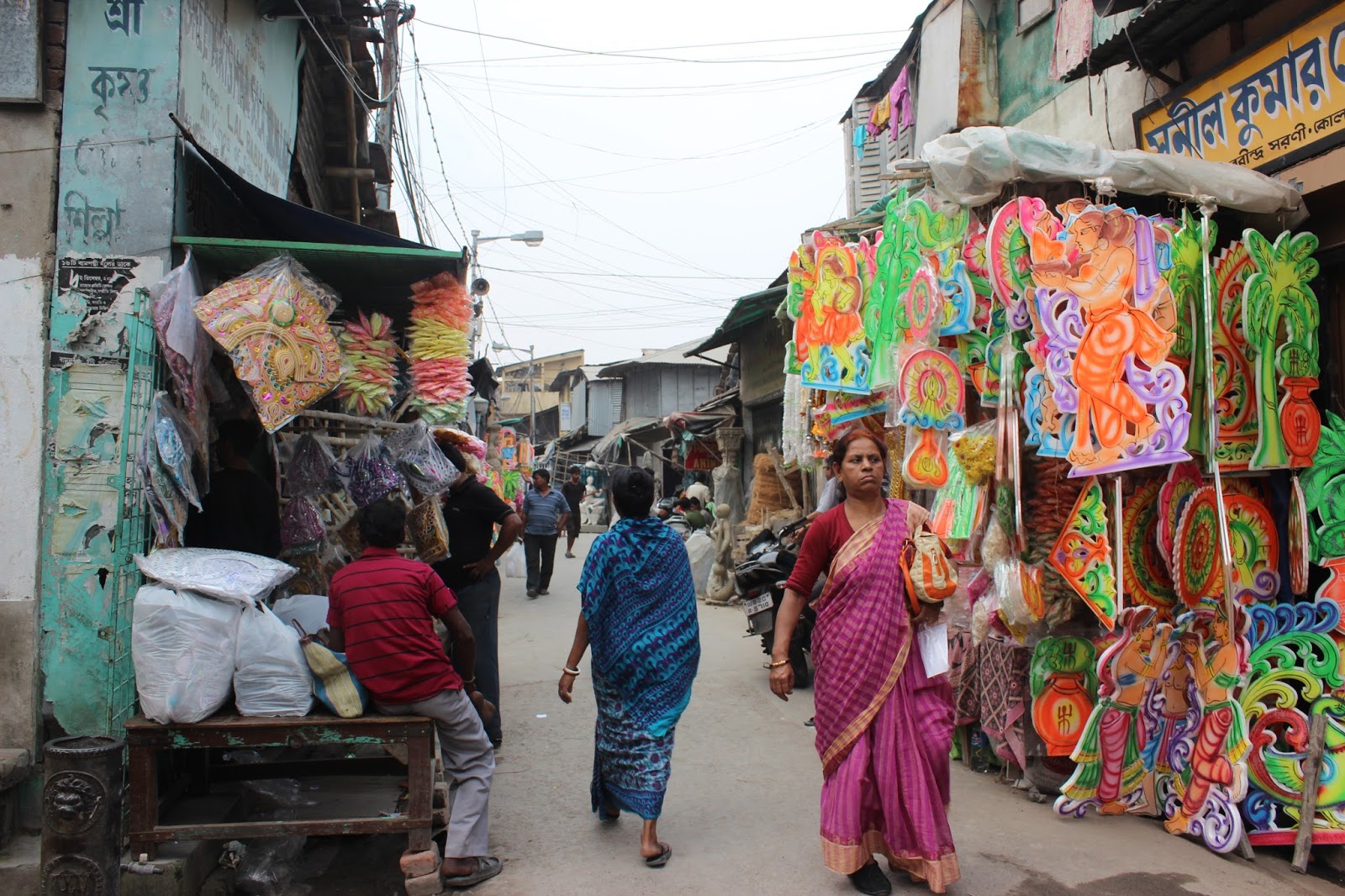
Saraswati idols at Kumartuli, Calcutta

Basant Panchami was celebrated yesterday in Calcutta, heralding the arrival of spring.  Homes, shops, schools and colleges, all celebrate Basant Panchami by worshipping Saraswati, the Goddess of Learning and of the Arts.

For several weeks before the festival, the potters at Kumartuli work hard to create beautiful idols of the goddess. I love the unfinished look of the statues, when they have no paint. Pure magic with clay and straw and water.
Saraswati is always depicted with a veena, a plucked stringed instrument that is mentioned in the natyashastra. In the photo below you can see how the hands are a different colour. That's because the hands are made separately, and attached after the base structure dries.
After the basic structure is completed, details are added. Crown, wavy hair, jewellery, these add beauty to the figures.
Here are some of the idols, being painted: in this one, the saree is the only part that is painted; only a first coat has been done. It will be further finished with more details and shading.
 Here's another one, see the curl of hair near the ears, on the cheek :) :) It is a traditional way of depicting beauty.
This one is also very beautiful, and waiting for more work to be done.
The entire area is busy at work. Some of the statues are very big, like the ones in this photo which the two men are working on.
There are decorations and embellishments also being sold.
I wanted to spend more time, but I had lots of other things to do. I hope you enjoyed this small glimpse!

Tuesday, November 24, 2015

Portrait of a musician from the Mir tribe, Gujarat

On our Ahmedabad Crafts Tour, we photographed this performer from the nomadic Mir tribe. Look at the wonderful colours on the stringed instrument in this portrait! I have never seen a musical instrument decorated like this. Have you?
Here is a closer look. Look at how the singer has personalised the instrument. The sense of colour and drama is incredible. The text on the left says Jai Khodiyar Maa, invoking the folk goddess Khodiyar, who is popular in Gujarat. There are interesting designs stencilled on the instrument; and even little Chinese or Japanese stickers have been used. I learnt that the word he uses for the instrument is "santaar". I had not heard this word before. Taar means string. I assume santaar means 4-string. Probably this is a variant of the taanpura?
The overall effect is amazing. See the photo below, with his family also nearby. I find so much beauty in this colourful chaos.

Saturday, October 24, 2015

Odhani dyeing, Jodhpur

Pink and orange are definitely the colours of Rajasthan. In Jodhpur I went to see this community of dyers. They were working with odhanis (scarves / dupattas) that day, laying them neatly in rows for drying.
The colours used to be natural once upon a time, of course. But these days the colours are synthetic, and sustained exposure can harm your skin. The women wear arm-gloves while handling the wet cloth, but their fingers are exposed to the dye. Some of them veil their faces, not from modesty, but to protect it from the harsh Rajasthani sun. 

Sunday, September 27, 2015

Jnana Pravaha, Varanasi

Baluchari Saree from Jnana Pravaha collection
For those interested in the preservation and documentation of India's great textile legacy, Jnana Pravaha in Varanasi is a good resource.

Jnana Pravaha was founded in 1997 by Bimla Poddar and Suresh Neotia.

Bimla Poddar was born in Varanasi and grew up there, so this institute was set up on the outskirts of the city. She is married into the Ambuja Cements family (this family surname is originally Neotia, there were 3 brothers, one of whom was adopted by his maternal grandfather Poddar). 

The Jnana Pravaha director R C Sharma used to be Director General / Vice Chancellor of the National Museum in Delhi. I don't know who is the person after his death. But Bimla Poddar is active in it. 

Their textile collection has some specialities: Phulkaris, many things from Bengal - excellent Balucharis, and Bengal textile folk art (really good stuff), then they also have a really good set of old Kashmiri shawl examples.

Here is a beautiful old Phulkari from their collection:
Please read about them: http://www.jnanapravaha.org/index.php They are doing a lot more than just textiles. It has a handicraft atelier, as well as a museum. It's very impressive. They organise a lot of lectures, music performances, etc. There is a Mumbai chapter which is also very active.

Thursday, June 4, 2015

The "Hoy" in Hoysala

- By Deepa Krishnan

Ever since I heard how the Hoysalas got their name, I keep saying their name differently in my head. Here, join me, try saying it the way I do. "Hoy! Sala" And put the emphasis on that Hoy! There you go. Hoy!

Those who have visited Belur will know that in Haley Kannada (the old form of the language), the word Hoy means Strike! That that is what Sala, the young man in the statue is doing, striking at the lion which threatened a Jain guru. 
It led to the naming of the Hoysala dynasty, which he founded. The dynasty ruled for 300 years, from 1026 to 1343 CE. The legend of Sala is immortalised in stone in Belur. This is the royal emblem of the Hoysala dynasty, and it is depicted in different artistic forms. Just see the photo above. Look at the variations the artists have come up with. Stunning. The lion, the weapon, the stance, the tail....simply outstanding. It is not for nothing that Hoysala architecture is considered among the world's masterpieces. Go on. Play the "spot the differences" game.

Hoy! Sala. Hoy!

Friday, May 22, 2015

Calico Museum of Textiles in Ahmedabad

The Calico Museum of Textile in Ahmedabad is one of the best textile museums in the world. It was established in 1949, a couple of years after India's independence from the British. 

The Sarabhai family, who founded the Museum, were in the textile business. The family was very involved in the Indian independence movement. They were close to Mahatma Gandhi, and they founded many new educational and research institutions in independent India. The Calico Museum was one of them.

Originally, the Museum was supposed to focus both on traditional hand-made textiles of India, as well as modern industrial textiles. But later, as the collection and research grew, the museum came to focus more and more on the traditional textile crafts of India.

The stature and reputation of the Sarabhais as connoiseurs of the artistic traditions of India attracted the best researchers and scholars. Eminent museum scholars and administrators such as John Irwin, Alfred Bühler, Moti Chandra and Pupul Jayakar have been instrumental in creating a high level of scholarship at the museum. When you visit the museum, what strikes you most is also the technical excellence - the work of designers, lighting experts and craftsmen - which offers a unique viewing experience.

In 1982, the Museum went through a period of serious crisis, as the Calico Textile company ran into losses and could not fund the Museum's activities. It was then brought under the Sarabhai Foundation, and it moved into the Sarabhai Haveli, from where it still operates.

Today the Calico Museum contains what is possibly India's best maintained and best presented collection of traditional fabrics spanning over five centuries. But it is much more than just textiles. There are two display venues in the Museum:
  • The Chauk contains textile-related displays: explanations of techniques (weaving, dyeing, embroidery, block printing etc), costumes, regional embroideries, textiles of the Mughal and provincial courts, and a display of India's textile trade with the world
  • The Haveli contains Jaina works (manuscripts, textiles, woodwork, sacred objects, etc), Indian paintings from the Sarabhai collection, ritual art of the Vallabh tradition, bronzes from South India, etc.
If you are visiting the museum, please note the following important details:

- The Museum is closed on Wednesdays and public holidays.
- There is no entry fee for visiting. 
- Visits are by appointment only; you have to write to them in advance and obtain permission.
- There are 2 guided tours per day: covering the Chauk in the morning and the Haveli in the afternoon. There is no way to see the galleries just wandering around independently.
- Bags, cameras, cell phones are not allowed. Photography is prohibited without prior permission.
- The exhibits are at multiple levels and require some amount of climbing; but it is easy to do. It is not suitable for wheelchairs.

The Museum website https://calicomuseum.org/ is excellent and informative; please go through the rules and do's and don'ts before you visit.

Photo Credit: calicomuseum.org

Wednesday, May 13, 2015

The Red and White Bridal Bangles of Punjab

- By Mansi Shanbag

It’s not uncommon to come across many stores selling red and white bangles in Amritsar, so much so that the wave of red and white is overwhelming.

The warren of lanes in the Chudi Bazaar, specializing entirely in the sale of bangles, is a hit with locals as well as guests.
Bangles can be traced back to 2600 BC, when a figurine of a dancing girl with bangles on her arm was excavated from the Mohenjo-daro ruins. Apart from this, numerous excavations of Indus Valley sites in Sind, Punjab and Gujarat have yielded bangles of shellac, clay and metal.
In Hindu and Sikh weddings in Punjab, the bride is gifted red-and-white bangles to wear on her wedding day. There is a ceremony, the chuda ceremony, which is on the day before the wedding, or on the actual wedding day itself. Traditionally, 21 bangles are gifted, although these days brides sometimes wear fewer bangles. 

Originally ivory-made, white bangles are now made in plastic. There are few things more picturesque than an Indian bride dressed up to her eyes in the traditional shades of red and white. And the red and white choora (bangles) do much to compliment the bride.
The bride wears the bangles as a sign of being newly married. The bangles are made of delicate materials, so that the bride is exempt from any heavy household chores. After the wedding, the bangles are traditionally worn for a year. In modern times, this too has reduced to 40 days.  Nevertheless, the tradition of bangle-wearing lives on and is quite delightful to behold. 

Sunday, May 10, 2015

Puppet Making in Rajasthan

- By Deepa Krishnan

I was walking in Jaisalmer, when I came upon a man making  string puppets (marionettes).
The puppeteers are Bhats of the Rajasthani Nat community, who are storytellers in the bardic tradition. The Bhats not only make puppets, but also use them to perform folk tales set to music and song.
Rajasthan's puppetry tradition is very old. The Bhats trace their history back to the legendary king Vikramaditya of Ujjain, who is said to have ruled central India in the 1st century BCE. Vikramaditya's famous Throne of Wisdom, called the Sinhasan Battisi, had 32 talking dolls, which (according to this book) are possibly the earliest account of puppets made by this community in India.

In olden times, the Bhats went from village to village with their puppets, enacting much beloved legends. Royalty and noblemen patronised specific Bhat families, and in return, the puppeteers composed ballads in praise of their patrons. In other words, the Bhats were to kings, what PR agencies are to corporates :)

Prithiviraj Chauhan, who ruled Ajmer and Delhi in the 12th century, was a major patron of the Bhats. Ballads celebrating his daring elopement with Samyukta, and his battlefield exploits against Muhammad Ghor, were performed by the Bhats all over north India. Prithviraj was routed, captured and put to death by Ghor, but balladeers and puppeteers went on to construct an elaborate myth about an archery competition, where a blind Prithviraj shoots an arrow unerringly at Ghor and strikes him dead. The legend of Prithviraj Chauhan's revenge on Muhammad Ghor has endured for more than 800 years, and is a widely accepted version of the truth.
Scene from Prithviraj Raso: Samyuka is love-struck by Kama's arrows

The revenge of Prithviraj against Ghor, Phad Painting
Another major patron of the Rajasthani Nat community was Amar Singh Rathore, a hot-headed 17th century nobleman from the house of Marwar (Jodhpur). He was exiled by his father after a fight; and found employment in the Mughal court, where he became the subedar of Nagaur under Shah Jahan. In this new employment, he squabbled with another courtier, and stabbed him right in Shah Jahan's court. In the melee that ensued, he narrowly escaped from Agra Fort with his life, after jumping across the moat on a horse. Later, one of Amar Singh's clansmen inveigled him back to Agra Fort and stabbed him.

I do not see Amar Singh's life as particularly heroic; in fact, I only see a quarrelsome guy with a strong instinct for self presevation! :) :) But that is not how the bards sing it. The puppeteers of Nagaur tell a stirring tale of what a dashing hero he was, and what a martyr his horse was. They sympathetically present his terrible betrayal and stabbing, and tell a grand tale of how his body was rescued from Agra Fort. The puppeteers of Nagaur have made Amar Singh Rathore into a Rajasthani legend. His story is popular in the desert regions of Rajasthan and performed with much dramatic flair at religious fairs even today.
Scene from Shah Jahan's court: Amar Singh Rathore is insulted by Salabat Khan
In spite of the popularity, influence and wide geographical spread of Rajsthani puppet shows, puppetry as a craft is dying today. The reasons are easy to find. Today, there are no royal patrons (in fact, the decline in patronage set in right from Mughal times). With the advent of radio and television, traditional rural performances have competition from modern entertainment channels. The wide availability of mobile phones has brought a lot of new music within the reach of audiences in remote locations. Old themes / folk tales do not appeal as much to the new generation as Bollywood. 

The Bhat community has adapted themselves to modern times. Some performers have incorporated tunes from popular Bollywood movie songs into their repertoire. Instead of long ballads, they have produced short-duration performances aimed at tourists (who typically have very short attention spans).

But many have given up their oral performances, and morphed simply into makers of colourful wood-and-cloth puppets. They are often seen in the bigger cities of Rajasthan, where tourists buy their attractive products. Rajasthani puppets are typically about 2 feet tall, but many are smaller as well. The local word for them is kathputhli. The word kath means wood, and puthli is a doll.
Beautifully decorated kathputli
Puppets are made out of soft wood, usually something like mango wood. While the carving of the wood is usually done by men, women make the decorative fabrics and clothes for the puppets. Puppets used for performances are usually never destroyed; even when they are broken. Instead, they are consigned to the river, to float away.
Puppeteers live in Nagaur, Bikaner, Ajmer, Udaipur and Jaipur, but wander all through Rajasthan performing and selling their dolls. If you are visiting any major city in Rajasthan, you will definitely be able to see a show.  And do stop to buy some of these colourful dolls - they make great souvenirs from Rajasthan to take back home!