Showing posts with label Festivals. Show all posts

Wednesday, October 19, 2016

Parama Padam: The 'Snakes and Ladders' of India

Snakes and Ladders originated in India as part of a family of dice board games. It was called Mokshapat or Moksha Patamu. Like many other things in India, this one also has religious background, and represents the ascent to Vaikunta or Paramapadam, the Supreme Abode of Lord Vishnu. It is most popularly played by people trying to stay awake on the holy night of Vaikunta Ekadasi. You can buy it in shops near Vishnu temples.

This one is from Giri Stores in Mylapore.


The game made its way to England and was sold as "Snakes and Ladders", then the basic concept was introduced in the United States as "Chutes and Ladders".

Tuesday, August 30, 2016

The Shankha-kshetra of Puri

- By Aishwarya Javalgekar

The famous Puri Rath Yatra (Chariot Festival) was held this July in Orissa. As I was reading up on the festival, I came across a very interesting image.
A conch shaped map of Puri's places of worship
But first let me give you a short introduction. Jagannath is an important deity of Orissa. The Jagannath temple in Puri is also the abode of his siblings, Baladeva and Subhadra. These three deities are carried in three enourmous chariots during the Rath Yatra.

According to the article I read, the region of Puri is shaped like a conch, and is called Shankha-kshetra. Similarly Bhubaneshwar is called Chakra-kshetra and Konark is named Padma-kshetra, all representing attributes of the Hindu god Vishnu.

As you can see in the picture, the temple of Jagannath stands at the heart of the conch, which acts like a map of Puri itself. Around the temple are numerous temples, shrines, trees and other religious sites.  There are approximately 115 such sacred spots scattered around the Jagannath temple, connected to the temple through a network of roads like a spiderweb.

I am not sure if the places drawn on the image are to scale. It is nevertheless a beautiful
visual of the Shankha-kshetra.

If you want to know more about the Rath Yatra, you can read our article here.

Monday, August 8, 2016

Padayani: The spirit of central Travancore

- By Aishwarya Javalgekar and Deepa Krishnan

Kerala is famous for its rich cultural heritage, and has many popular art forms to its name. But an art form that is perhaps not yet widely known is Padayani; the worship of Mother Goddess, practiced in the Bhagavathy temples of the central Travancore region.
http://pathanamthittatourism.com/destinations/heritage/padayani.php
Padayani is not just an art form. It is a community gathering to ensure the physical and mental well-being of the entire village. It is a set of rituals that transcends the boundaries of caste and religion, generating a sense of unity.

The legend says that Padayani originated as a form of prayer to pacify the goddess Kali, after she killed the demon Darika. This art form has several important cultural aspects:
  • Kolamezhuthu - These are beautiful and elaborate coloured drawings of folk deities. Kolams individually embody a certain character associated with spirits and deities. They are made from natural materials which comprise spathes (paalas) of the areca nut palm tree. Natural colours are painted on these paalas using a brush made from the stem of a coconut leaf. 
  • Kolappattu - Folk songs with traditional lyrics that include the exaltation of the deities, as well as requests to obtain their grace
  • Thappumelam - Musical performance specially featuring a Thappu, a drum made by covering a jackfruit hardwood piece with buffalohide
  • Kolamthullal - A dance form that accompanies the festival
  • Vinodam - Satire, an essential part of Padayani! This is performed making fun of petty vanities of people, as well as to target areas for social reform.

In this outstanding video below, you can see entire cultural process explained with English sub-titles. The first 3 minutes are an excellent introduction in Malayalam, without sub-titles, but the rest of the video has wonderful sub-titles.

Some practical information:
Padayani performances at temples are easily accessible from Cochin, Kumarakom or Alleppey. They are performed at night outside Bhadrakali temples, during the Padayani festival, typically between March and April. If you are visiting India this September, you can attend the padayani at the Neelamperoor Bhagavathy Temple at Kottayam on 29 Sep (photo below). It's only a 2hr drive from Cochin, and a 1hr drive from Kumarakom or Alleppey. 
http://babuscamera.blogspot.in/2008/09/pooram-padayani-at-neelamperoor.html
You can stay overnight in Kottayam if you prefer. The Athreya Ayurvedic Resort in Kottayam provides excellent therapies, so you can combine a detox stay with a festival visit. They also have yoga practitioners who can teach you yoga. 

If you'd like more information about a tour that incorporates the Padayani festival, please send an email to deepa@magictoursofindia.com. Or you can also look up the Kerala Festival Calendar (search for "patayani") to see the schedule. 

Saturday, June 25, 2016

What is Culture? Thoughts upon seeing the Sarpam Thullal of Kerala

What is culture? It is a way of life, rich with symbols and meaning.

I do not have adequate words to express the many layers of myth, legend, and beliefs that are in this Sarpam Thullal video. This is actually a 3-part video series. Please see it. Look at the number of people involved in it. Look at all the elements. Music, art, craft, religion, food, ecology, environment, people, clothing, all the richness of the land....everything is embodied in this video.


If Sarpam Thullal ends, all of this culture will die. The communities who depend on it for survival will lose a way of life. The musicians will stop singing. The artisans will stop making these crafts. The beautiful sarapakkalams will stop being drawn.

This post is not really about Sarpam Thullal. It is about culture and change. I fear that we are already losing much that is unique about our land. Under our very noses, a whole way of life is being lost through the relentless urbanisation of India. And it's not a slow, gradual change. It is abrupt change, in the space of a single generation.

I agree that change is inevitable. That some of the ways of our forefathers are no longer feasible. But we have much that is good. How do we save this?

Tuesday, May 17, 2016

Thrissur Pooram

One of Kerala's biggest festivals is the 'elephant festival' at Thrissur. The festivities, dedicated to the Hindu God Shiva, last for over 36 hours. They start when small elephant processions carry deities from various villages across Thrissur and culminate at the grounds of the Vadukunathan Temple.

The festival is marked by fireworks, and a display of umbrellas, as well as caparisons that adorn the elephants. Typically, the festival takes place during April-May.
See the crowds!
Mahouts have trained themselves to stand atop the elephants.
It's amazing how these elephants remain calm even when faced with hordes of people. 

There is increasing awareness in Kerala these days regarding the need for better treatment of elephants. A movement against the training and use of elephants is slowly taking shape. However, elephants have been an integral part of Kerala culture for hundreds of years and in fact, many of the majestic elephants have fan clubs of their own. You can find these fan clubs on facebook these days. Fans eagerly await the festivals and the processions.


Saturday, February 13, 2016

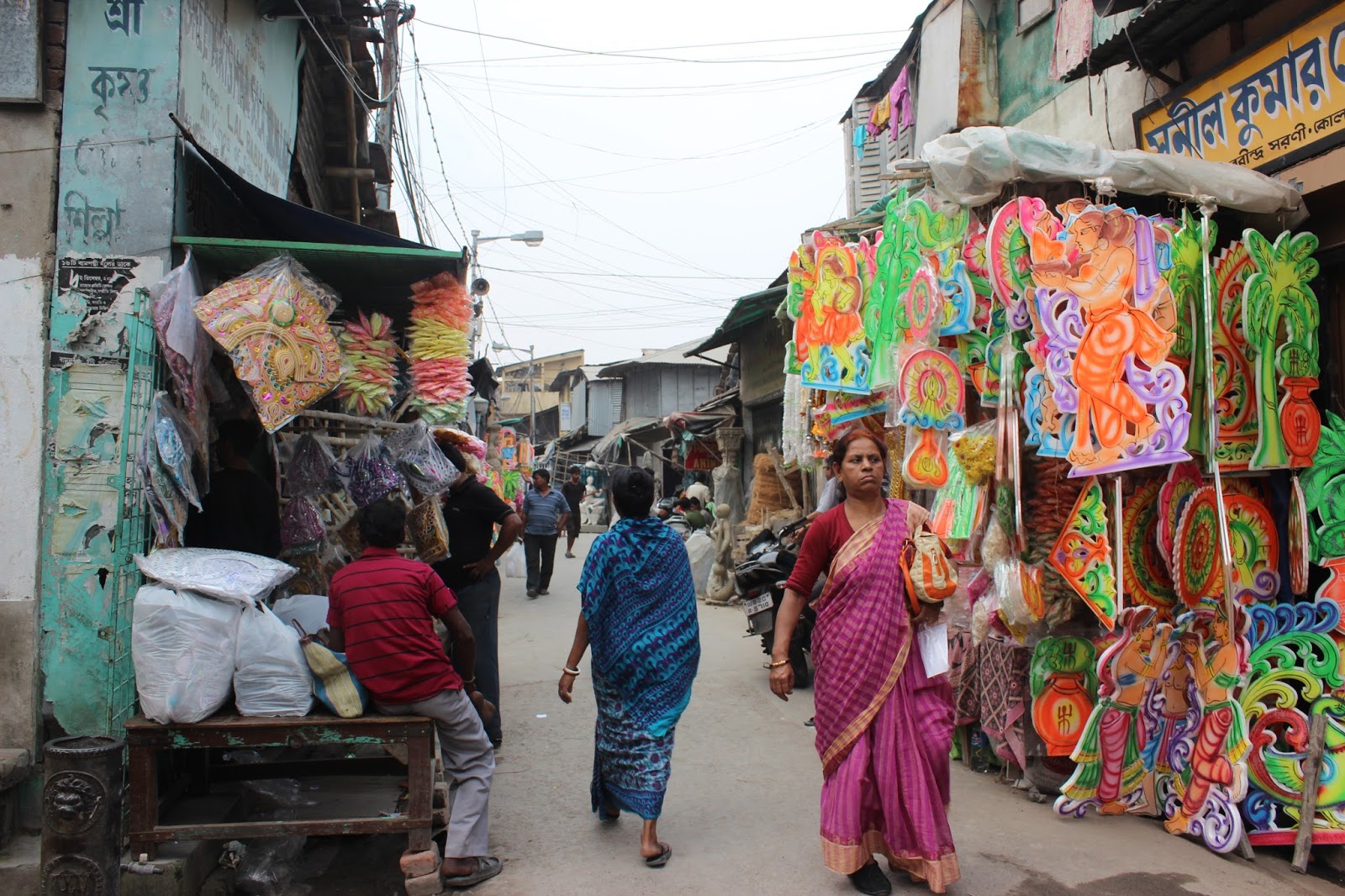
Saraswati idols at Kumartuli, Calcutta

Basant Panchami was celebrated yesterday in Calcutta, heralding the arrival of spring.  Homes, shops, schools and colleges, all celebrate Basant Panchami by worshipping Saraswati, the Goddess of Learning and of the Arts.

For several weeks before the festival, the potters at Kumartuli work hard to create beautiful idols of the goddess. I love the unfinished look of the statues, when they have no paint. Pure magic with clay and straw and water.
Saraswati is always depicted with a veena, a plucked stringed instrument that is mentioned in the natyashastra. In the photo below you can see how the hands are a different colour. That's because the hands are made separately, and attached after the base structure dries.
After the basic structure is completed, details are added. Crown, wavy hair, jewellery, these add beauty to the figures.
Here are some of the idols, being painted: in this one, the saree is the only part that is painted; only a first coat has been done. It will be further finished with more details and shading.
 Here's another one, see the curl of hair near the ears, on the cheek :) :) It is a traditional way of depicting beauty.
This one is also very beautiful, and waiting for more work to be done.
The entire area is busy at work. Some of the statues are very big, like the ones in this photo which the two men are working on.
There are decorations and embellishments also being sold.
I wanted to spend more time, but I had lots of other things to do. I hope you enjoyed this small glimpse!

Wednesday, July 22, 2015

Marapachi Bommai and Golu

I photographed this antique "marapachi" couple at the Kanchi Kudil museum in Kanchipuram. They were beautifully and simply decorated in traditional cotton weaves.
Marapachi dolls are part of the traditional doll collection of south Indian homes. In olden days they were part of a woman's dowry, given to her by her parents during the wedding, to continue the traditon of decorating and displaying them. Typically they are always found in twos, and they represent prosperity and abundance.

Marapachi dolls are displayed during the annual Golu/Navarathri festival (a 9-day festival that usually happens in Oct-Nov).  During this festival, women make attractive displays of dolls and figurines, arranged in a series of steps (Golu padi). The Golu padi is decorated prettily and women from the neighbourhood visit each other to see the golu arrangement. It is a time for socialising and meeting with friends, exchanging news, and singing songs.

Here is the stepped display that I photographed at the home of my dance guru, Dr. Jayashree Rajagopalan. At the bottom row there is a set of marapachi dolls.
No golu padi is considered ok unless it contains the auspicious marapachi bommai. In some houses, these are the very first dolls to be decorated and placed on the padi. It is a practice to put new clothes for the marapachi bommai each year. Here is the closer look at the bottom row, you can see 3 pairs of marapachi bommai in this photo.
Marapachi dolls are made of teak or rosewood and are not easy to buy these days. In fact it is quite difficult to get large-sized marapachi dolls with aesthetically designed features. I went looking for some in Mylapore but couldn't find them. I have heard that good ones are available in Tirupati. If I go there, I will surely look for some. Meanwhile if you know some place in Chennai or Bangalore where I can buy them, please let me know!

Thursday, July 2, 2015

The Chariot Festival at Puri

- By Aishwarya Javalgekar

It is July now, and all eyes in Odisha are turned towards the Jagannath Temple, waiting for the grand procession of the Rath Yatra (Journey of Chariots).

Puri Rath Yatra (Photo taken from Wikimedia Commons)
Beginning on 18th July, three chariots will go on a procession from the Jagannath Temple to the Gundicha Temple, where they will remain for seven days. The chariots will return to the Jagannath temple on 26th July, marking the end of the Rath Yatra.

The Jagannath Temple in Puri is an important pilgrimage destination for Hindus all over India. The temple's origins are mentioned in the ancient Puranas, and several religious gurus and sects have made Puri their home. It is believed that a journey to Puri will free a pilgrim from the cycle of rebirth, and lead him to salvation.  

Jagannath (meaning Lord of the Universe) is associated with Lord Krishna. The legend goes like this: When Krishna was accidentally killed by a hunter, some devotees found his body and stored the bones. Later, Lord Vishnu directed a king called Indrayumna to make a statue and place the bones inside it. Vishwakarma was asked to make the statue. He agreed on the condition that he be given complete privacy till the work was complete. But the king and queen grew impatient and visited the site while Vishwakarma was at work. This upset him, and he left the statues undone. Even today, Jagannath is depicted without hands and feet.

In Puri, Lord Jagannath is worshipped as a part of a triad, along with his brother Balbhadra and his sister Subhadra. 
(From left to right) Idols of Balabhadra, Subhadra and Jagannath (Picture taken from newindianexpress.com)
Three idols are taken in enormous chariots, built specially for this festival. The chariots are richly decorated, and are drawn by the devotees who join the yatra (journey or pilgrimage). This festival attracts a large number of people, both from India and abroad. There is music and chanting, creating a colourful and euphoric atmosphere.
The three chariots being drawn during Puri Rath Yatra, 2007 (Photo taken from Wikimedia Commons)
Once the ceremony is over, the chariots are broken down and converted into religious relics. New chariots are made from scratch and beautifully decorated every year.They are a reference to the Bhagvad Gita, a sacred text of the Hindus. The festival is steeped in symbolism and carries forth ancient rituals that have remained much unchanged for centuries.


This year, the Rath Yatra will be even more special. The three patron deities will be given a new physical form. This only happens once in 12 to 19 years! The new idols will be carved from the Neem (Margossa) tree and consecrated in the temple.

Monday, April 14, 2014

Neem flower on Tamil New Year's Day

Today is the New Year for many parts of India: Tamil Nadu, Kerala, Punjab, Bengal, Assam, Odisha, Mizoram etc.

In Tamil Nadu, one of the ways we celebrate the festival is by making a dish with neem flowers.

Vepampoo or neem flower is known for its curative properties and the dish we make with it has all tastes - bitter (neem), sweet (usually jaggery), sour (usually tamarind), spicy (chillies) and salty.

Tuesday, January 14, 2014

South Indian Harvest Festival : Thai Pongal in Chennai


Today is Thai Pongal, South Indian Harvest Festival where the tradition is to thank the Sun God. A small fire is lit in an open space facing the East (Sun rising direction) decorated with kolam, flowers, mango leaves. Then a pot of milk is boiled and the head of the family will put rice and jaggery in it (saying a small prayer). Finally we have delicious pongal...served !!

Photo: Today is Thai Pongal, South Indian Harvest Festival where the tradition is to thank the Sun God. A small fire is lit in an open space facing the East (Sun rising direction) decorated with kolam, flowers, mango leaves. Then a pot of milk is boiled and the head of the family will put rice and jaggery in it (saying a small prayer). Finally we have delicious pongal...served !!