Showing posts with label Nature. Show all posts

Wednesday, April 18, 2018

Ranthambhore Visit April 2018

My fourth visit to Ranthambhore in the last 10 years, and great sightings of tigers.

Here is one of the young tigresses we saw. Look at her alert face, ears pricked, stalking!

Summer (April-June) is a great time to visit this park, so what are you waiting for?


Saturday, June 25, 2016

What is Culture? Thoughts upon seeing the Sarpam Thullal of Kerala

What is culture? It is a way of life, rich with symbols and meaning.

I do not have adequate words to express the many layers of myth, legend, and beliefs that are in this Sarpam Thullal video. This is actually a 3-part video series. Please see it. Look at the number of people involved in it. Look at all the elements. Music, art, craft, religion, food, ecology, environment, people, clothing, all the richness of the land....everything is embodied in this video.


If Sarpam Thullal ends, all of this culture will die. The communities who depend on it for survival will lose a way of life. The musicians will stop singing. The artisans will stop making these crafts. The beautiful sarapakkalams will stop being drawn.

This post is not really about Sarpam Thullal. It is about culture and change. I fear that we are already losing much that is unique about our land. Under our very noses, a whole way of life is being lost through the relentless urbanisation of India. And it's not a slow, gradual change. It is abrupt change, in the space of a single generation.

I agree that change is inevitable. That some of the ways of our forefathers are no longer feasible. But we have much that is good. How do we save this?

Tuesday, May 17, 2016

The Living Root Bridges of Meghalaya

May conjures up images of sweltering Indian summers, but in the north-eastern mountains of Meghalaya, it is the time for the Indian Summer Monsoon. 
Cherapunjee in Meghalaya is among the rainiest places in the world; but you can easily visit it before the monsoon arrives in full force. Apart from the cool weather and beautiful clouds, the chief attractions of Cherapunjee are the famous Living Root Bridges. 

The Living Root Bridges are a man-made natural wonder. The local Khasi people developed an ancient network of bridge building that leaves visitors stunned. The secondary roots of the rubber fig tree (scientific name: Ficus elastica) are directed around a hollow betel nut bark until they stretch across the opposite bank of the river. As the tree grows, the roots are woven together and the bridge strengthened to withstand significant weight.
It takes anything from 15 to 30 years to get a bridge started, and then they go on and on, until the tree itself dies.

Here is one bridge, in the making. Perhaps in another 10 years it will be ready. Ficus trees have very long lives; so these "Living Bridges" of Meghalaya continue to live and grow for many decades.

The bridges are not easy to reach. Meghalaya is made up of valleys, and the bridges are usually at the bottom of the valley, where there is a river flowing below. It's usually a long trek down, for example, this one in Cherrapunjee.
There are several Living Root bridges in Meghalaya. There's one bridge in fact, which has been used to create seats to watch a football match :) Some bridges, like the first one in this blogpost, are on two levels (called double-decker bridges). Some are twin bridges built parallel to each other.

It is a fully developed Culture of Bridges, in which one generation invests patiently for the coming generation. How amazing is that!

Sunday, January 10, 2016

Suprabhatam – The Dawn Prayer

- by Deepa Krishnan

This morning I listened to Suprabhatam - the Dawn Prayer - as sung in the Tirumala temple in Andhra Pradesh. This is the prayer sung to wake up the sleeping Lord Vishnu. To me, there has always been something mesmerising and calming about the sound of this morning chant. 

Perhaps the sound of Sanskrit appeals to me; or perhaps it is the cadence itself, or perhaps it is the knowledge that I am listening to something very old.

On an impulse, I looked up the Tirumala website for a translation of the Dawn Prayer - and found myself captivated by the beauty of the lyrics.

Wake up, Lord, the song says, wake up! See the beauty of the Dawn! 
The breeze carries the scent of half-opened blue lotuses; it blows gently through coconut and arecanut trees. 
Green parrots in beautiful cages open their eyes; they eat bananas and sweet payasam, and sing gracefully. 
The black bees hum loudly, declaring themselves more beautiful than the flowers! 
Wake up, Lord, and with your waking, render the three worlds auspicious!

For me, the imagery these words conjure up is very "South Indian". In my mind, I can see a green prosperous fertile country, with rice fields and coconut groves, where the morning brings with it gentle breezes and calm beauty. 

Dark-skinned beautiful women walk in the fields, their sarees brilliant with colour. Temple spires – tall, colorful gopurams - rise above the trees. White oxen are being yoked to the plough. Everything is green and beautiful…and somehow blessed. (It is just me or does anyone else see these things? I don’t know!) 

Other than descriptions of the land, the Dawn Prayer also contains poetic descriptions of Vishnu:
Darling child of Kausalya! Lord with the Eagle Banner! 
Lord of the Seshachala Hills! Padmanabha, he of the Lotus Navel! 
Purushottama, ideal among Men! Madhava! Janardana! Chakrapani, Holder of the Divine Discus! Lord of the ten incarnations! He whose body is marked by the sacred Srivatsa sign!

The names go on, each bringing with it more and more rich visual images, until the whole Dawn Prayer is infused with a divine grace where God and Nature intertwine, where lines blur, where all you can see is the glory of the Universal Truth manifested in everything around you. 

Dawn sighting of the Lord of Tirumala!
Is it not fitting, then, that the dawn darshanam (sighting of the Lord) in the Tirumala temple is also called “Viswarupa Sarva darshanam”? (For those who do not know, the Viswarupa is the Cosmic Form of the Lord, said to contain the entire Universe in itself).

I am not religious, but I tell you, the Suprabhatam with its full meaning is enough to give me goosebumps.

My only regret is that my knowledge of Sanskrit is still half-baked, that three years of learning it is nowhere near enough to appreciate its depth and grace.

Truly, when you do not know the languages of your ancestors, you have lost half the world.

Saturday, October 31, 2015

Shundorbon (Sundarban) - the Beautiful Forests of Bengal

- by Deepa Krishnan

The Shundorbon (Sundarban) is the largest single block of tidal halophytic mangrove forest in the world. Shundorbon means 'Beautiful Forest'. It is easily accessible from Calcutta.

A halophyte is a plant that grows in waters of high salinity, coming into contact with saline water through its roots or by salt spray.
"Shundorbon" is made of two Bengali words: Shundor (beautiful) and Bon (forest). The name comes from the beautiful Shundari tree which makes up more than 70% of the forest.
The Shundorbon extends over Bangladesh and India, covering approximately 10,000 square kilometres. It is a UNESCO World Heritage Site.

India has 3% of the world’s mangroves, of which the Sundarbans comprise almost half of the total area. Apart from the Sundarbans, the other large belts of mangroves are in the Andaman-Nicobar Islands and the Gulf of Kutch in Gujarat.

The Sundarban National Park is one of the largest reserves for the Bengal tiger. It is also home to a wide variety of birds, reptiles and invertebrates, including the salt-water crocodile.

Photo credits:
First photo: https://en.wikipedia.org/wiki/Sundarbans#/media/File:Boat,_trees_and_water_in_Sundarbans.jpg
The Sundari tree: https://en.wikipedia.org/wiki/Heritiera_fomes#/media/File:Sundarbans_02.jpg
Map of Shundorbon: Public domain

Thursday, May 28, 2015

Datun-wali (neem-twig seller) in Varanasi

- by Deepa Krishnan

Varanasi is a city which wakes up really early. Many people visit the temples at dawn. Naturally the city's vendors also begin early. I photographed this datun-wali at 6 am.
Neem seller with cutting implements
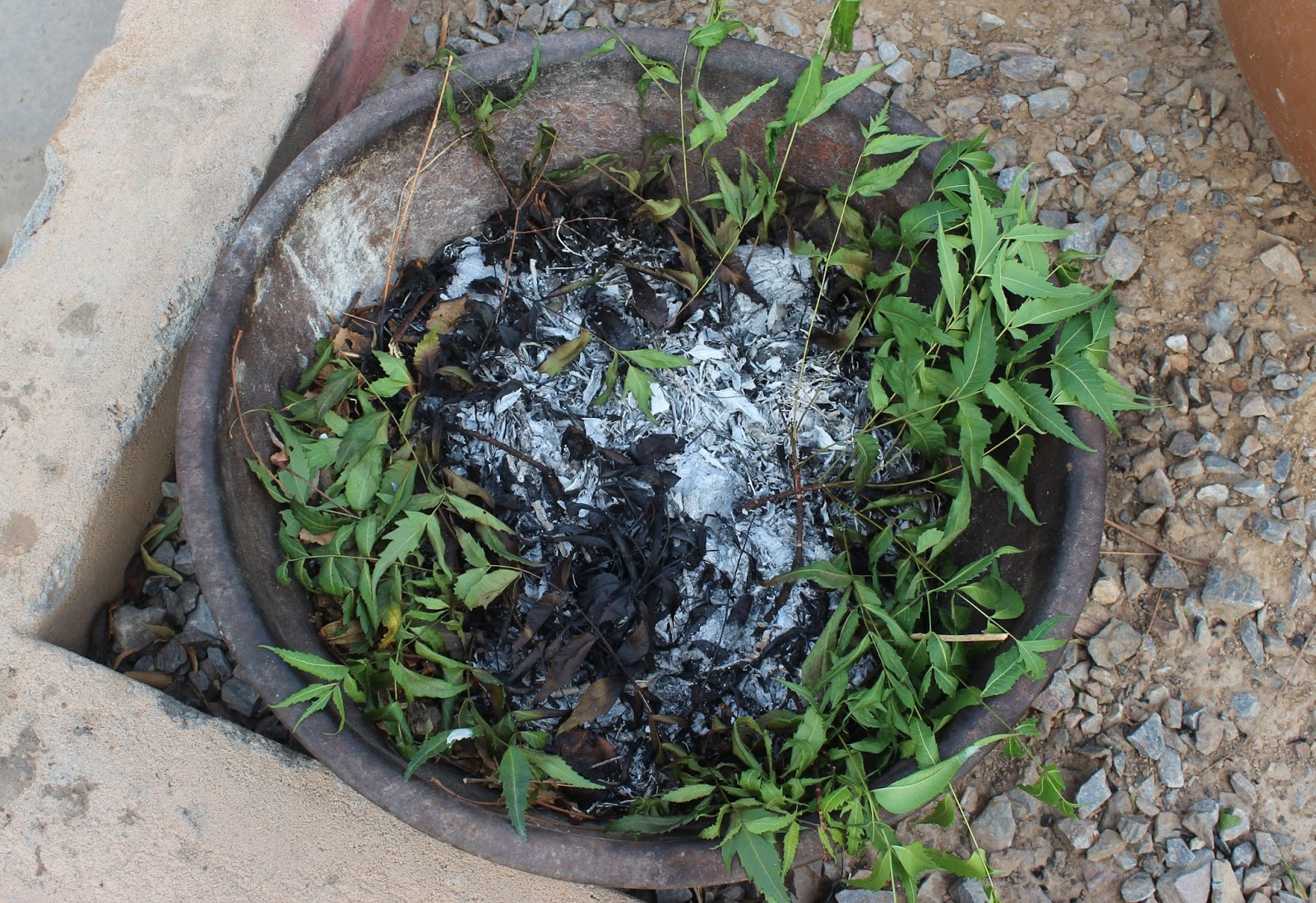
Datun is made of neem twigs. The twigs are harvested from trees, then cut into shape (she is using a wooden board and sickle, which you can see in the photo above). Then they are bundled and sold. Datun is the traditional method of cleaning teeth. Chewing on the end of the twig releases the medicinal properties of neem.

Azadirachta indica (neem) has a wide range of medicinal properties and is extensively used in Ayurveda, Unani and Homoeopathic medicine. More than 140 compounds have been isolated from different parts of neem. All parts of the neem tree- leaves, flowers, seeds, fruits, roots and bark have been used traditionally for the treatment of inflammation, infections, fever, skin diseases and dental disorders.
Neem leaves being smoked over charcoal fire to keep away mosquitoes and insects

Thursday, April 9, 2015

The works of Charles Forrest

"City of Benares" by Lieutenant-Colonel Charles Ramus Forrest (1750-1827). He was an amateur artist who also served in the British (East India) army from 1802-1827.
The painting above is one of 24 illustrations in a book called "Picuresque Tour along the Riverrs Ganges and Jumna in India". It was published in London.
Like many Englishmen and women,  Forrest was enamored of India and its romantic landscapes. He was based in Calcutta, and whenever his regiment was sent upcountry, he would make excursions from the camp on horseback, palanquin or boat, to capture images. He drew sketches of what he saw, and then later coloured them. The image below is of Barrackpore, which was the earliest cantonment town in India:
Forrest drew unfamiliar vegetation, animals, palaces, forts, temples and other landscapes. He drew not only grand monuments but also smaller places. Along with other artists like Daniells and Salt, Forrest was responsible for creating exotic images of India in the public imagination. 

Monday, February 9, 2015

Gaur sighting at Kanha

It was evening and the sun was setting among the treetops, when we saw a herd of gaur in Kanha. The density of gaur population in Kanha is quite low (it is a very large park, spread over 940 square kilometers). So this was definitely an unexpected sighting for me.

The gaur (Bos gaurus), is the largest bovine in Asia. It is the tallest species of wild cattle and is native to South Asia and Southeast Asia. In India they are usually spotted in south Indian forests; so that's another reason why I didn't really expect to see them in Kanha.

The herd emerged from the bush, and started to graze on the edges of the road. This effectively blocked our road access and we had to wait for a while, until they left the road. So I had a good chance to look at them. There were perhaps 5 or 6 gaur, of which we could see clearly two females and their young. The gaur typically live in maternal herds, led by a matriarch. The herd has juveniles and calves, and during the breeding season (April-May) the herd also has males. Even after the breeding season, the herd may have a large male.

I looked for the largest gaur in the herd - it was a big dark brown one. I was trying to figure out if it was male or female.  Females remain brown all their lives, while males darken and become black as they grow past 5 years. I figured this must be a female, and possibly she was the leader for this herd. (See this great article for information on how to tell the age and gender of gaur). Female horns point inwards and are more closely set, male horns grow out wide and then curve up.

The horns of both males and females start to whiten as they get older. This female has 40% or so white, so she must be around 4 yrs old.

The gaur prefers green grass when available. We could see this family grazing on whatever green grass they could find. When green grass is not available, they eat leaves, buds, shoots and even tree bark. They like bamboo quite a bit. They eat for most of the day, nearly 15 hours or so. After a few minutes, the herd spotted us and I think the young calves got a little alarmed (see photo below). I realised that the gaur in Kanha are not really used to humans and vehicles. Within a few seconds, they all crashed away into the bushes.
As we drove past the area where they were standing, suddenly a female gaur came back again, out of the bushes. She stood there staring straight at us. It's as if she was saying, I'm not scared of *you*! I remembered that the gaur is a pretty dauntless creature, and will even face down a tiger.
In 2011, the forest department relocated some gaur from Kanha to Bandhavgarh (where they had gone extinct around 1996). A total of 19 gaur were translocated in the first phase. A couple of them were killed by tigers but the rest are doing well. Later another 31 gaur were translocated, and they have also managed to survive very well in tiger territory. In fact,  Bandhavgarh now has some 70+ gaurs (there have been several births and the gaur population is thriving). The belief is that gaur do well when their herds are in significant numbers. In the wild, you can see gaur in herds ranging from 2 to 20 individuals. But the smaller units have less ability to protect their calves and juveniles from tigers.

Here's another gaur we saw, in a different part of Kanha. This one is a male (I'm guessing!), based on the shape of the horns. They are broader, they sort of shape outwards and then up. And the center of his head is more pronounced. He is still not very black, and his horns are small, so I would say, not more than 2.5 years old. 
If you go to Kanha, do ask your guide if you are in gaur territory. I think (if i remember right) they frequent only some parts of the park.

Friday, October 17, 2014

The gorgeous Noor of Ranthambhore - sighting in October 2014

I got these photos of Noor aka Mala (T-39) from Robert and Katie Cowan. They were in Ranthambhore last week. Isn't Noor just gorgeous?
Here's another photo: you can clearly see the "beads" on her back. This characteristic pattern is what gives her the name "Mala", which means garland. Noor and her two cubs have been among the star attractions of Ranthambhore this season.
Noor is the daughter of the Sultanpur tigress T-13 (Chhoti), and the granddaughter of the legendary Machhli (T-16). Noor's first cub is a male called Sultan (T-72); born a couple of years ago when she mated with Ustad (T-24).  This year she has had two more cubs with Ustad. 

The grass has started to dry up in Ranthambhore in many places, although many places are also still very green.  In this photo below, you can see that Noor looks well-fed and healthy; and there are reports that she has been having good hunting success.
In my previous trip to Ranthambhore, I had excellent sightings of Noor; but that was just a few days after Sultan was born, and she was super skinny and hungry at that time. Take a look at my previous encounter with Noor here. http://delhimagic.blogspot.in/2012/06/tiger-sighting-at-ranthambhore-may-2012.html

Monday, February 17, 2014

Thar desert: man and animal in conflict?

At sunset when the Thar desert (Rajasthan) is golden and the colours are surreal. This is a group of female neelgai antelope with young ones. 
We were ooh-ing and aah-ing when our guide explained to us that the neelgai were a major threat to his farm crop (millet and mustard are grown in the Thar, apart from many other things). The negative feeling in his voice was clear: he did not like these animals. His tone made me stop and think about man-animal conflict, and how groups of people who traditionally have coexisted with animals are now losing their tolerance.

Traditionally the neelgai has not been hunted in India because it is believed that this is a type of cow. But attitudes are changing.

I don't blame the farmer. Life is precarious in the desert, and farming is not easy. Once the crop is sown, it must be guarded from being eaten, which is of course, taxing for small farmers (since the labour usually is sourced entirely from the farmer's family).

Unfortunately, there is no systematic, nation-wide approach towards managing man-animal conflict. The root causes of the problem are well known: widespread loss of natural habitat and food sources, changes in land use and cropping patterns, cutting off of wildlife corridors, and so on.

What is to be done? We need comprehensive policies that treat land in a holistic manner irrespective of state boundaries; we need to think about our 'development' model. Most importantly, we need to stop producing more and more Indians!! The huge population needs to stop growing at unsustainable rates.

None of these solutions are easy.

Here's an article that talks about the man-animal conflicts in India.

Friday, June 28, 2013

The Nagapushpam in Mylapore, Chennai

Nagpushpam/ Nagapoo / Nagalingapoo (literally, snake flower, from the Cannonball Tree) is said to be the favourite flower of Lord Shiva. It gets its name because the flower has a hood, resembling a snake (naga). Because it is often offered to Lord Shiva in prayer, it is also known as Shivalinga poo.

This particular bunch of flowers was photographed in the bazaar at Mylapore in Chennai. Mylapore has always been the religious and cultural epicenter of the people of Chennai.

Mylapore was once a great port, with a great shore temple, dedicated to Lord Shiva. When the Portuguese arrived in the mid 16th century, they destroyed the temple, and pushed Myapore inshore, where it still stands today. The temple to Lord Shiva was rebuilt 300 years ago and is today known as the Kapileeswara temple. Naturally, the flowers are quite popular in this market.

Funnily enough, the tree is not native to India; it originates from South America. It is not clear when the tree arrived in India, but it is widely cultivated, especially near Shiva temples, both in north and south India. I am told that even for worship, the flowers are picked from the ground; instead of being plucked from the tree. That is unusual in India. 

There are some blogposts about the Buddha actually dying under the cannonball tree; but those writers seem to have mixed up this tree with the sal tree or shala tree, shorea robusta. The Buddha reached a grove of sal trees in Kushinagara, and asked to be laid down there, between two trees; and that's where he died.

Wednesday, August 1, 2012

Nal Sarovar Bird Sanctuary

By- Deepa Krishnan

The Nal Sarovar Bird Sanctuary is 1.5hrs drive west of Ahmedabad. Spread over 120 sq.kms, it is the largest wetland bird sanctuary in Gujarat.
The huge lake and the extensive reed beds and marshes support rich aquatic life and plants, and thus provide the perfect habitat for birds. Over 225 species of birds have been spotted here, of which 140 are water birds.
The best time to visit Nal Sarovar is in winter when migrant birds appear from various parts of the world. Thousands of migratory waterfowl flock to the shallow areas of the lake and the ponds on the outer fringes of the lake. Birding is usually done on foot as well as by small hand-punted boats.
Popular waterbirds include flamingoes, cranes, ducks, gulls, terns, kingfishers, shovellers, cormorants, egrets, herons, ibis, etc. Apart from waterbirds, you can also see birds of prey, bee-eaters, rollers, doves, lapwings, coucals, parakeets, fly catchers, starlings, mynahs, bulbuls, sunbirds, wagtails etc.

Photos courtesy Gujarat Tourism