Sunday, January 10, 2016

Suprabhatam – The Dawn Prayer

- by Deepa Krishnan

This morning I listened to Suprabhatam - the Dawn Prayer - as sung in the Tirumala temple in Andhra Pradesh. This is the prayer sung to wake up the sleeping Lord Vishnu. To me, there has always been something mesmerising and calming about the sound of this morning chant. 

Perhaps the sound of Sanskrit appeals to me; or perhaps it is the cadence itself, or perhaps it is the knowledge that I am listening to something very old.

On an impulse, I looked up the Tirumala website for a translation of the Dawn Prayer - and found myself captivated by the beauty of the lyrics.

Wake up, Lord, the song says, wake up! See the beauty of the Dawn! 
The breeze carries the scent of half-opened blue lotuses; it blows gently through coconut and arecanut trees. 
Green parrots in beautiful cages open their eyes; they eat bananas and sweet payasam, and sing gracefully. 
The black bees hum loudly, declaring themselves more beautiful than the flowers! 
Wake up, Lord, and with your waking, render the three worlds auspicious!

For me, the imagery these words conjure up is very "South Indian". In my mind, I can see a green prosperous fertile country, with rice fields and coconut groves, where the morning brings with it gentle breezes and calm beauty. 

Dark-skinned beautiful women walk in the fields, their sarees brilliant with colour. Temple spires – tall, colorful gopurams - rise above the trees. White oxen are being yoked to the plough. Everything is green and beautiful…and somehow blessed. (It is just me or does anyone else see these things? I don’t know!) 

Other than descriptions of the land, the Dawn Prayer also contains poetic descriptions of Vishnu:
Darling child of Kausalya! Lord with the Eagle Banner! 
Lord of the Seshachala Hills! Padmanabha, he of the Lotus Navel! 
Purushottama, ideal among Men! Madhava! Janardana! Chakrapani, Holder of the Divine Discus! Lord of the ten incarnations! He whose body is marked by the sacred Srivatsa sign!

The names go on, each bringing with it more and more rich visual images, until the whole Dawn Prayer is infused with a divine grace where God and Nature intertwine, where lines blur, where all you can see is the glory of the Universal Truth manifested in everything around you. 

Dawn sighting of the Lord of Tirumala!
Is it not fitting, then, that the dawn darshanam (sighting of the Lord) in the Tirumala temple is also called “Viswarupa Sarva darshanam”? (For those who do not know, the Viswarupa is the Cosmic Form of the Lord, said to contain the entire Universe in itself).

I am not religious, but I tell you, the Suprabhatam with its full meaning is enough to give me goosebumps.

My only regret is that my knowledge of Sanskrit is still half-baked, that three years of learning it is nowhere near enough to appreciate its depth and grace.

Truly, when you do not know the languages of your ancestors, you have lost half the world.

Saturday, January 9, 2016

The colourful bazaars of Udaipur

If you start walking past the Jagdish Temple, into the little lanes, you will come across a wealth of colour: Udaipur's market for fresh vegetables.

Here's a glimpse of the market, from Steve and Wendy Johnston who visited this week.
Many of the stalls are run by women. Right now the market is full of fresh winter veggies.
Indian gooseberry (amla), waiting to be pickled
Chukandar (beetroot); both the tuber as well as the greens are used in Rajasthani curry recipes
There is a community of basket makers in Udaipur, who supply these bamboo baskets
The namkeen shops sell very popular savouries
And the sweet shops are especially enticing!
More namkeen (savoury snacks) and sweets
And what's a bazaar without a couple of cows!!
If you'd like to explore the market, check out the Ghat and Bazaar Walk on the Udaipur Magic website: http://udaipurmagic.net/udaipur-bazaar-ghatwalk.html

Tuesday, November 24, 2015

Portrait of a musician from the Mir tribe, Gujarat

On our Ahmedabad Crafts Tour, we photographed this performer from the nomadic Mir tribe. Look at the wonderful colours on the stringed instrument in this portrait! I have never seen a musical instrument decorated like this. Have you?
Here is a closer look. Look at how the singer has personalised the instrument. The sense of colour and drama is incredible. The text on the left says Jai Khodiyar Maa, invoking the folk goddess Khodiyar, who is popular in Gujarat. There are interesting designs stencilled on the instrument; and even little Chinese or Japanese stickers have been used. I learnt that the word he uses for the instrument is "santaar". I had not heard this word before. Taar means string. I assume santaar means 4-string. Probably this is a variant of the taanpura?
The overall effect is amazing. See the photo below, with his family also nearby. I find so much beauty in this colourful chaos.

Saturday, October 31, 2015

Shundorbon (Sundarban) - the Beautiful Forests of Bengal

- by Deepa Krishnan

The Shundorbon (Sundarban) is the largest single block of tidal halophytic mangrove forest in the world. Shundorbon means 'Beautiful Forest'. It is easily accessible from Calcutta.

A halophyte is a plant that grows in waters of high salinity, coming into contact with saline water through its roots or by salt spray.
"Shundorbon" is made of two Bengali words: Shundor (beautiful) and Bon (forest). The name comes from the beautiful Shundari tree which makes up more than 70% of the forest.
The Shundorbon extends over Bangladesh and India, covering approximately 10,000 square kilometres. It is a UNESCO World Heritage Site.

India has 3% of the world’s mangroves, of which the Sundarbans comprise almost half of the total area. Apart from the Sundarbans, the other large belts of mangroves are in the Andaman-Nicobar Islands and the Gulf of Kutch in Gujarat.

The Sundarban National Park is one of the largest reserves for the Bengal tiger. It is also home to a wide variety of birds, reptiles and invertebrates, including the salt-water crocodile.

Photo credits:
First photo: https://en.wikipedia.org/wiki/Sundarbans#/media/File:Boat,_trees_and_water_in_Sundarbans.jpg
The Sundari tree: https://en.wikipedia.org/wiki/Heritiera_fomes#/media/File:Sundarbans_02.jpg
Map of Shundorbon: Public domain

Friday, October 30, 2015

Araiyar Sevai: Sacred Recitals of the Vaishnavite Faith

Credit: Bharathwaj Thirumalai Ananthanpillai
Although it is 1200 years old, not many people know about Araiyar Sevai, a sacred art form of Tamil Nadu.

Araiyar Sevai is centered on the ritual singing and dance-enactment of the hymns of the Naalayiram Divya Prabandham (The 4000 Sacred Verses).

These verses were composed by the 12 Alvars (Poet-Saints) in praise of Vishnu, and were compiled in their present form by Nathamuni during the 9th–10th centuries. These hymns are still sung extensively today. However the enactment / performance of these hymns by the Araiyars is now increasingly rare.

Araiyar Sevai is usually performed in the presence of the temple utsavamoorty, i.e., the temple's processional deity.

Although temple inscriptions suggest its performance was once widespread, it is today only performed in a few temples in Tamil Nadu. These include the main temple at Srirangam, the Azhagiya Manavala Perumal and Alwar Tirunagari Temples near Trichy, and the temple of Andal at Srivilliputhur.

The performers are known as the Araiyar, and like all such traditions in India, it is a group of hereditary performers, who train from childhood to become proficient in the art. The photo below is from Srirangam:

Credit: http://jaghamani.blogspot.com/2014/11/blog-post_19.html
An araiyar sevai begins with a ritual summons, where the officiating priest calls upon the araiyar to come before the deity. The araiyar replies with a formulaic response and puts on the araiyar kullai (a conical hat) as he approaches. He then sounds a few strokes on the cymbals and begins the performance.

Each verse is performed in three steps. In the first, the araiyar sings the verse. In the second, he dances a few steps which, through a system of ritualised gestures, give expression to the literal meaning of the verse. In the third step, he explains the inner meaning of the verse, as explained in Tampirāṉ paṭi, a traditional commentary on the Divya Prabandham.

In this video you can see a performance: see the high musical quality of the story-recital:
https://www.youtube.com/watch?v=rMgDUTnq910 

Here is another performance, this one is quite different and I enjoyed watching the slow progress of the dance steps. The mudras and the footwork definitely have similarities with the other classical dance forms of South India, thus establishing their roots in the Natya Shastra.
https://www.youtube.com/watch?v=su5C4crgWKI
In this video, you can see how a program begins: https://www.youtube.com/watch?v=Zl_9LTxQxkM 

In this video, I was happy to see a young Araiyar, although there is not much happening in the video by way of music: https://www.youtube.com/watch?v=Q2cPtXHTvtk

The tradition is dying. Why? Because, frankly, we don't reward any of our performing arts. There is no patronage system that will entice a young man to adopt the way of life of his ancestors. We neither know about these arts, nor do we actively encourage them.

Here is the story of 83-year old Araiyar Srinivasa Rangachariyar, which I found on a blog. He has been peforming since the age of 13. I was delighted to see his grandson being trained. But there is simply not enough income! And yet the responsibility of keeping the art alive is on the shoulders of this young man. How will he manage?
Blog by Prabhu S: http://prtraveller.blogspot.in/2010/12/araiyar-sevai-saving-rare-art.html

Saturday, October 24, 2015

Odhani dyeing, Jodhpur

Pink and orange are definitely the colours of Rajasthan. In Jodhpur I went to see this community of dyers. They were working with odhanis (scarves / dupattas) that day, laying them neatly in rows for drying.
The colours used to be natural once upon a time, of course. But these days the colours are synthetic, and sustained exposure can harm your skin. The women wear arm-gloves while handling the wet cloth, but their fingers are exposed to the dye. Some of them veil their faces, not from modesty, but to protect it from the harsh Rajasthani sun. 

Sunday, September 27, 2015

Jnana Pravaha, Varanasi

Baluchari Saree from Jnana Pravaha collection
For those interested in the preservation and documentation of India's great textile legacy, Jnana Pravaha in Varanasi is a good resource.

Jnana Pravaha was founded in 1997 by Bimla Poddar and Suresh Neotia.

Bimla Poddar was born in Varanasi and grew up there, so this institute was set up on the outskirts of the city. She is married into the Ambuja Cements family (this family surname is originally Neotia, there were 3 brothers, one of whom was adopted by his maternal grandfather Poddar). 

The Jnana Pravaha director R C Sharma used to be Director General / Vice Chancellor of the National Museum in Delhi. I don't know who is the person after his death. But Bimla Poddar is active in it. 

Their textile collection has some specialities: Phulkaris, many things from Bengal - excellent Balucharis, and Bengal textile folk art (really good stuff), then they also have a really good set of old Kashmiri shawl examples.

Here is a beautiful old Phulkari from their collection:
Please read about them: http://www.jnanapravaha.org/index.php They are doing a lot more than just textiles. It has a handicraft atelier, as well as a museum. It's very impressive. They organise a lot of lectures, music performances, etc. There is a Mumbai chapter which is also very active.

Saturday, August 29, 2015

Granth Sahib - The Scripture for a Universal Religion

- by Aishwarya Javaglekar

The sacred book of Sikhism, known as the Guru Granth Sahib, is venerated by all Sikhs as the highest embodiment of Sikh philosophy and way of life.

At the Golden Temple in Amritsar, every evening, the Granth Sahib is carried in a procession. It is taken from its usual golden shrine (the Harmandir Sahib) to a room upstairs (Akal Takht), to rest for the night. The book is brought back early next morning.
Palkhi Sahib (procession)
The Guru Granth Sahib is a magnificent collection of religious and mystical poetry by thirty-six composers written in twenty-two languages. It incorporates the compositions of Hindu devotees, Muslim, divines and Sufi poets along with the ten Sikh gurus.
The Guru Granth Sahib - the scripture for a universal religion! (Photo credits: www.sikhanswers.com)
The sacred verses in the Granth Sahib are called Gurbani, meaning Guru’s word. Here, guru doesn't mean a particular person. It means the wisdom of the world. Thus, the Granth Sahib isn't meant to be the word of a person. It is the wisdom of the world compiled into a single book. It includes the preachings of all religions, and is regarded as a complete, sacrosanct message from God.
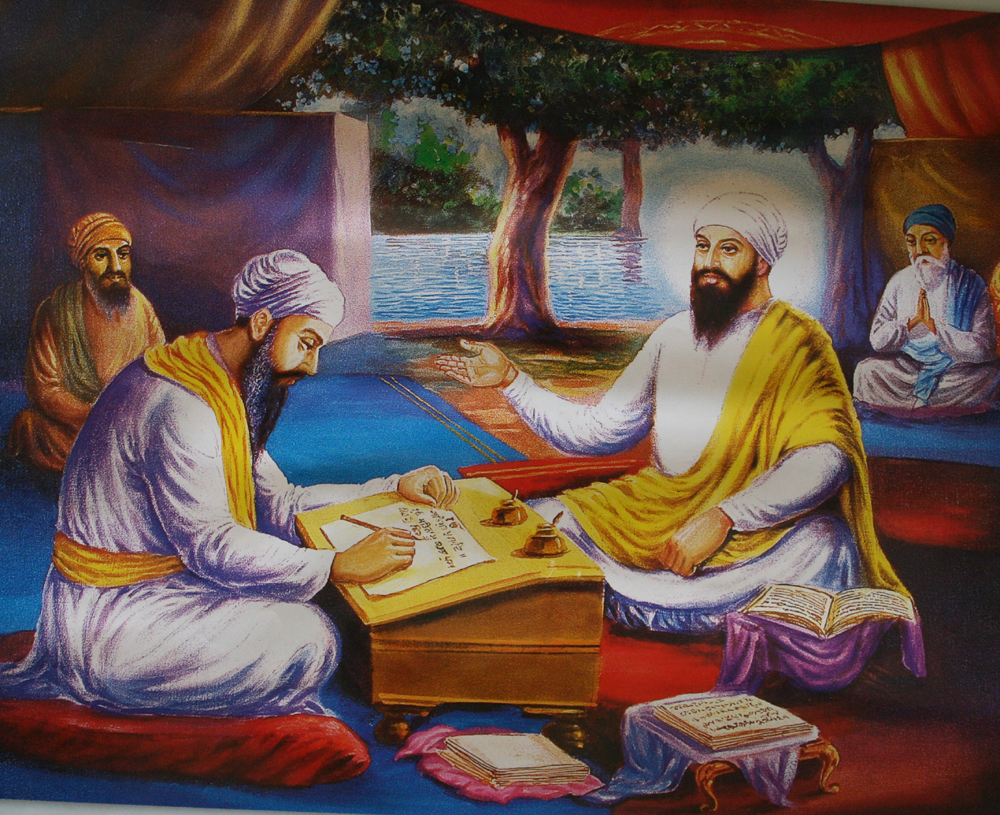
Painting of Guru Arjun Dev, the fifth Sikh Guru, dictating the text of Granth Sahib. He first compiled the book in 1604. It was completed by Guru Gobind Singh in 1705. (Photo credits: www.vismaadnaad.org)
In his final address to the Sikhs in 1708, Guru Gobind Singh, the tenth Sikh guru, said:
“Those who desire to behold the Guru should obey the Granth Sahib. Its contents are the visible body of the Guru."

Friday, August 14, 2015

Nachiyar Amman shrine in Chennai

I photographed this gorgeous idol of the folk goddess Nachiamman or Nachiyar Amman on Badrian Street in Chennai. The idol was housed in a little shrine and the flower seller women were offering their prayers to her. 

Nachiamma is one of the benevolent forms of the goddess, said to bestow good health and prosperity on her worshippers. 

I was struck by the alangaaram of the idol (decoration). She is depicted with beautiful dark eyes, with a smiling countenance. Her forehead is smeared with three lines of ash, and the auspicious red kungumam is prominently placed in the middle. Her nose-rings and round heavy olai (ear-rings) speak clearly of her folk origins.

Even though she is benevolent, her power is clearly visible in the sword, axe and trident which she holds. A halo of flames is around her head.  She is dressed in a golden silk saree, with a green border. The flower-sellers in the market have adorned her with fresh garlands.

Below this relatively new idol, there is an old black granite idol - possibly the original one that was established in this shrine. Offerings of flowers, coconuts, neem leaves and lemons have been made as per the usual practice in such goddess temples. In front of the idol is an image of the lion / tiger, which is the mount of the goddess.

I photographed this elderly flower seller as she came out of the temple after offering prayers. To me, she looked like the goddess herself, come to life.


- Photos and text by Deepa Krishnan

Wednesday, August 12, 2015

The Painted Havelis of Shekhawati (1)

Every once in a while, exotic cliches come alive. Peacock posing against faded wall, in the village of Mandawa.
Photo credit: Gaurav Jain, Delhi Magic
Some of India's most wealthy Marwari business families have their havelis in the Shekhawati region of Rajasthan. Birla, Piramal, Dalmia, Goenka etc are known to all Indians. Today many of the havelis lie abandoned, making for a surreal walk through what must be the country's largest open-air art gallery.

Sunday, August 9, 2015

Evening in the Blue City, Jodhpur

A quiet turning in the lanes of Brahmpuri. Sunset hour. Magical.
Photo credit: Deepa Krishnan

Monday, July 27, 2015

Puffed rice seller, Bangalore

- By Deepa Krishnan

Spicy puffed rice is one of the delights of Bangalore. I was starving at the end of our Vidhana Soudha Walk yesterday, but had no time for a meal. I thought this was the perfect snack to tide me over.
The puffed rice (puri) is spicy. It is called churumuri puri or khara kadele puri. It is sold in paper cones at Rs 10 for a cone. The vendor uses the glowing coals to keep the rice crisp even in the soggy monsoon season. If it rains, he's got an emergency solution - a blue pastic wrap (see photo below).
I reckon he sells about 30-50 of these in a day, so his daily income is around Rs 300 to 500. After expenses (raw material, travel, food), I think he probably earns Rs 200 to Rs 300 a day. I don't think he works every day. Weather, illness, family responsibilities, festivals and other social requirements probably cut into his work time and impact his earning capacity. I would have liked to stop and ask about his family, and where they live, what they are doing, etc. But I was late for a flight, so I dashed off. 

The churmuri was delicious. In many parts of Karnataka it is also served along with other garnishes, like finely chopped tomatoes, onions, green mango, coriander etc.

Wednesday, July 22, 2015

Marapachi Bommai and Golu

I photographed this antique "marapachi" couple at the Kanchi Kudil museum in Kanchipuram. They were beautifully and simply decorated in traditional cotton weaves.
Marapachi dolls are part of the traditional doll collection of south Indian homes. In olden days they were part of a woman's dowry, given to her by her parents during the wedding, to continue the traditon of decorating and displaying them. Typically they are always found in twos, and they represent prosperity and abundance.

Marapachi dolls are displayed during the annual Golu/Navarathri festival (a 9-day festival that usually happens in Oct-Nov).  During this festival, women make attractive displays of dolls and figurines, arranged in a series of steps (Golu padi). The Golu padi is decorated prettily and women from the neighbourhood visit each other to see the golu arrangement. It is a time for socialising and meeting with friends, exchanging news, and singing songs.

Here is the stepped display that I photographed at the home of my dance guru, Dr. Jayashree Rajagopalan. At the bottom row there is a set of marapachi dolls.
No golu padi is considered ok unless it contains the auspicious marapachi bommai. In some houses, these are the very first dolls to be decorated and placed on the padi. It is a practice to put new clothes for the marapachi bommai each year. Here is the closer look at the bottom row, you can see 3 pairs of marapachi bommai in this photo.
Marapachi dolls are made of teak or rosewood and are not easy to buy these days. In fact it is quite difficult to get large-sized marapachi dolls with aesthetically designed features. I went looking for some in Mylapore but couldn't find them. I have heard that good ones are available in Tirupati. If I go there, I will surely look for some. Meanwhile if you know some place in Chennai or Bangalore where I can buy them, please let me know!

Monday, July 20, 2015

Tapioca Chips- Junk food of Kerala

- Trisha George 

While most people know about Kerala's famous banana chips, not many have heard of its country cousin - tapioca chips. Tapioca, or 'kappa' (in Malayalam; pronounced 'cup-pa') is also called 'cassava'. The tapioca plant is popularly grown in the tropics for its edible, tuberous root. Tapioca chips are usually deep-fried and then seasoned with spicy red chilli powder.

Image taken from this video explaining how to make the chips: https://www.youtube.com/watch?v=5v16Kz5PlsM

Although the chips are rightly grouped as junk food, there are many healthy ways of eating tapioca. It's prepared as a vegetable on its own, cooked with rice, and with fish curry. Sometimes it forms the whole meal and sometimes an appetizer. It isn't uncommon to just eat boiled kappa plain either.


Kappa, with a chicken dish, and white 'patri', a thin and soft roti-like pancake made of rice
If the starchy tuber is too bland, one can dip it in any available gravy. For those of us, who don't have access to Mallu cooks and cooking skills, mass produced chips are the best way to get a taste of this vegetable. Once considered to be a poor man's meal, as a substitute for rice, its position has risen along with demand. However, production in Kerala is still dwindling. The state's high labour wage rate, combined with inevitable rodent attacks do not make this a profitable crop. Let's hope tourist interest comes as aid to the Tapioca plant!

Saturday, July 4, 2015

Rumi Darwaza in Lucknow - the grandest gateway in India

- By Deepa Krishnan

What the Charminar is to Hyderabad, the Rumi Darwaza is to Lucknow - an iconic monument that immediately identifies the city. Rumi Darwaza, which translates to "Roman Door", is an arched gateway that was built in the 18th century as the entrance to Lucknow.
Front of the Rumi Darwaza (Photo taken from travelokam.com)
Why would a very un-Roman looking gate in Lucknow be called Rumi? Because of the Turkish connection, of course. 

Istanbul in Turkey became the capital of Roman Empire in 355 AD (it was called Constantinople then). The Romans built walls around Constantinople, punctuated with many impressive gates. The Roman Empire in Constantinople ended in 1453 when the Ottoman Turks conquered Istanbul. The Ottomans repaired the gates in Istanbul which were destroyed during the war, and built new gates as well. 

Perhaps the idea of a grand entry gate came to Lucknow because of the many Persianised Turks who settled in Lucknow. No one knows for sure. Locally, the Rumi Darwaza is also called the Turkish gate. So we presume there was definitely some Turkish influence.

The Encyclopedia Brittanica says that Rumi Darwaza has been modeled on a gate in Istanbul called Bab-i-Humayun. Frankly, I fail to see any resemblance between the two. Maybe it was just the idea of having a grand gate, which came from Istanbul. Here's what Bab-i-Humayun in Istanbul looks like. 
Bab-i-Humayun, Istanbul, photo credit: Panoramio
https://geolocation.ws/v/P/59155102/bab-hmayunsaltanat-kaps-zum-topkapi/en

Before the Rumi Darwaza, there were many other Indian cities with entry gates. Delhi's Shahjahanabad had gates. Ahmedabad had gates. But no one had ever built such a magnificent gate as the Rumi Darwaza. Its architecture is a mix of Turkish, Mughal, and stuff that is purely Avadh in origin. 

Here is the other side of the Rumi Darwaza, which you see after you enter inside the city. I was there on a bright summer day, and clicked these beautiful photos:
Rumi Darwaza - after you enter the city
As the city has grown and expanded, Rumi Darwaza is now no longer the entrance to the city. It is instead, the beginning of a grand ceremonial road, flanked by the impressive Bada Imambada on one side. Here is the second photo I clicked:
Rumi Darwaza at the end of the driveway, with Imambara entrance on the left
Gorgeous isn't it?