Showing posts with label Uttar Pradesh. Show all posts

Wednesday, July 11, 2018

Jatar Ghat and Raja Gwalior Ghat in Varanasi


Continuing the series on the ghats of Varanasi; Jatar Ghat was built in the mid 1800's by the finance secretary of the Gwalior Estate, Balaji Cimadaji Jatar. There is a Laxminarayan temple here, which is in disrepair. The Gwalior Ghat was built by Jayajirao Shinde, the raja of Gwalior. The 1800's was a period when the Maratha empire was prosperous.


This area of Varanasi even today has many Maharashtrians.

The English scholar and architect James Prinsep, who arrived in Benaras in the 1820s, refers to this ghat as Chor Ghat (Thieves Ghat). Apparently in those days it was known for the disappearance of pilgrims's clothes and belongings :)

Saturday, September 17, 2016

The Story behind Bada Imambara - Lucknow's Architectural Marvel

- By Aishwarya Javalgekar

The Bada Imambara is the most popular monument in Lucknow. It is also called Asifi Imambara  after Asaf-ud Daula, the Nawab of Awadh who is entombed in the Imambara's central hall.
The grand Bada Imambara facade (Photo credits: Wikipedia)
Not only is this Imambara marvelous to look at, it has a back-story, that adds more romance to this beautiful monument. 

In 1785, Awadh was hit by a devastating famine, leaving thousands of people jobless and starving. Nawab Asaf-ud Daula took up the grand project of building this Imambara to provide employment to these people. People were given food in return for work. Thus the Nawab made sure that his subjects did not starve during the famine.
Zoffany's painting: 'Asaf ud-Daula, Nawab Wazir of Oudh', 1784. (Photo credits: The New York Times)
The common people used to work during the day to build the structure, while noblemen and the other elite worked at night and demolished parts of the structure for payment. This brilliant scheme kept the construction in progress for almost a decade! 

It is inspiring to see how a simple project helped thousands of people, saving an entire kingdom from devastation and poverty. And the Bada Imambara remains a living reminder of the Nawab's brilliance and generosity. 

Even today, there is a well-known saying in Lucknow - 
Jisko na de Maula, usko de Asaf-ud Daula
(He who does not receive (livelihood) from God, will receive it from Asaf-ud Daula)

Thursday, May 19, 2016

Claude Martin's legacy

- By Aishwarya Javalgekar

Of all the Europeans who made fortunes in India, Major-General Claude Martin is unique,  because he bequeathed the major part of his wealth to charities, and thus left a lasting legacy in India.

Claude Martin was the son of a casket maker from Lyon. Abandoning the family business, he came to India as an officer in the French East India Company. When the French lost Pondicherry to the English, he switched over to the British East India Company. His fortunes took a turn for the better after that; and his services were requested by the Nawab of Awadh, Asaf-ud-Daulah. As an able administrator and man of astute financial acumen, he soon amassed a great fortune. He was believed to be the richest Frenchman in India!
Claude Martin (Photo taken from www.lmbcal.ac.in/)
From this wealth, he commissioned the construction of Constantia, a palatial building that was supposed to be his country residence. Though its construction began in 1785, it could not be completed until 1802, two years after Martin's death. Martin is buried beneath the building, in a vault constructed specially for that purpose; for which he left detailed instructions in his will.

Martin dedicated his fortune to the establishment of schools in Lucknow, Calcutta and Lyon, his birthplace in France. The schools were named 'La Martinière' in his memory. As per his will, the school in Lucknow was established at Constantia. 
Constantia: now called La Martinière College, Lucknow


Even after all these years, La Martinière schools and colleges still remain among the grandest educational institutions in India.  

Sunday, September 27, 2015

Jnana Pravaha, Varanasi

Baluchari Saree from Jnana Pravaha collection
For those interested in the preservation and documentation of India's great textile legacy, Jnana Pravaha in Varanasi is a good resource.

Jnana Pravaha was founded in 1997 by Bimla Poddar and Suresh Neotia.

Bimla Poddar was born in Varanasi and grew up there, so this institute was set up on the outskirts of the city. She is married into the Ambuja Cements family (this family surname is originally Neotia, there were 3 brothers, one of whom was adopted by his maternal grandfather Poddar). 

The Jnana Pravaha director R C Sharma used to be Director General / Vice Chancellor of the National Museum in Delhi. I don't know who is the person after his death. But Bimla Poddar is active in it. 

Their textile collection has some specialities: Phulkaris, many things from Bengal - excellent Balucharis, and Bengal textile folk art (really good stuff), then they also have a really good set of old Kashmiri shawl examples.

Here is a beautiful old Phulkari from their collection:
Please read about them: http://www.jnanapravaha.org/index.php They are doing a lot more than just textiles. It has a handicraft atelier, as well as a museum. It's very impressive. They organise a lot of lectures, music performances, etc. There is a Mumbai chapter which is also very active.

Saturday, July 4, 2015

Rumi Darwaza in Lucknow - the grandest gateway in India

- By Deepa Krishnan

What the Charminar is to Hyderabad, the Rumi Darwaza is to Lucknow - an iconic monument that immediately identifies the city. Rumi Darwaza, which translates to "Roman Door", is an arched gateway that was built in the 18th century as the entrance to Lucknow.
Front of the Rumi Darwaza (Photo taken from travelokam.com)
Why would a very un-Roman looking gate in Lucknow be called Rumi? Because of the Turkish connection, of course. 

Istanbul in Turkey became the capital of Roman Empire in 355 AD (it was called Constantinople then). The Romans built walls around Constantinople, punctuated with many impressive gates. The Roman Empire in Constantinople ended in 1453 when the Ottoman Turks conquered Istanbul. The Ottomans repaired the gates in Istanbul which were destroyed during the war, and built new gates as well. 

Perhaps the idea of a grand entry gate came to Lucknow because of the many Persianised Turks who settled in Lucknow. No one knows for sure. Locally, the Rumi Darwaza is also called the Turkish gate. So we presume there was definitely some Turkish influence.

The Encyclopedia Brittanica says that Rumi Darwaza has been modeled on a gate in Istanbul called Bab-i-Humayun. Frankly, I fail to see any resemblance between the two. Maybe it was just the idea of having a grand gate, which came from Istanbul. Here's what Bab-i-Humayun in Istanbul looks like. 
Bab-i-Humayun, Istanbul, photo credit: Panoramio
https://geolocation.ws/v/P/59155102/bab-hmayunsaltanat-kaps-zum-topkapi/en

Before the Rumi Darwaza, there were many other Indian cities with entry gates. Delhi's Shahjahanabad had gates. Ahmedabad had gates. But no one had ever built such a magnificent gate as the Rumi Darwaza. Its architecture is a mix of Turkish, Mughal, and stuff that is purely Avadh in origin. 

Here is the other side of the Rumi Darwaza, which you see after you enter inside the city. I was there on a bright summer day, and clicked these beautiful photos:
Rumi Darwaza - after you enter the city
As the city has grown and expanded, Rumi Darwaza is now no longer the entrance to the city. It is instead, the beginning of a grand ceremonial road, flanked by the impressive Bada Imambada on one side. Here is the second photo I clicked:
Rumi Darwaza at the end of the driveway, with Imambara entrance on the left
Gorgeous isn't it?

Friday, July 3, 2015

Architecture of Lucknow - What is an Imambara?

- By Aishwarya Javalgekar

There are many famous mosques and tombs in India, known for their splendorous architecture and intricate carvings. But an Imambara is different from a mosque, and may not necessarily hold the Friday Prayer. It is also different from a mausoleum, though it might contain tombs. 

An Imambara is a congregation hall built for Shia ceremonies, especially those which take place in Muharram, the first month of the Islamic calendar. Hussain Ibn Ali, the third Imam of Shia Muslims was killed in the Battle of Karbala in 680 CE. Shia Muslims gather in imambaras every year to mourn his death on the tenth day of Muharram. 

There are several majestic Imambaras in Lucknow, that embody the the city's royal history and rich heritage. Two of the most popular ones are Bada Imambara and Chota Imambara. The Shah Najaf and Sibtainabad Imambaras are also historically important.

Bada Imambara
One of the most popular sites in Lucknow, it is admired worldwide for its architectural design and grandeur. It was built by Nawab Asaf-ud Daulah, so it is also called Asifi Imambara. 
Bada Imambara (Picture Credits: Wikimedia Commons)
The entire structure is made of special Lakhanui bricks and lime plaster. No wood or metal has been used. The main hall of this complex is considered to be the largest vault chamber in the world. It is the largest hall in Asia without any external support from wood, iron or stone beams. The acoustics of the hall are such that one can even hear the strike of a matchstick across the length of the hall!

Chota Imambara
Also called Husainabad Imambara, it was built by Mohammad Ali Shah Bahadur, the Nawab of Awadh, between 1837 and 1842. This stately structure contains the tombs of the Nawab, his mother, and many other family members.  It is a blend of Indo-Islamic and Persian styles, and has a beautiful gilded dome. The walls are decorated with Arabic calligraphy. The Chota Imambara complex also has a shahi hamam (royal Turkish bath).
"Palace of lights" - Chota Imambara lit up during festivals (Picture Credits: 500px.com)

 To know more about the other two Imambaras, read Part II of this article. 

Thursday, May 28, 2015

Datun-wali (neem-twig seller) in Varanasi

- by Deepa Krishnan

Varanasi is a city which wakes up really early. Many people visit the temples at dawn. Naturally the city's vendors also begin early. I photographed this datun-wali at 6 am.
Neem seller with cutting implements
Datun is made of neem twigs. The twigs are harvested from trees, then cut into shape (she is using a wooden board and sickle, which you can see in the photo above). Then they are bundled and sold. Datun is the traditional method of cleaning teeth. Chewing on the end of the twig releases the medicinal properties of neem.

Azadirachta indica (neem) has a wide range of medicinal properties and is extensively used in Ayurveda, Unani and Homoeopathic medicine. More than 140 compounds have been isolated from different parts of neem. All parts of the neem tree- leaves, flowers, seeds, fruits, roots and bark have been used traditionally for the treatment of inflammation, infections, fever, skin diseases and dental disorders.
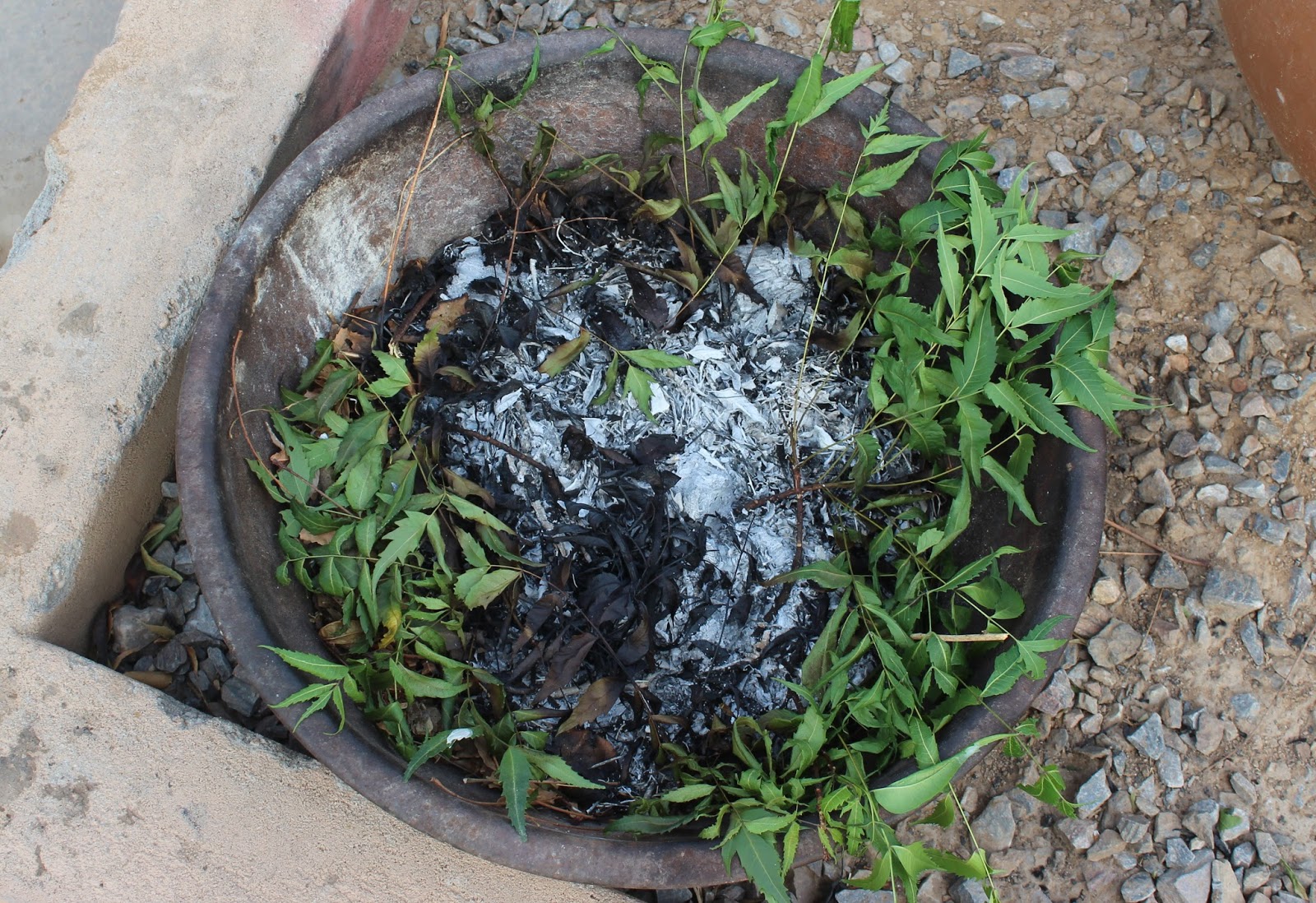
Neem leaves being smoked over charcoal fire to keep away mosquitoes and insects

Thursday, April 9, 2015

The works of Charles Forrest

"City of Benares" by Lieutenant-Colonel Charles Ramus Forrest (1750-1827). He was an amateur artist who also served in the British (East India) army from 1802-1827.
The painting above is one of 24 illustrations in a book called "Picuresque Tour along the Riverrs Ganges and Jumna in India". It was published in London.
Like many Englishmen and women,  Forrest was enamored of India and its romantic landscapes. He was based in Calcutta, and whenever his regiment was sent upcountry, he would make excursions from the camp on horseback, palanquin or boat, to capture images. He drew sketches of what he saw, and then later coloured them. The image below is of Barrackpore, which was the earliest cantonment town in India:
Forrest drew unfamiliar vegetation, animals, palaces, forts, temples and other landscapes. He drew not only grand monuments but also smaller places. Along with other artists like Daniells and Salt, Forrest was responsible for creating exotic images of India in the public imagination. 

Saturday, December 27, 2014

Temple at Satuwa Baba Ashram, Manikarnika Ghat

This is the temple at Satuwa Baba Ashram at Manikarnika Ghat. This ashram follows the Vaishnavite Rudra Sampradaya (a philosophy said to have been established by Shri Adi Vishnuswami in 3rd century BC).


Within traditional Vaishnavam there are four main Sampradayas (philosophies with guru-disciple lineages), each of which traces its roots back to a specific Vedic figure (Rudra Sampradaya, Brahma Sampradaya, Lakshmi Sampradaya, Kumara Sampradaya). Of these, Rudra Sampradaya of Vishnuswami is the oldest. The philosophy of Vishnuswami is called Shuddha Advaita, or Pure Advaita. Rudra or Shiva is said to be the foremost and ideal Vaishnavite, who teaches the Shudda Advaita philosophy to humankind.

The Satuwa Baba ashram was established in the 1800s by an ascetic from Bhavnagar in Gujarat who followed the Shudda Advaita philosophy. It is said that here Lord Shiva appeared to the Baba in the form of an old man and taught him the philosophy. The current mahant is Shri Santosh Das, who is the 7th Satuwa Baba. The previous mahant Shri Yamunacharyaji died in 2012 at the age of 99 years. Apart from being the head of the Satuwa Baba Ashram, he was also the head (Acharya) of the Vishnuswami Sampradaya itself, and a highly respected guru.

Many miracles are attributed to Satuwa Baba, such as bringing a dead man back to life, and miraculously finding gold coins in the river. As a result, the Satuwa Baba Ashram has become famous. Processions of dead bodies stop at this ashram and pay their respects before proceeding to the ghat. After the cremation ceremony the sanskar ghada (clay pot) is also broken here.

There are also ancient legends associated with Satuwa Baba Ashram. The ascetic Vishnuswami who founded the Rudra Sampradaya is believed to have visited this place in person (since the name Vishnuswami actually refers to 3 different people within the Rudra sampradaya, this legend probably refers to the second Vishnuswami who lived around 8th or 9th century, or to the third Vishnuswami who lived in the 14th century). Shankaracharya (8th century) is also believed to have visited this place, and it is said that he was tested here by Lord Shiva in the form of a Chandala.

Tuesday, November 18, 2014

Mansarovar Ghat, Varanasi

Like Manmandir Ghat, Mansarovar Ghat was built by Raja Man Singh of Amber (Jaipur) in 1585. The king also added a pool (kund) nearby called Mansarovar Kund. It was believed that the water in the pool gave equal merit as the sacred Lake Mansarovar (in Tibet): thus the nearby ghat was also given the name Mansarovar.
And right in the middle of it is this bright red guest house, owned by one Mr. Tandon.
The ghat was rebuilt multiple times, by the king's descendants and by the government of Uttar Pradesh. While the ghat became pucca, the pool (kund) became smaller due to lack of space and turned into a well called Mansarovar Kupa.

Another name of Mansarovar Ghat is Kshemeshvara Ghat. This is named after Kshema Gana, one of Lord Shiva's ganas, who is said to be the founder of the linga in a Shiva temple nearby.

In 1962, the upper part of the ghat was purchased by the Kumaraswamy Matt, established by the 17th century saint Kumaragurupapar in Kashi. He was born in Tamil Nadu and later travelled to Kashi to spread the teachings of Shaivism. The Matt has now constructed a building with shrines and rest houses for pilgrims.
Kumaraguruparar Swamigal

Sunday, October 12, 2014

Rickshawallahs in Varanasi

I could not resist posting this photo of two cycle-rickshawallahs in Chowk, Varanasi. See the difference between them; one is old and experienced, the other is young and seems to be just starting out with a newish rickshaw.
As per the records of licensing department of Varanasi Municipal Corporation (VMC), there are around 10000 registered rickshaws in the city. There are far more rickshaw pullers than there are rickshaws. Some rickshawallahs own their own rickshaws, but most rent them from others. Rental is around Rs 35 per day. Typical earnings in a day are around Rs 250, and after accounting for living expenses, the rickshaw puller may save around Rs 5000 a month. 

But there are many problems. Harassment by the traffic police is one of the biggest ones; and the rickshawallahs pay bribes routinely. Sometimes rickshaws are confiscated, resulting in loss of income. If the rickshawallah falls ill, he has no earning on that day. Often during festivals, weddings, deaths and other family occassions, they go back to the villages surrounding Varanasi; and they have no earnings at that time either. During harvest season also, they go home to provide labour for their family farm, and there is no earning from the rickshaw at that time. 

With this kind of low income, the rickshawallah has no money to spare for any event in the family - a medical emergency, the birth of a child, or a death. For meeting these needs, the rickshawallah has to take a loan. With no access to formal credit, loans are obtained at crazily high rates from local moneylenders. The interest piles up and often older rickshawallahs are struggling under a heavy debt burden.

All these thoughts ran through my head as I saw these two men, one old, one young. I wondered what life had been like for the older one. I wondered what was in store in the future for the young one.

Wednesday, September 3, 2014

Ekam Sat: One Reality, Many Forms

"Ekam sat vipra bahudha vadanti" says the Rig Veda. "That which exists is One: sages call it by various names." This photo, taken in Varanasi, reminded me of that.

Banaras is Shiva's city, he is everywhere you look. At the souvenir stalls, Shiva is represented in colourful popular art as Gangadhara, bearing the Ganges in his hair. But the stalls also sell pictures of a host of other deities - Kuber the God of Wealth, Hanuman, Rama, Krishna, Durga, Kali, Ganesh, Lakshmi ... there are pictures also of objects such as the Sri Yantra, and there are pictures of godmen and gurus - Sai Baba, Ravidas, and many others. 

Why are there so many deities, gurus, and other pictures? Because Hinduism allows its practitioners to choose whichever form of God that inspires and resonates with them the most. This is the concept of "Ishta Devata" or "Chosen Deity". Here the form itself is not as important as the ultimate goal. While all Hindus agree there is only one Eternal Brahman, or Cosmic Truth, they reach this Brahman through different routes. That route is the Ishta Devata. 

It is difficult to meditate upon an abstract concept. So teachers of meditation tell their pupils to select an Ishta Devata in order to do "Saguna Dhyana" - in this type of meditation the practitioner focuses on the visible aspects of the Ishta Devata. For example, Saguna Dhyana of Vishnu could include meditating one by one on his face, his golden ornaments, his yellow robes etc. You can see this form of meditation being practised by many Bhaktimarga followers. 

For Ramakrishna Paramahamsa, the Goddess Kali was his Ishta Devata. He saw her everywhere and meditated solely upon her. Such meditation - usually also done with a specific mantra chanting (involving the name or the characteristics of the Ishta Devata) - can have powerful effects on the mind. 

From this type of Saguna Dhyana, the practitioner can eventually move to "Nirguna Dhyana", meditation on the abstract. The Ishta Devata provides a sort of gateway, almost. Obviously, it is important to choose an Ishta Devata that resonates most with you. Many families use the concept of kula-devata or family deity as their Ishta Devata. Many people use the face of their spiritual guru as their ishta-devata. There are really no rules or restrictions. Sincerity is important.

The term Ishta Devata should also be understood as a way to define a chosen ideal or goal. For example, in the Yogasutra, Patanjali says: "svadhyayad ishta devata sanprayogah" meaning that self-study and reflection brings you into contact with the desired ideal.

Monday, September 1, 2014

Merchant mansion in Varanasi


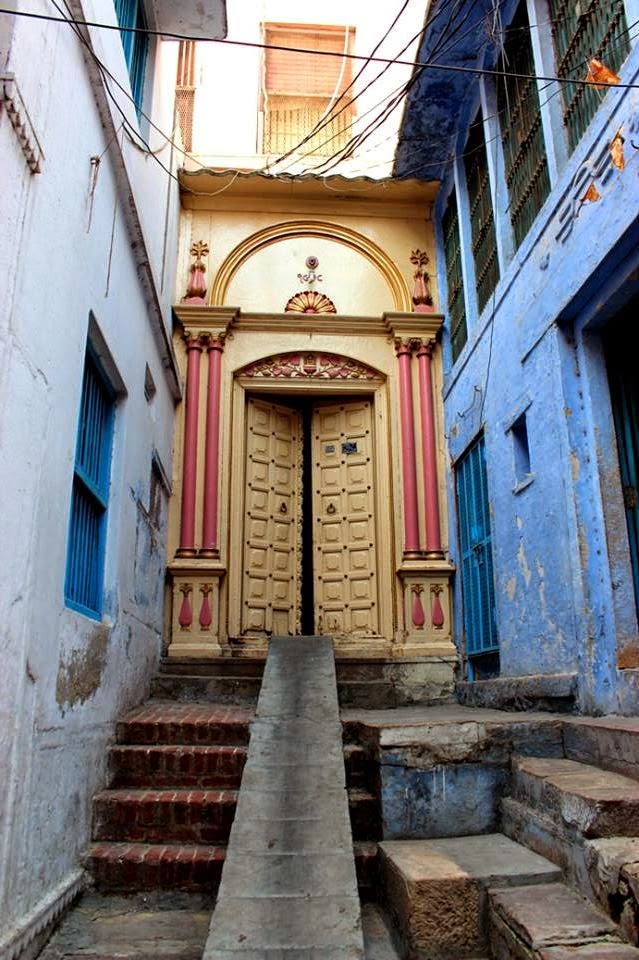
While walking from Manikarnika Ghat towards Vishwanath Temple, I saw this lovely house. It has made such beautiful use of maroon, cream-yellow, gold and pink. I went closer and spotted the stylized numeral lettering on the house, which says "1978" in Gujarati script. The house must belong to a Jain or Hindu Gujarati merchant.


Here is a closeup of the previous picture. Notice the half-lotus design on the top centre, which has been highlighted in gold and maroon. The semi-circle arch stucco work has a very Art-Deco feel to it. On the left and right, there is a depiction of a mashaal (torch). On the mashaal too there are lotus designs. There is a small Ganesh idol on top of the doorway, surrounded by carved grape vines: this reflects either Gandhara influence or British influence. European influence can definitely be seen in the capitals: they seem sort of Ionic or Corinthian or something!

Tuesday, August 5, 2014

Sherwali Kothi (Lion Mansion) in Varanasi

Sherwali Kothi (Sher = Lion, Kothi = Mansion) is a mansion in Thatteri Bazaar. This area is to the north of Chauk. The mansions in this area belong to business families and are used both for residential and business purposes. There is some elaborate wood carving, although the mess of electrical wiring hides some
In Sherwali Kothi, two roaring winged lions guard the gate to the haveli. Here is a close-up of one of the lions.
 There is a saree shop on the first floor here called Rastogi. Many of the families who lived in this area have moved to the newer parts of the city, and they use this old part for business, but also they have showrooms in modern areas. An armed sentinel stands guard outside the haveli. This sort of representation is done typically by wealthy merchants, to show that this is a rich household.

Saturday, July 26, 2014

Kedara Ghat, Varanasi

Kedara Ghat is one of the most important ghats of Kashi. 

Kedara is mentioned in the older Puranas and is therefore considered to be older than the more popular Vishweshara. The Gauri Kund (small water pool) at Kedara is called 'Adi Manikarnika', thus signifying that it is the original and greatest of Varanasi's tirthas.


The Kedareswara Temple here is a 'jyotirlinga'; that is, one of the 12 places where Shiva is manifested in the form of light. Also the Kedareshwara temple at Kedar Ghat was not destroyed during Aurangazeb's rule, so the temple here remains one of the oldest major ones in the city. 

Just as Kashi is the essence or microcosm of the entire sacred universe, it is believed that the Kedara Kshetra (area) is the essence or microcosm of Kashi. 

Typically the people who worship here are South Indians, and also Bengalis. 

The Sringeri Shankara Math is situated here. For people from the south one of the most important aspects of Kedara is that Adi Shankaracharya lived here and composed important works here, including the Manisha Panchakam and the Kashi Panchakam. In 1346, the 13th Shankaracharya of Dakshinamnaya Sri Sharada Peetham established the Sringeri Math in Kedara, near the Kedareswara Temple.

Adi Shankaracharya
Picture credit: www.sringeri.net

Navaratri-utsav at Sri Sringeri Shankar Math
Photo Credit: www.sringeri.net
Kedareshwara Temple is right by the river, and is easily recognised by its colourful Dravidian temple architecture as well as the vertical striped walls.
The word Kedara means meadow or field. According to the Kashi Kedara Mahatmya, Lord Shiva is supposed to have said: “It is known as the ‘field’ (Kedara) where the crop of liberation grows. Therefore, that place became famous as Kedara, both in Kashi and in the mountains”.

Sunday, July 13, 2014

Manmandir Ghat, Varanasi

Continuing the Ghat series: this is the Manmandir Ghat, right next to the popular Dasashwamedh Ghat.
Earlier this ghat was called Someshwar Ghat. In 1586, Raja Man Singh of Amber developed this ghat and built a grand palace here. So the ghat was named after him.

In the 1700's Sawai Jai Singh of Jaipur built an astronomical Observatory on the roof of the palace; the observatory is now in ruins; although it was repaired by 1911-12 by Sawai Madho Singh of Jaipur, and then further by Department of Tourism in 2000.

The palace building is still visible and is a good example of Rajput and Durg architecture, with ornate carved windows.

The upper part of the ghat has shrines to Someshwara, Dalabeshwara, Rameshwara and Stuladanta Vinayaka.

Tuesday, June 10, 2014

Chausatti Ghat and Digpatiya Ghat, Varanasi


The Chausatti Ghat at Varanasi is named after the Chausat Yoginis, the 64 sacred feminine beings who are representations of Shakti, the primordial cosmic energy. The word chausatt means 64 in Hindi. According to popular legend, the Chausatt Yoginis were sent by Shiva to reside in Varanasi. 

 The fourth canto of the Skanda Purana, called Kashi Khanda (which is dated to the 14th Century), mentions the 64 yoginis in Chaussati Ghat. Thus we know that at least since the 14th century, the worship of these goddesses has been practiced in Varanasi. Yogini worship was very popular in India in the 10th and 11th centuries; so it is possible that these goddesses existed in Varanasi even earlier.

In the 16th century, the great Sanskrit philosopher Madhusudana Sarasvati (1540 – 1640) lived at Chausatti Ghat. He is famous for his treatises on advaita philosophy. Madhusudana initiated many sanyasins into the Dashanami orders, in order to form large groups of martially trained ascetics.

King Pratapaditya of Jessore, Bangladesh (1561 - 1611) changed the ghat into a 'pucca' structure in the 16th century. In 1670, the Mewar king Rana Jagat Singh I built the Rana Mahal near the Chausatti Ghat, and the goddess idols were kept there. In 1690, the Udaipur rulers further improved the Chaussati Ghat.

The lower portion of Chausatthi Ghat was re-built in 1830 by the Raja of Digpatia; so that part is now called Digpatia Ghat. You can still see the beautiful architecture of the palace built by the Digpatiya king.

The stone steps lead up to a temple. In the temple compound there are old images of Kali, folk goddesses, Shiva, Ganesha and Kartikeya. Among the 64 Yogini images, only 16 are presently existing in Varanasi. Out of these, only two are in the vicinity of the Chausatti Ghat, i.e. Gajanana, “the elephant-headed” (House: D 21/ 22) and Mayuri, “the peacock-headed”, on the steps of the ghat.

Currently the Sitaramdas Omkarnath Kashi Ashram is located on this ghat. This sect has its headquarters in Calcutta. They welcome people of all faiths and castes. The founder, Sitaramdas Omkarnath, believed that religion is fundamentally the relationship between one's soul and God. Through chanting the Name of God, the mind can be oriented towards god. Thus, the ashram’s activities are designed towards promoting the chant of Hare Ram, Hare Ram, Rama Rama Hare Hare; Hare Krishna, Hare Krishna, Krishna Krishna Hare Hare. You can hear the chant in Sitaramdas Omkarnath’s own voice here: https://www.facebook.com/pages/1008-Sri-Sri-Thakur-Sita-Ram-Das-Omkarnath/284717055452
 
Chausatti Ghat is also the location of "Satyalok", the home of Lahiri Mayasaya, who is mentioned in the famous book Autobiography of a Yogi by Paramahansa Yogananda. You can read more about Lahiri Mahayasa here: http://www.kriyayogalahiri.com/ His grandson continues to live in Satyalok and teach Kriya Yoga
 

Monday, May 5, 2014

Ahilyabai Ghat in Varanasi

Continuing the series on the ghats of Varanasi: this is Ahilyabai Ghat, named after one of India's most popular Maratha queens. 

There was an earlier ghat here known as Kevalagiri Ghat. In 1778-1785 it was extended and rebuilt by Queen Ahilyabai Holkar and after that, the name changed. The Holkars were a Maratha clan which ruled the Malwa kingdom (present day Madhya Pradesh) with their capital at Indore and Maheshwar. Queen Ahilyabai was renowned not only for leading her men in battle, but also for her patronage of culture, arts and religion. In her 30-year reign, she built literally thousands of wells, temples, dharamshalas and did many other charitable works, for which she received enormous respect from people all over India.

 At this ghat there is a palace and residential compound. The palace compound opens towards the city side, there is a gateway there with a noubat-khana (welcoming drum). There is also a group of religious buildings including temples and servants’ quarters, some of which are used as an akhada. There are two temples on the ghat in Nagara style, and in addition there is a Hanuman temple and Shiva temple also. The quarters of the Brahmin priests attached to the Indore estate are also on this ghat; it is a set of 10 houses and is called Brahmapuri (it is on a street parallel to the river).

The building in yellow is where Pandit Kaviraj Ashutosh Bhattacharya lived. He came from a lineage of ayurvedic doctors, but was blessed with musical ability. He was famous as both an extraordinary tabla player and teacher and reputed Ayurvedic doctor.

Wednesday, December 25, 2013

Manikarnika Ghat, Varanasi

Manikarnika Ghat, where cremations take place. This is the "Maha-Smashaaana", the Great Cremation Ground.
 Here is an older photo from 1922; there is encroachment in the area since then with modern-style buildings.

Thursday, December 5, 2013

Munshi Ghat and Darbhanga Ghat, Varanasi

Munshi Ghat is named after Sridhara Narayana Munshi, a finance minister in the estate of Nagpur, who built this ghat and part of the palatial building.

In 1915 the Brahmin king of Darbhanga (Bihar) purchased this ghat and developed/extended it further, giving it the name Darbhanga Ghat.

The Darbhanga Palace is one of the more impressive buildings on the waterfront, but mired in controversy over its redevelopment by the Clarks Hotel group.