Showing posts with label Amritsar. Show all posts

Thursday, June 7, 2018

The songs of Phulkari

Phulkari meri reshmi
Rang na aiya theek
Chheti darshan devne
Main rasta rahi udeek

My phulkari is silken
But the colour doesn't seem right
Come quickly now, my love (let me see you)
My eyes search the road.

Phulkari is an embroidery technique from the Punjab region, and is practised both in India and Pakistan, by Hindus, Sikhs and Muslims. The word 'phul' means flower and 'kari' means craft, thus Phulkari literally means floral work or floral craft. Exquisite and labor-intensive, Phulkari embroideries have been produced by Punjabi and Haryanvi women from at least the early 19th century. Phulkaris are traditionally done in brightly colored silk thread on rough, earth-toned cotton fabric. The cotton was local, but the silk came from far off places via nomads, and was dyed in the Punjab. Phulkaris are deeply ingrained into Punjabi culture and several folks songs sung by women have Phulkari as the motif.

When done for domestic use, Phulkaris function primarily as women’s wraps (odhnis). Originally, they signified a woman’s material wealth and were deemed an important part of her wardrobe. In addition to being worn, phulkaris are also placed on woven cots (charpais) as seat covers for special guests, or draped on dowry chests or hung in the home as decoration during religious festivals. They are presented to temple deities, or to gurudwaras as a cover for the Guru Granth Sahib (the Sikh holy book).

During colonial rule, Phulkaris became part of gift basket locally described as “dali” that were presented to the British and other high officials on Christmas and also as a gesture of gratification.

Following Punjab’s devastating partition in 1947, many treasured Phulkaris were lost or left behind in the traumatic events of the Partition. The Partition Museum in Amritsar has a Phulkari placed on a well, representing the tragedy of the many women who threw themselves into village wells in attempted suicides. To me it seems as if the death of all that was beautiful in the Punjab has been portrayed very poignantly via the Phulkari.

Today in Amritsar, there are plenty of machine-made Phulkaris, but they lack the beauty of the women's voices that made them unique.

Kawal phool main kadhke
Kardi han ardas
Chheti aa mere sajna
Bhul-chuk maaf

Having embroidered a lotus
I petition you
My love come to me quickly
All is forgiven/Forgive me

In May 2017, the Philadelphia Museum of Art showcased ‘Phulkari: The Embroidered Textiles of Punjab’, with phulkaris from the collection of Jill and Sheldon Bonovitz. The collection contained all types of Phulkaris:

- Baghs (all-over embroidered phulkaris, almost like a floral garden),
- Darshan Dwars (architectural motifs, meant to be presented at gurdwaras)
- Sainchis (narrative embroideries which depicted scenes of routine village life and included human motifs)
- Thirmas (embroidered on plain white khaddars for elderly women and widows)
- Chopes (presented to a girl by her maternal grandmother on her wedding day)

The Museum also showcased two gowns made especially for the exhibition by Indian designer Manish Malhotra, in an effort to highlight the couture culture and the new stories developing around phulkari. With the ace designers employing materials such as velvet and silk, a new set of audiences is being inspired to embrace the warmth of the textile tradition.

Photos Courtesy: Philadelphia Museum of Art, sourced from Architectural Digest

The information and text for this post came from this page, which has more about the show, and different types of Phulkaris is here: https://www.architecturaldigest.in/content/philadelphia-museum-art-showcases-history-punjabs-rich-embroidery-craft-phulkari/

Monday, May 28, 2018

Bazaar Thaterian - The Market of the MetalWorkers


No automatic alt text available.
About 10 kilometers south-east from Amritsar, along what used to be the historic Grand Trunk Road, there is a nondescript town called Jandiala Guru. No one knew much about it until 2014, when it suddenly received international recognition by UNESCO for its metalwork craft. The metalworkers are called Thateras.

If you walk into Jandiala Guru, you can find the Thateras in a lane called 'Gali Kashmirian' (Lane of the Kashmiris). I was a little puzzled by this name. Why were there Kashmiri Thateras in a little nondescript Punjabi town?

It turns out that in the late 18th century, Maharaja Ranjit Singh invited skilled metal workers from Kashmir, primarily Muslims, to settle in his kingdom. They established themselves in Gali Kashmirian, and began making brass and copper utensils.

Bazaar Thaterian (the Metalworkers Market) became a thriving market for all sorts of utensils, including those for household use as well as for community cooking (have you seen the huge cauldrons at gurudwaras?).

During the partition of India, the Muslim Thateras of Jandiala Guru migrated to Kujranwala in Pakistan (another metalwork town). Hindu and Sikh Thateras from Kujranwala arrived in Jandiala Guru and began practising their craft. Thus, the metalworkers in Jandiala Guru today are either Hindus or Sikhs. But the name of the lane has endured. Gali Kashmirian. The Lane of the Kashmiris.

The Thathera community has a long oral tradition of craft. Knowledge is passed through apprenticeship, usually within the family. Designs are made by skilfully hammering a series of tiny dents into the heated metal. Even the tools they use are handmade.

In spite of being inscribed in 2014 on the UNESCO representative list of the Intangible Cultural Heritage List of Humanity, the Thateras are struggling to make a living. The popularity of steel, aluminum and plastic has killed the market for brass and copper utensils.

There's a very nice video here, of the Thateras. It appears from the interviews that that Bazaar Thaterian is dying: https://www.youtube.com/watch?v=_SXc7L9d0ds

Thursday, June 9, 2016

Panj Sarovar Yatra - Journey to The Five Sacred Tanks of Amritsar

- by Deepa Krishnan

At the heart of Amritsar is the most sacred tank of the Sikh faith; the Amrit Sarovar. This is the tank from which the city of Amritsar gets its name. In the centre of the sacred water tank is the golden temple.

The tank was excavated in the late 16th century / early 17th century, on land that was already considered to be sacred. The work was done by devotees.

Before the large tank was excavated, the site was a low-lying area with a small pond, surrounded by a large number of shady trees. Guru Ram Das, the fourth guru of Sikhs, had been searching for a place to establish a new Sikh centre. Although Guru Ram Das began the construction of the tank and temple on this land, it was completed by his son, Guru Arjan.

There are many legends about the land on which the Amrit Sarovar has been excavated.

One legend is about the Amrit Kund (Spring of Nectar). Mentioned in the Puranas and the Hindu epic Ramayana, the Amrit Kund is believed to have been an ancient place of worship that lost its importance due to the rise of Buddhism.

Another story is of Guru Amar Das (the third guru), who found near the pond a herb to cure the skin ailment of Guru Angad (the second Guru). Yet another local story is of Rajni, whose husband was cured of leprosy after taking a dip in the pond.

Whenever you visit the golden temple, you will see pilgrims take a sacred dip in the Amrit Sarovar. It is believed to be the holiest of experiences.


But Amrit Sarovar is not the only sacred tank in Amritsar. You can do a pilgrimage walk, the "Panj Sarovar Yatra", covering 5 important tanks, including Amrit Sarovar.

The other four tanks are:
  • Gurudwara Shri Santoksar Sahib - the oldest sacred tank in Amritsar, and said to be the first sarovar in Sikh history
  • Gurudwara Shri Ramsar Sahib - the smallest of the five sarovars, marking the spot where the Guru Granth Sahib took form
  • Gurudwara Shri Bibeksar Sahib - the sarovar built by the sixth guru, who introduced martial arts and weapons
  • Gurudwara Mata Kaulsar Sahib - named after a holy lady who was the follower of the sixth guru  
The tanks are nearby and you can explore the area on foot and rickshaw. On the way, you will also see several historic spots of Amritsar, such as the Jallianwalla Bagh and the Baba Atal Sahib.

Please write to deepa@magictoursofindia.com if you want more information about the Panj Sarovar pilgrimage.We would be happy to explain the sites and the sequence.

Saturday, August 29, 2015

Granth Sahib - The Scripture for a Universal Religion

- by Aishwarya Javaglekar

The sacred book of Sikhism, known as the Guru Granth Sahib, is venerated by all Sikhs as the highest embodiment of Sikh philosophy and way of life.

At the Golden Temple in Amritsar, every evening, the Granth Sahib is carried in a procession. It is taken from its usual golden shrine (the Harmandir Sahib) to a room upstairs (Akal Takht), to rest for the night. The book is brought back early next morning.
Palkhi Sahib (procession)
The Guru Granth Sahib is a magnificent collection of religious and mystical poetry by thirty-six composers written in twenty-two languages. It incorporates the compositions of Hindu devotees, Muslim, divines and Sufi poets along with the ten Sikh gurus.
The Guru Granth Sahib - the scripture for a universal religion! (Photo credits: www.sikhanswers.com)
The sacred verses in the Granth Sahib are called Gurbani, meaning Guru’s word. Here, guru doesn't mean a particular person. It means the wisdom of the world. Thus, the Granth Sahib isn't meant to be the word of a person. It is the wisdom of the world compiled into a single book. It includes the preachings of all religions, and is regarded as a complete, sacrosanct message from God.
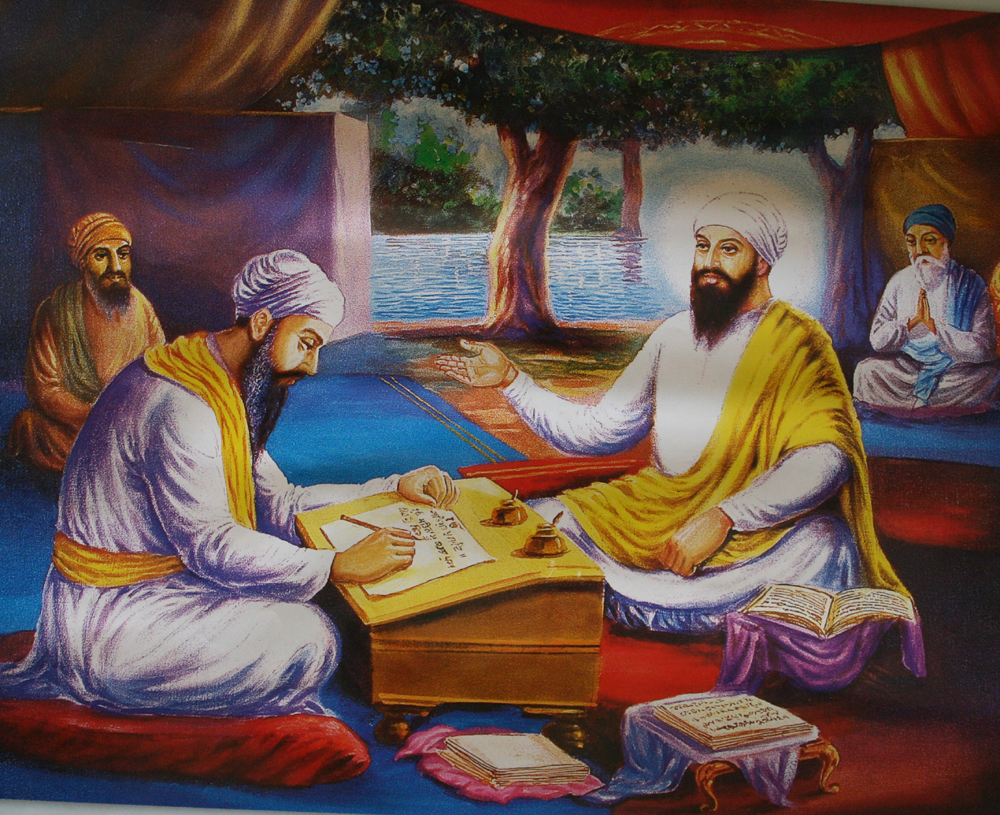
Painting of Guru Arjun Dev, the fifth Sikh Guru, dictating the text of Granth Sahib. He first compiled the book in 1604. It was completed by Guru Gobind Singh in 1705. (Photo credits: www.vismaadnaad.org)
In his final address to the Sikhs in 1708, Guru Gobind Singh, the tenth Sikh guru, said:
“Those who desire to behold the Guru should obey the Granth Sahib. Its contents are the visible body of the Guru."

Wednesday, May 13, 2015

The Red and White Bridal Bangles of Punjab

- By Mansi Shanbag

It’s not uncommon to come across many stores selling red and white bangles in Amritsar, so much so that the wave of red and white is overwhelming.

The warren of lanes in the Chudi Bazaar, specializing entirely in the sale of bangles, is a hit with locals as well as guests.
Bangles can be traced back to 2600 BC, when a figurine of a dancing girl with bangles on her arm was excavated from the Mohenjo-daro ruins. Apart from this, numerous excavations of Indus Valley sites in Sind, Punjab and Gujarat have yielded bangles of shellac, clay and metal.
In Hindu and Sikh weddings in Punjab, the bride is gifted red-and-white bangles to wear on her wedding day. There is a ceremony, the chuda ceremony, which is on the day before the wedding, or on the actual wedding day itself. Traditionally, 21 bangles are gifted, although these days brides sometimes wear fewer bangles. 

Originally ivory-made, white bangles are now made in plastic. There are few things more picturesque than an Indian bride dressed up to her eyes in the traditional shades of red and white. And the red and white choora (bangles) do much to compliment the bride.
The bride wears the bangles as a sign of being newly married. The bangles are made of delicate materials, so that the bride is exempt from any heavy household chores. After the wedding, the bangles are traditionally worn for a year. In modern times, this too has reduced to 40 days.  Nevertheless, the tradition of bangle-wearing lives on and is quite delightful to behold.