Showing posts with label Faiths of India. Show all posts

Thursday, December 26, 2019

Garuda Purana and the democratization of knowledge production

The Garuda Purana, composed in Sanskrit, contains 16000 verses, dealing with an incredibly diverse collection of topics.

It covers cosmology, mythology, salvation theory, ethics, Hindu philosophical schools, theory of Yoga, ancestral rites, rivers and geography, types of minerals and stones, testing methods for gems for their quality, listing of plants and herbs, disease symptoms and medicines, astronomy, astrology, architecture, grammar, literature classification etc.

It also includes statecraft and more practical matters such as charity and gift making, economy, thrift, duties of a king, politics, state officials and their roles, and how to appoint officials. Lastly, it also covers personal development and self awareness through Sankhya and Advaita Yoga.

The text is attributed to the legendary sage Vyasa, in the absence of clear authorship. It is believed to have been first composed at least a thousand years ago, with the core being even older. The versions that survive today contain different lengths and different sets of scriptures, pointing to diverse authorship over time as it gained popularity.

Garuda Vahana, at Chennai airport, a beautiful wooden sculpture 
used for temple processions. It is likely from Tanjore.
One of India's unique features is the way in which many of our scriptures co-opt and include multiple authors. Imagine a book, with many chapters by different writers, all of whom help to grow the book continuously over centuries. As it spreads, more chapters appear, more commentaries and discussions take place, and diverse versions grow and become popular in different parts of the land. The closest parallel is a river, with a single origin but which branches into thousands of tributaries, ending in many lakes and ponds, and watering many fertile lands as it goes along. One could also draw a parallel to the way the internet functions, democratizing the production and dissemination of knowledge. In the case of scriptures, the dissemination takes place in thousands of sabhas and temples, where readings and recitations bring different versions to the people. Confusing? Yes. That is the nature of a cooperative effort at knowledge production. But it is also very appealing, that there is no "one book", no single authority.

#hinduliterature
#magictoursofindia
#chennaimagic

Monday, November 18, 2019

Karaikkal Ammaiyar - The Mother from Karaikkal

Karaikkal Ammaiyar (The Mother from Karaikkal) lived in Tamil Nadu in 6th century. She was a poet-saint, one of the 63 Shaivite Nayanmars. This sculpture is a copper alloy, about 9 inches high, dated during the Chola period (880–1279). . It is now at the Metropolitan Museum.


Karaikkal Ammaiyar belonged to the Chettiar (Nagarathar) community. She was a devotee of Lord Shiva, and said to be very beautiful. On seeing her perform miracles, her husband recognized her divine nature, and worshipped her as a goddess. She left her home, and went to Mount Kailash, on pilgrimage to Lord Shiva's abode. She prayed to Shiva to transform her into a ghoul (gana), one of Shiva's many attendants. Shiva granted her wish, changing her into a wizened old woman.

Thus she became free of the burden of social norms, and spent her life as a free spirit, composing and singing hymns in praise of Shiva. In this sculpture, you can see her holding a pair of cymbals as she sings her own compositions. The sculptor has stayed within the stylistic tradition of Chola art, with fine nose, curved lips, large eyes, square shoulders and slim waist. Thus he maintains her divinity. He has chosen to represent her ghoul transformation by focusing purely on exaggeratedly deformed breasts. He has chosen to represent her mendicant status by giving her only a single garment. And, to show her great age, her ear lobes are sagging with the weight of her ear-ring (a feature of older women).


Beginning in the 6th century in Tamil Nadu, India witnessed a widespread Bhakti movement, where several women rejected the life of a householder, and embraced a life of devotion/renunciation, Examples include Andal from Tamil Vaishnavism of the ninth century, Mahadevi Akka of Karnataka (13th century), Muktabai of Maharashtra (13th century), Mirabai of Rajasthan (16th century), and many more.

Tuesday, February 5, 2019

"Daan Paatra" at Pushkar

Spotted at Pushkar: a collection box (Daan Patra) for Gau Seva (the welfare of cows). A young bull stands next to it, looking quite annoyed with life :)
Holy Cow Container, India -
Rod Waddington from Kergunyah, Australia [CC BY-SA 2.0
(https://creativecommons.org/licenses/by-sa/2.0)], via Wikimedia Commons
The cow is depicted with a peacock feather decoration for her horns, indicating the linkage of cows with the cowherd God Krishna of the Braj region. The Braj region (Brajbhoomi) is the land associated with Krishna's birth and major events in his life. While there is no official geographical demarcation, it lies more or less within the golden triangle circuit that is popular with tourists. Pushkar is nearby.

The cow is depicted with auspicious symbols (the Om and the Swastika) on her body. She is adorned with jewellery, denoting her special status. Similar decorations can be seen in many Rajasthani miniatures, particularly the Pichhawai paintings depicting Krishna as a cowherd. 

Saturday, December 29, 2018

The Portuguese Church Bells of Maharashtra

This week I read a story in Hindustan Times about Portuguese church bells, which are being used all over temples in Maharashtra.
Temple bell at Naroshankar, Nashik. Photo Credit: Hindustan Times
The bells were acquired by the Marathas from various churches, during their conflicts with the Portuguese. The 17th and 18th century were full of many conflicts, with the Marathas, Siddis, the French, the English and the Portuguese, all jostling for supremacy on the Western coast of India.

Fr. Francis Correa, a priest based in Vasai (Bassein) says discovering the bells has broadened his view of India. He says: “Seeing the bells for the first time, I initially felt like it was my community’s property and that I should work on restoring them to the church. But over time I’ve realised that in Hindu temples, they’ve been given a new life, with new missions to perform. They are our shared heritage.”

When I read this quote I couldn't help thinking that if more of us had such enlightened views we would be living in a much happier world!

For many years now, we have been sitting on this Ayodhya mandir-masjid controversy. Was it originally a temple or a mosque? Now that the mosque is broken, what should we build there? Whose monument is it now? ... All these questions could be more easily resolved if we thought of it as our country's shared heritage!

Whether we like it or not, we cannot wish away history; nor can we turn back the clock. If more politicians had the guts to celebrate the Ganga-Jamuna tehzeeb (cultural diversity) of this land, India would be a different place. Come to think of it, every time we eat a biryani, it is a Ganga-Jamuna celebration. Every time we wear a salwar-kameez, it is the same celebration. The notion of India as belonging only to only one community is really impractical, not to mention immoral.

Magar yeh ghanti kisi ke dimaag mein bajti hi nahi!
(but this bell does not ring clear to anyone!)

Wednesday, July 11, 2018

Jatar Ghat and Raja Gwalior Ghat in Varanasi


Continuing the series on the ghats of Varanasi; Jatar Ghat was built in the mid 1800's by the finance secretary of the Gwalior Estate, Balaji Cimadaji Jatar. There is a Laxminarayan temple here, which is in disrepair. The Gwalior Ghat was built by Jayajirao Shinde, the raja of Gwalior. The 1800's was a period when the Maratha empire was prosperous.


This area of Varanasi even today has many Maharashtrians.

The English scholar and architect James Prinsep, who arrived in Benaras in the 1820s, refers to this ghat as Chor Ghat (Thieves Ghat). Apparently in those days it was known for the disappearance of pilgrims's clothes and belongings :)

Friday, January 12, 2018

Vintage poster, Sarnath

I was looking for vintage posters on travel to India, when I came across this one:

It's from the 1930's, for travel to Varanasi (to the holy Buddhist site of Sarnath). Commissioned by the Railways, it is part of a series designed by the artist Dorothy Newsome. She signs her name as D. Newsome, so of course, true to stereotype, I assumed it was a male artist. You think you're a feminist, and then this sort of thing comes along and trips you. I live and learn. Printed at the Calcutta Chromotype Ltd at Bowbazaar in Calcutta.

The word the poster uses for Sarnath is "Isipatana", the ancient name for the Deer Park where the Buddha preached his first sermon and set in motion the Wheel of Dharma (Dhamma Chakka).

Isipatana is an open space near Varanasi; it is the site of the famous Migadāya or Deer Park. After his Enlightenment, the Buddha joined his friends, the Pañcavaggiya monks, who were in Isipatana. To them he preached his first sermon, the Dhammacakkappavattana Sutta, on a full-moon day.

The name "Isipatana" is derived from the belief that sages and divine beings, as they fly to/from the Himalayas, alight here. In the Pali canon, the phrase "isayo ettha nipatanti uppatanti cāti-Isipatanam", means, "the place where the divine beings fly down to and alight/stay, that is known as Isipatana".

Isipatana is not just where the first sermon was preached. It is also the place where the Buddha spent many rainy seasons. Thus, many sermons originated here.

Isipatana was a very large and thriving Buddhist centre. We know from written records that there was a large community of monks at Isipatana in the second century B.C, when at the foundation ceremony of the Stupa in Anurādhapura, Sri Lanka, twelve thousand monks went from Isipatana,  led by the Elder Dhammasena. The Chinese traveller Huen Tsang, in the 7th century AD, recorded that 1500 monks were studying the Hinayana form of Buddhism in Isipatana.

Tuesday, September 19, 2017

On visiting the Mahakaal Temple at Ujjain

I'm going through an interesting experience, I am writing a sales brochure for a tour called "Pilgrimage tour to Ujjain". I have never written brochures for any purely pilgrimage tours so far. So this is a new thing for me.

Ram Ghat after sunset, on the Kshipra River, Ujjain
As some of you probably know, Ujjain is an ancient city which used to be the capital of Avanti, one of the Mahajanapadas, the great 16 Republics of India (6 BCE). The poet Kalidasa talked about the beauty of Ujjain (in his famous poem Meghadoota, The Cloud Messenger).

But now I need to write about Ujjain from a purely religious angle, and I find myself a little stumped.

You see, I cannot bring myself to write religious "facts". In India all major temples have a 'sthala-mahima' or story associated with that place. For example, so and so maharishi did penance here, such and such God automatically manifested here, so and so Goddess sat right upon this very spot... These stories are not historical, they are legends, and I can't help thinking that no doubt some clever temple priest made them up at some point. And I simply don't have the necessary religious belief to make a sales-pitch extolling some imaginary sthala-mahima!

How do I write a convincing spiel for something that I don't quite believe in? Naturally, I'm going to have to write this in the third person, for example, I've got to say something like, "Legend has it that..." or "It is believed that ...". A cop out, really :-)

And yet, when I went to the main temple in Ujjain, the Mahakaal temple, dedicated to the Shiva the Destroyer of Time, and heard the chanting, it affected me immediately. I was crying and had goosebumps. They were decorating the lingam with a thick paste of bhaang leaves. Never seen anything like that, so fascinating. People were shouting Mahadev! Mahadev! and Om Namah Shivay! And I heard many powerful descriptions of Shiva's name, Neelkanth, He of the Blue Throat and Gangadhara, He Who Holds the Ganges. One man would shout it out, and others would pick up the chant...I sat there with goosebumps and tears, perhaps it was the faith of the people that moved me, and perhaps it was the energy around me.

One thing I know for sure - whether I'm religious or not - this country has got me in its grip. I am connected viscerally to the people, the temples, the stories, the words, the sound of Sanskrit. The very soil of Bharatavarsha talks to me.

Now - off to write that brochure.

Wednesday, October 19, 2016

Parama Padam: The 'Snakes and Ladders' of India

Snakes and Ladders originated in India as part of a family of dice board games. It was called Mokshapat or Moksha Patamu. Like many other things in India, this one also has religious background, and represents the ascent to Vaikunta or Paramapadam, the Supreme Abode of Lord Vishnu. It is most popularly played by people trying to stay awake on the holy night of Vaikunta Ekadasi. You can buy it in shops near Vishnu temples.

This one is from Giri Stores in Mylapore.


The game made its way to England and was sold as "Snakes and Ladders", then the basic concept was introduced in the United States as "Chutes and Ladders".

Tuesday, August 30, 2016

The Shankha-kshetra of Puri

- By Aishwarya Javalgekar

The famous Puri Rath Yatra (Chariot Festival) was held this July in Orissa. As I was reading up on the festival, I came across a very interesting image.
A conch shaped map of Puri's places of worship
But first let me give you a short introduction. Jagannath is an important deity of Orissa. The Jagannath temple in Puri is also the abode of his siblings, Baladeva and Subhadra. These three deities are carried in three enourmous chariots during the Rath Yatra.

According to the article I read, the region of Puri is shaped like a conch, and is called Shankha-kshetra. Similarly Bhubaneshwar is called Chakra-kshetra and Konark is named Padma-kshetra, all representing attributes of the Hindu god Vishnu.

As you can see in the picture, the temple of Jagannath stands at the heart of the conch, which acts like a map of Puri itself. Around the temple are numerous temples, shrines, trees and other religious sites.  There are approximately 115 such sacred spots scattered around the Jagannath temple, connected to the temple through a network of roads like a spiderweb.

I am not sure if the places drawn on the image are to scale. It is nevertheless a beautiful
visual of the Shankha-kshetra.

If you want to know more about the Rath Yatra, you can read our article here.

Sunday, August 14, 2016

The Lucknow School of Miniature Painting

This beautiful piece called 'Ascetics resting in a camp beside a Shrine' is a Mughal miniature painting from the Lucknow School. Created in the 1820s, it currently resides in the Mittal Museum of Hyderabad alongwith minature paintings from different schools across the country.

The Mughal style of miniature painting emerged in India during the 16th century. A blend of Persian, Hindu, Jain and Buddhist influences, the style developed in Mughal courts. It later spread to all courts, leading to the formation of different schools of Indian miniature painting.

The Lucknow School painted in the Mughal tradition, with some Rajput influences. This style of painting was popular till the 1800s, but declined slowly after the demise of the Awadhi Nawab Asaf-ud Daula. Later the school developed with European influences during the reign of Nawab Shuja-ud-Daula. By the end of the 18th century, the Lucknow school had become a Indo-European style of miniature painting.

'Ascetics resting in a camp beside a Shrine' c. 1825-30
Even today in many parts of the country, you can see groups of bairagis (ascetics) gathered together. Look at all the skin colours and the costumes that the artist has represented in this painting; showcasing the diversity of the bairagis. 

Monday, August 8, 2016

Padayani: The spirit of central Travancore

- By Aishwarya Javalgekar and Deepa Krishnan

Kerala is famous for its rich cultural heritage, and has many popular art forms to its name. But an art form that is perhaps not yet widely known is Padayani; the worship of Mother Goddess, practiced in the Bhagavathy temples of the central Travancore region.
http://pathanamthittatourism.com/destinations/heritage/padayani.php
Padayani is not just an art form. It is a community gathering to ensure the physical and mental well-being of the entire village. It is a set of rituals that transcends the boundaries of caste and religion, generating a sense of unity.

The legend says that Padayani originated as a form of prayer to pacify the goddess Kali, after she killed the demon Darika. This art form has several important cultural aspects:
  • Kolamezhuthu - These are beautiful and elaborate coloured drawings of folk deities. Kolams individually embody a certain character associated with spirits and deities. They are made from natural materials which comprise spathes (paalas) of the areca nut palm tree. Natural colours are painted on these paalas using a brush made from the stem of a coconut leaf. 
  • Kolappattu - Folk songs with traditional lyrics that include the exaltation of the deities, as well as requests to obtain their grace
  • Thappumelam - Musical performance specially featuring a Thappu, a drum made by covering a jackfruit hardwood piece with buffalohide
  • Kolamthullal - A dance form that accompanies the festival
  • Vinodam - Satire, an essential part of Padayani! This is performed making fun of petty vanities of people, as well as to target areas for social reform.

In this outstanding video below, you can see entire cultural process explained with English sub-titles. The first 3 minutes are an excellent introduction in Malayalam, without sub-titles, but the rest of the video has wonderful sub-titles.

Some practical information:
Padayani performances at temples are easily accessible from Cochin, Kumarakom or Alleppey. They are performed at night outside Bhadrakali temples, during the Padayani festival, typically between March and April. If you are visiting India this September, you can attend the padayani at the Neelamperoor Bhagavathy Temple at Kottayam on 29 Sep (photo below). It's only a 2hr drive from Cochin, and a 1hr drive from Kumarakom or Alleppey. 
http://babuscamera.blogspot.in/2008/09/pooram-padayani-at-neelamperoor.html
You can stay overnight in Kottayam if you prefer. The Athreya Ayurvedic Resort in Kottayam provides excellent therapies, so you can combine a detox stay with a festival visit. They also have yoga practitioners who can teach you yoga. 

If you'd like more information about a tour that incorporates the Padayani festival, please send an email to deepa@magictoursofindia.com. Or you can also look up the Kerala Festival Calendar (search for "patayani") to see the schedule. 

Saturday, June 25, 2016

What is Culture? Thoughts upon seeing the Sarpam Thullal of Kerala

What is culture? It is a way of life, rich with symbols and meaning.

I do not have adequate words to express the many layers of myth, legend, and beliefs that are in this Sarpam Thullal video. This is actually a 3-part video series. Please see it. Look at the number of people involved in it. Look at all the elements. Music, art, craft, religion, food, ecology, environment, people, clothing, all the richness of the land....everything is embodied in this video.


If Sarpam Thullal ends, all of this culture will die. The communities who depend on it for survival will lose a way of life. The musicians will stop singing. The artisans will stop making these crafts. The beautiful sarapakkalams will stop being drawn.

This post is not really about Sarpam Thullal. It is about culture and change. I fear that we are already losing much that is unique about our land. Under our very noses, a whole way of life is being lost through the relentless urbanisation of India. And it's not a slow, gradual change. It is abrupt change, in the space of a single generation.

I agree that change is inevitable. That some of the ways of our forefathers are no longer feasible. But we have much that is good. How do we save this?

Thursday, June 9, 2016

Panj Sarovar Yatra - Journey to The Five Sacred Tanks of Amritsar

- by Deepa Krishnan

At the heart of Amritsar is the most sacred tank of the Sikh faith; the Amrit Sarovar. This is the tank from which the city of Amritsar gets its name. In the centre of the sacred water tank is the golden temple.

The tank was excavated in the late 16th century / early 17th century, on land that was already considered to be sacred. The work was done by devotees.

Before the large tank was excavated, the site was a low-lying area with a small pond, surrounded by a large number of shady trees. Guru Ram Das, the fourth guru of Sikhs, had been searching for a place to establish a new Sikh centre. Although Guru Ram Das began the construction of the tank and temple on this land, it was completed by his son, Guru Arjan.

There are many legends about the land on which the Amrit Sarovar has been excavated.

One legend is about the Amrit Kund (Spring of Nectar). Mentioned in the Puranas and the Hindu epic Ramayana, the Amrit Kund is believed to have been an ancient place of worship that lost its importance due to the rise of Buddhism.

Another story is of Guru Amar Das (the third guru), who found near the pond a herb to cure the skin ailment of Guru Angad (the second Guru). Yet another local story is of Rajni, whose husband was cured of leprosy after taking a dip in the pond.

Whenever you visit the golden temple, you will see pilgrims take a sacred dip in the Amrit Sarovar. It is believed to be the holiest of experiences.


But Amrit Sarovar is not the only sacred tank in Amritsar. You can do a pilgrimage walk, the "Panj Sarovar Yatra", covering 5 important tanks, including Amrit Sarovar.

The other four tanks are:
  • Gurudwara Shri Santoksar Sahib - the oldest sacred tank in Amritsar, and said to be the first sarovar in Sikh history
  • Gurudwara Shri Ramsar Sahib - the smallest of the five sarovars, marking the spot where the Guru Granth Sahib took form
  • Gurudwara Shri Bibeksar Sahib - the sarovar built by the sixth guru, who introduced martial arts and weapons
  • Gurudwara Mata Kaulsar Sahib - named after a holy lady who was the follower of the sixth guru  
The tanks are nearby and you can explore the area on foot and rickshaw. On the way, you will also see several historic spots of Amritsar, such as the Jallianwalla Bagh and the Baba Atal Sahib.

Please write to deepa@magictoursofindia.com if you want more information about the Panj Sarovar pilgrimage.We would be happy to explain the sites and the sequence.

Saturday, June 4, 2016

Gyan-Vapi, the Well of Knowledge, Varanasi

- By Aishwarya Javaglekar

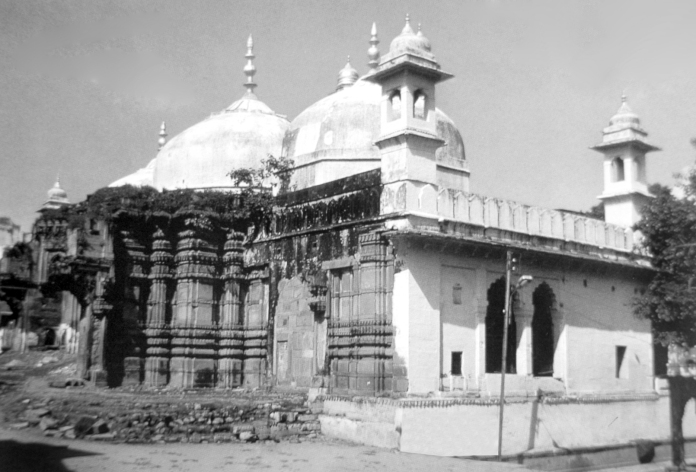
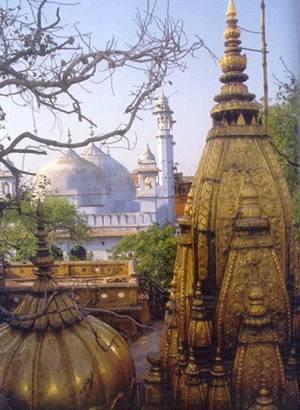
The Gyan-Vapi (Well of Knowledge) in Varanasi lies near the Great Mosque of Aurangzeb and the present Vishwanath temple, the Golden Temple of Varanasi.
An old photograph of the Gyan-Vapi
The land around Gyan-Vapi has been considered sacred since historical times, and has had an eventful past. The original Vishwanath temple was destroyed by Qutb ud-din-Aibek in 1194 during a raid of Varanasi. In its place, he built the Razia Mosque. The temple was rebuilt in 1585 by Todar Mal from Akbar's Court, and was destroyed once again by Aurangzeb in 1669. He used the materials from the temple to build a mosque, calling it the Great Mosque of Aurangzeb. The Vishwanath temple, built once again under the patronage of Queen Ahilya Bai Holkar in 1776, still stands next to Aurangzeb's mosque.
Incorporation of the second Vishwanath temple in Aurangzeb's mosque
While the Gyan-Vapi lies in the mosque precincts, legend says that the original Vishwanath Shiva Linga (an object of worship personifying the god Shiva) is hidden inside the well. During the British period, the Gyan-Vapi was a pilgrimage destination for many Hindus, who believed the well water to be more sacred than the Ganges itself.
A view of the Gyan-Vapi mosque (left) and Vishwanath temple (right)
While some consider the well to be a testament to the tumultuous relations between Hindus and Muslims, standing on ground sacred for both religions and surrounded by Hindu, Muslim, Jain and Buddhist iconography, the well manifests the diversity of Indian culture and the city of Varanasi.

Tuesday, May 17, 2016

Thrissur Pooram

One of Kerala's biggest festivals is the 'elephant festival' at Thrissur. The festivities, dedicated to the Hindu God Shiva, last for over 36 hours. They start when small elephant processions carry deities from various villages across Thrissur and culminate at the grounds of the Vadukunathan Temple.

The festival is marked by fireworks, and a display of umbrellas, as well as caparisons that adorn the elephants. Typically, the festival takes place during April-May.
See the crowds!
Mahouts have trained themselves to stand atop the elephants.
It's amazing how these elephants remain calm even when faced with hordes of people. 

There is increasing awareness in Kerala these days regarding the need for better treatment of elephants. A movement against the training and use of elephants is slowly taking shape. However, elephants have been an integral part of Kerala culture for hundreds of years and in fact, many of the majestic elephants have fan clubs of their own. You can find these fan clubs on facebook these days. Fans eagerly await the festivals and the processions.


Saturday, February 13, 2016

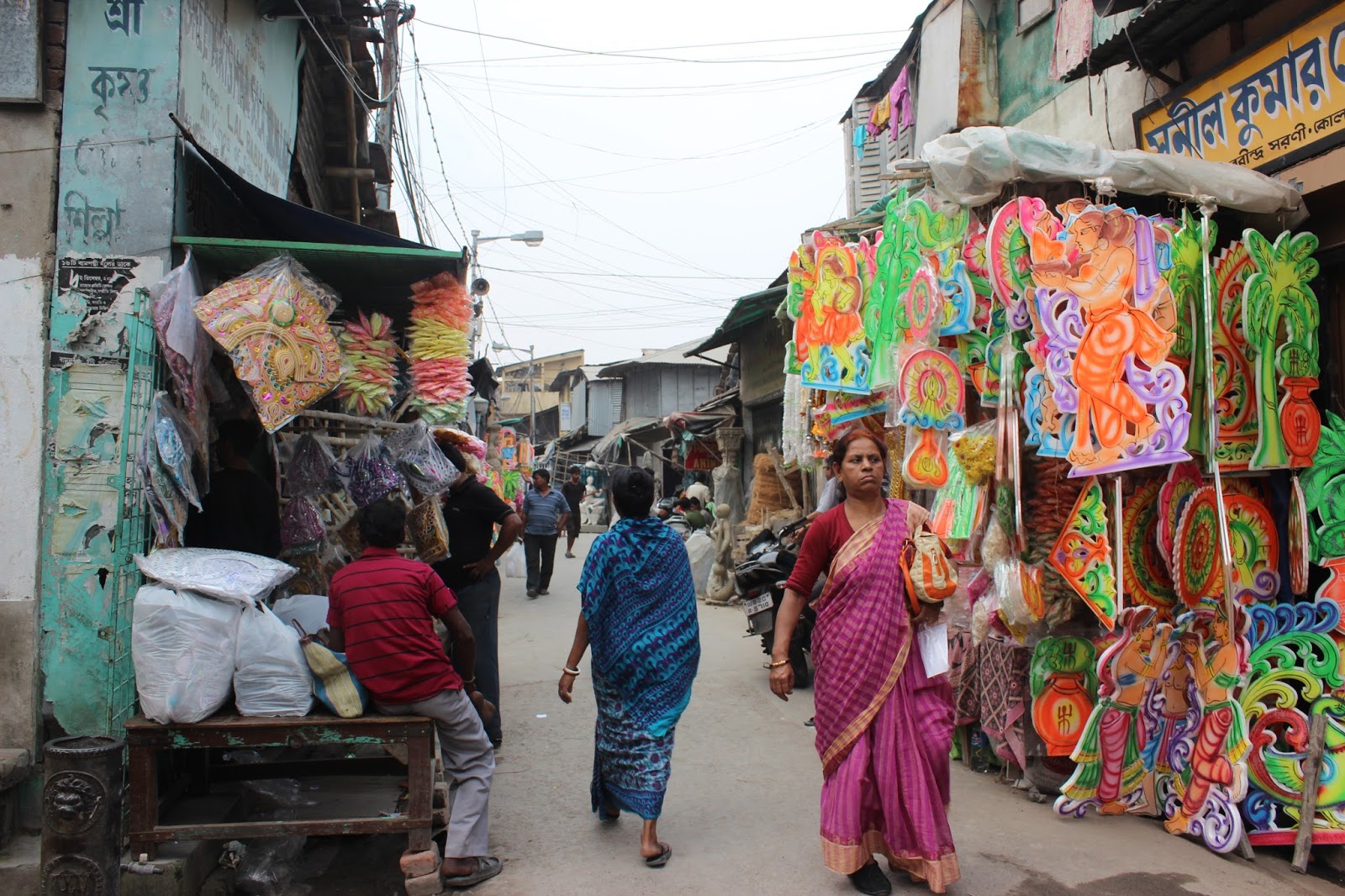
Saraswati idols at Kumartuli, Calcutta

Basant Panchami was celebrated yesterday in Calcutta, heralding the arrival of spring.  Homes, shops, schools and colleges, all celebrate Basant Panchami by worshipping Saraswati, the Goddess of Learning and of the Arts.

For several weeks before the festival, the potters at Kumartuli work hard to create beautiful idols of the goddess. I love the unfinished look of the statues, when they have no paint. Pure magic with clay and straw and water.
Saraswati is always depicted with a veena, a plucked stringed instrument that is mentioned in the natyashastra. In the photo below you can see how the hands are a different colour. That's because the hands are made separately, and attached after the base structure dries.
After the basic structure is completed, details are added. Crown, wavy hair, jewellery, these add beauty to the figures.
Here are some of the idols, being painted: in this one, the saree is the only part that is painted; only a first coat has been done. It will be further finished with more details and shading.
 Here's another one, see the curl of hair near the ears, on the cheek :) :) It is a traditional way of depicting beauty.
This one is also very beautiful, and waiting for more work to be done.
The entire area is busy at work. Some of the statues are very big, like the ones in this photo which the two men are working on.
There are decorations and embellishments also being sold.
I wanted to spend more time, but I had lots of other things to do. I hope you enjoyed this small glimpse!

Sunday, January 10, 2016

Suprabhatam – The Dawn Prayer

- by Deepa Krishnan

This morning I listened to Suprabhatam - the Dawn Prayer - as sung in the Tirumala temple in Andhra Pradesh. This is the prayer sung to wake up the sleeping Lord Vishnu. To me, there has always been something mesmerising and calming about the sound of this morning chant. 

Perhaps the sound of Sanskrit appeals to me; or perhaps it is the cadence itself, or perhaps it is the knowledge that I am listening to something very old.

On an impulse, I looked up the Tirumala website for a translation of the Dawn Prayer - and found myself captivated by the beauty of the lyrics.

Wake up, Lord, the song says, wake up! See the beauty of the Dawn! 
The breeze carries the scent of half-opened blue lotuses; it blows gently through coconut and arecanut trees. 
Green parrots in beautiful cages open their eyes; they eat bananas and sweet payasam, and sing gracefully. 
The black bees hum loudly, declaring themselves more beautiful than the flowers! 
Wake up, Lord, and with your waking, render the three worlds auspicious!

For me, the imagery these words conjure up is very "South Indian". In my mind, I can see a green prosperous fertile country, with rice fields and coconut groves, where the morning brings with it gentle breezes and calm beauty. 

Dark-skinned beautiful women walk in the fields, their sarees brilliant with colour. Temple spires – tall, colorful gopurams - rise above the trees. White oxen are being yoked to the plough. Everything is green and beautiful…and somehow blessed. (It is just me or does anyone else see these things? I don’t know!) 

Other than descriptions of the land, the Dawn Prayer also contains poetic descriptions of Vishnu:
Darling child of Kausalya! Lord with the Eagle Banner! 
Lord of the Seshachala Hills! Padmanabha, he of the Lotus Navel! 
Purushottama, ideal among Men! Madhava! Janardana! Chakrapani, Holder of the Divine Discus! Lord of the ten incarnations! He whose body is marked by the sacred Srivatsa sign!

The names go on, each bringing with it more and more rich visual images, until the whole Dawn Prayer is infused with a divine grace where God and Nature intertwine, where lines blur, where all you can see is the glory of the Universal Truth manifested in everything around you. 

Dawn sighting of the Lord of Tirumala!
Is it not fitting, then, that the dawn darshanam (sighting of the Lord) in the Tirumala temple is also called “Viswarupa Sarva darshanam”? (For those who do not know, the Viswarupa is the Cosmic Form of the Lord, said to contain the entire Universe in itself).

I am not religious, but I tell you, the Suprabhatam with its full meaning is enough to give me goosebumps.

My only regret is that my knowledge of Sanskrit is still half-baked, that three years of learning it is nowhere near enough to appreciate its depth and grace.

Truly, when you do not know the languages of your ancestors, you have lost half the world.

Friday, October 30, 2015

Araiyar Sevai: Sacred Recitals of the Vaishnavite Faith

Credit: Bharathwaj Thirumalai Ananthanpillai
Although it is 1200 years old, not many people know about Araiyar Sevai, a sacred art form of Tamil Nadu.

Araiyar Sevai is centered on the ritual singing and dance-enactment of the hymns of the Naalayiram Divya Prabandham (The 4000 Sacred Verses).

These verses were composed by the 12 Alvars (Poet-Saints) in praise of Vishnu, and were compiled in their present form by Nathamuni during the 9th–10th centuries. These hymns are still sung extensively today. However the enactment / performance of these hymns by the Araiyars is now increasingly rare.

Araiyar Sevai is usually performed in the presence of the temple utsavamoorty, i.e., the temple's processional deity.

Although temple inscriptions suggest its performance was once widespread, it is today only performed in a few temples in Tamil Nadu. These include the main temple at Srirangam, the Azhagiya Manavala Perumal and Alwar Tirunagari Temples near Trichy, and the temple of Andal at Srivilliputhur.

The performers are known as the Araiyar, and like all such traditions in India, it is a group of hereditary performers, who train from childhood to become proficient in the art. The photo below is from Srirangam:

Credit: http://jaghamani.blogspot.com/2014/11/blog-post_19.html
An araiyar sevai begins with a ritual summons, where the officiating priest calls upon the araiyar to come before the deity. The araiyar replies with a formulaic response and puts on the araiyar kullai (a conical hat) as he approaches. He then sounds a few strokes on the cymbals and begins the performance.

Each verse is performed in three steps. In the first, the araiyar sings the verse. In the second, he dances a few steps which, through a system of ritualised gestures, give expression to the literal meaning of the verse. In the third step, he explains the inner meaning of the verse, as explained in Tampirāṉ paṭi, a traditional commentary on the Divya Prabandham.

In this video you can see a performance: see the high musical quality of the story-recital:
https://www.youtube.com/watch?v=rMgDUTnq910 

Here is another performance, this one is quite different and I enjoyed watching the slow progress of the dance steps. The mudras and the footwork definitely have similarities with the other classical dance forms of South India, thus establishing their roots in the Natya Shastra.
https://www.youtube.com/watch?v=su5C4crgWKI
In this video, you can see how a program begins: https://www.youtube.com/watch?v=Zl_9LTxQxkM 

In this video, I was happy to see a young Araiyar, although there is not much happening in the video by way of music: https://www.youtube.com/watch?v=Q2cPtXHTvtk

The tradition is dying. Why? Because, frankly, we don't reward any of our performing arts. There is no patronage system that will entice a young man to adopt the way of life of his ancestors. We neither know about these arts, nor do we actively encourage them.

Here is the story of 83-year old Araiyar Srinivasa Rangachariyar, which I found on a blog. He has been peforming since the age of 13. I was delighted to see his grandson being trained. But there is simply not enough income! And yet the responsibility of keeping the art alive is on the shoulders of this young man. How will he manage?
Blog by Prabhu S: http://prtraveller.blogspot.in/2010/12/araiyar-sevai-saving-rare-art.html

Friday, August 14, 2015

Nachiyar Amman shrine in Chennai

I photographed this gorgeous idol of the folk goddess Nachiamman or Nachiyar Amman on Badrian Street in Chennai. The idol was housed in a little shrine and the flower seller women were offering their prayers to her. 

Nachiamma is one of the benevolent forms of the goddess, said to bestow good health and prosperity on her worshippers. 

I was struck by the alangaaram of the idol (decoration). She is depicted with beautiful dark eyes, with a smiling countenance. Her forehead is smeared with three lines of ash, and the auspicious red kungumam is prominently placed in the middle. Her nose-rings and round heavy olai (ear-rings) speak clearly of her folk origins.

Even though she is benevolent, her power is clearly visible in the sword, axe and trident which she holds. A halo of flames is around her head.  She is dressed in a golden silk saree, with a green border. The flower-sellers in the market have adorned her with fresh garlands.

Below this relatively new idol, there is an old black granite idol - possibly the original one that was established in this shrine. Offerings of flowers, coconuts, neem leaves and lemons have been made as per the usual practice in such goddess temples. In front of the idol is an image of the lion / tiger, which is the mount of the goddess.

I photographed this elderly flower seller as she came out of the temple after offering prayers. To me, she looked like the goddess herself, come to life.


- Photos and text by Deepa Krishnan

Friday, July 3, 2015

Architecture of Lucknow - What is an Imambara?

- By Aishwarya Javalgekar

There are many famous mosques and tombs in India, known for their splendorous architecture and intricate carvings. But an Imambara is different from a mosque, and may not necessarily hold the Friday Prayer. It is also different from a mausoleum, though it might contain tombs. 

An Imambara is a congregation hall built for Shia ceremonies, especially those which take place in Muharram, the first month of the Islamic calendar. Hussain Ibn Ali, the third Imam of Shia Muslims was killed in the Battle of Karbala in 680 CE. Shia Muslims gather in imambaras every year to mourn his death on the tenth day of Muharram. 

There are several majestic Imambaras in Lucknow, that embody the the city's royal history and rich heritage. Two of the most popular ones are Bada Imambara and Chota Imambara. The Shah Najaf and Sibtainabad Imambaras are also historically important.

Bada Imambara
One of the most popular sites in Lucknow, it is admired worldwide for its architectural design and grandeur. It was built by Nawab Asaf-ud Daulah, so it is also called Asifi Imambara. 
Bada Imambara (Picture Credits: Wikimedia Commons)
The entire structure is made of special Lakhanui bricks and lime plaster. No wood or metal has been used. The main hall of this complex is considered to be the largest vault chamber in the world. It is the largest hall in Asia without any external support from wood, iron or stone beams. The acoustics of the hall are such that one can even hear the strike of a matchstick across the length of the hall!

Chota Imambara
Also called Husainabad Imambara, it was built by Mohammad Ali Shah Bahadur, the Nawab of Awadh, between 1837 and 1842. This stately structure contains the tombs of the Nawab, his mother, and many other family members.  It is a blend of Indo-Islamic and Persian styles, and has a beautiful gilded dome. The walls are decorated with Arabic calligraphy. The Chota Imambara complex also has a shahi hamam (royal Turkish bath).
"Palace of lights" - Chota Imambara lit up during festivals (Picture Credits: 500px.com)

 To know more about the other two Imambaras, read Part II of this article.