Saturday, July 4, 2015

Rumi Darwaza in Lucknow - the grandest gateway in India

- By Deepa Krishnan

What the Charminar is to Hyderabad, the Rumi Darwaza is to Lucknow - an iconic monument that immediately identifies the city. Rumi Darwaza, which translates to "Roman Door", is an arched gateway that was built in the 18th century as the entrance to Lucknow.
Front of the Rumi Darwaza (Photo taken from travelokam.com)
Why would a very un-Roman looking gate in Lucknow be called Rumi? Because of the Turkish connection, of course. 

Istanbul in Turkey became the capital of Roman Empire in 355 AD (it was called Constantinople then). The Romans built walls around Constantinople, punctuated with many impressive gates. The Roman Empire in Constantinople ended in 1453 when the Ottoman Turks conquered Istanbul. The Ottomans repaired the gates in Istanbul which were destroyed during the war, and built new gates as well. 

Perhaps the idea of a grand entry gate came to Lucknow because of the many Persianised Turks who settled in Lucknow. No one knows for sure. Locally, the Rumi Darwaza is also called the Turkish gate. So we presume there was definitely some Turkish influence.

The Encyclopedia Brittanica says that Rumi Darwaza has been modeled on a gate in Istanbul called Bab-i-Humayun. Frankly, I fail to see any resemblance between the two. Maybe it was just the idea of having a grand gate, which came from Istanbul. Here's what Bab-i-Humayun in Istanbul looks like. 
Bab-i-Humayun, Istanbul, photo credit: Panoramio
https://geolocation.ws/v/P/59155102/bab-hmayunsaltanat-kaps-zum-topkapi/en

Before the Rumi Darwaza, there were many other Indian cities with entry gates. Delhi's Shahjahanabad had gates. Ahmedabad had gates. But no one had ever built such a magnificent gate as the Rumi Darwaza. Its architecture is a mix of Turkish, Mughal, and stuff that is purely Avadh in origin. 

Here is the other side of the Rumi Darwaza, which you see after you enter inside the city. I was there on a bright summer day, and clicked these beautiful photos:
Rumi Darwaza - after you enter the city
As the city has grown and expanded, Rumi Darwaza is now no longer the entrance to the city. It is instead, the beginning of a grand ceremonial road, flanked by the impressive Bada Imambada on one side. Here is the second photo I clicked:
Rumi Darwaza at the end of the driveway, with Imambara entrance on the left
Gorgeous isn't it?

Friday, July 3, 2015

Architecture of Lucknow - What is an Imambara?

- By Aishwarya Javalgekar

There are many famous mosques and tombs in India, known for their splendorous architecture and intricate carvings. But an Imambara is different from a mosque, and may not necessarily hold the Friday Prayer. It is also different from a mausoleum, though it might contain tombs. 

An Imambara is a congregation hall built for Shia ceremonies, especially those which take place in Muharram, the first month of the Islamic calendar. Hussain Ibn Ali, the third Imam of Shia Muslims was killed in the Battle of Karbala in 680 CE. Shia Muslims gather in imambaras every year to mourn his death on the tenth day of Muharram. 

There are several majestic Imambaras in Lucknow, that embody the the city's royal history and rich heritage. Two of the most popular ones are Bada Imambara and Chota Imambara. The Shah Najaf and Sibtainabad Imambaras are also historically important.

Bada Imambara
One of the most popular sites in Lucknow, it is admired worldwide for its architectural design and grandeur. It was built by Nawab Asaf-ud Daulah, so it is also called Asifi Imambara. 
Bada Imambara (Picture Credits: Wikimedia Commons)
The entire structure is made of special Lakhanui bricks and lime plaster. No wood or metal has been used. The main hall of this complex is considered to be the largest vault chamber in the world. It is the largest hall in Asia without any external support from wood, iron or stone beams. The acoustics of the hall are such that one can even hear the strike of a matchstick across the length of the hall!

Chota Imambara
Also called Husainabad Imambara, it was built by Mohammad Ali Shah Bahadur, the Nawab of Awadh, between 1837 and 1842. This stately structure contains the tombs of the Nawab, his mother, and many other family members.  It is a blend of Indo-Islamic and Persian styles, and has a beautiful gilded dome. The walls are decorated with Arabic calligraphy. The Chota Imambara complex also has a shahi hamam (royal Turkish bath).
"Palace of lights" - Chota Imambara lit up during festivals (Picture Credits: 500px.com)

 To know more about the other two Imambaras, read Part II of this article. 

Thursday, July 2, 2015

The Chariot Festival at Puri

- By Aishwarya Javalgekar

It is July now, and all eyes in Odisha are turned towards the Jagannath Temple, waiting for the grand procession of the Rath Yatra (Journey of Chariots).

Puri Rath Yatra (Photo taken from Wikimedia Commons)
Beginning on 18th July, three chariots will go on a procession from the Jagannath Temple to the Gundicha Temple, where they will remain for seven days. The chariots will return to the Jagannath temple on 26th July, marking the end of the Rath Yatra.

The Jagannath Temple in Puri is an important pilgrimage destination for Hindus all over India. The temple's origins are mentioned in the ancient Puranas, and several religious gurus and sects have made Puri their home. It is believed that a journey to Puri will free a pilgrim from the cycle of rebirth, and lead him to salvation.  

Jagannath (meaning Lord of the Universe) is associated with Lord Krishna. The legend goes like this: When Krishna was accidentally killed by a hunter, some devotees found his body and stored the bones. Later, Lord Vishnu directed a king called Indrayumna to make a statue and place the bones inside it. Vishwakarma was asked to make the statue. He agreed on the condition that he be given complete privacy till the work was complete. But the king and queen grew impatient and visited the site while Vishwakarma was at work. This upset him, and he left the statues undone. Even today, Jagannath is depicted without hands and feet.

In Puri, Lord Jagannath is worshipped as a part of a triad, along with his brother Balbhadra and his sister Subhadra. 
(From left to right) Idols of Balabhadra, Subhadra and Jagannath (Picture taken from newindianexpress.com)
Three idols are taken in enormous chariots, built specially for this festival. The chariots are richly decorated, and are drawn by the devotees who join the yatra (journey or pilgrimage). This festival attracts a large number of people, both from India and abroad. There is music and chanting, creating a colourful and euphoric atmosphere.
The three chariots being drawn during Puri Rath Yatra, 2007 (Photo taken from Wikimedia Commons)
Once the ceremony is over, the chariots are broken down and converted into religious relics. New chariots are made from scratch and beautifully decorated every year.They are a reference to the Bhagvad Gita, a sacred text of the Hindus. The festival is steeped in symbolism and carries forth ancient rituals that have remained much unchanged for centuries.


This year, the Rath Yatra will be even more special. The three patron deities will be given a new physical form. This only happens once in 12 to 19 years! The new idols will be carved from the Neem (Margossa) tree and consecrated in the temple.

Friday, June 26, 2015

Make-up art for Kathakali,

- By Trisha George

Kathakali is an Indian classical dance form that originated in the 17th century, in what is today the southern state of Kerala. Kathakali is known for its unique costumes, well-defined gestures and of course - the elaborate make-up. Although it is paint that is applied, the effect is more mask-like!

The colour and type of the paint-job helps the audience identify characters. A green faced performer is likely to be pious, while a red faced performer is probably evil. Female characters (played by men) tend to have yellowish, comparatively realistic faces. 
A female character
The paints are traditionally made of locally available materials: rice from rice four, black from soot, and colours from various stones. Coconut oil is used as a base for mixing these colours.

Nowadays, some Kathakali performances are preceded by the application of make-up for the benefit of the modern viewer or tourist. A performer painstakingly applies colour on his face - a process that may take over an hour.
'Make-up' application in process
 It does add a whole new aspect to the performance!

Thursday, June 18, 2015

Road trips in India

One of the best parts about road travel through India is catching glimpses of entertaining road signs. Both, governments and locals are (often unintentionally) entertaining. 
Not sure which advice to take- sound the horn or keep the distance? Best bet would be the latter.
Photos by Sigrid, who travelled through Kerala capturing such tidbits with her camera.

Saturday, June 13, 2015

The Jews of Kerala

Malabar Jews meet the king of Cranganore.

The year was 70 AD. Rome had attacked Palestine and rent the land asunder. Handfuls of the Jewish people fled in small boats with whatever little they could.

One of the boats landed on what was then called Shingly (now Cranganore or Kodungulloor), a trade center for spices, ivory and coconut along the Malabar coast.


The people on the boat disembarked with gifts forth for the king, who had arrived - all dressed in finery and shaded by a royal umbrella. He permitted the people on the boat to make Cranganore their home. Not only that, he granted them social standing in his kingdom.


The group made the new place their home and came to be called the Malabar Jews. 


Parts of Fort Kochi today have a visible Jewish heritage, from synagogues to 'Jewish Streets' to signs in Hebrew.

Jewish synagogue in Kochi
 
Years passed and once Israel was formed, many of them opted to return and their numbers in this country dwindled. 


It seems like a part of history - of a time when rulers were inclusive, visitors were grateful and peace reigned for a while.

Tuesday, June 9, 2015

Santa Cruz Basilica, heritage church in Fort Kochi

- By Trisha George

The Santa Cruz Basilica was among built by the Portuguese in 1505, and was eventually consecrated by Pope IV and raised to the status of a Cathedral.


Strangely enough when the Dutch army captured Cochin, they were instructed to destroy most religious structures. This has been rationalised as a strategic move: "to draw Cochin into a more narrow compass" and reduce the area and structures that would have to be manned by armed guards. Whether or not this is accurate, it is true that the soldiers followed their order to a T. Only two churches from the Portuguese period remain today and Santa Cruz Basilica is one of them.

The original structure was however, demolished and rebuilt by the British in the 19th century and that's what we can visit today! Only one decorative pillars from the original remains, but the rest of the church is unique enough to warrant heritage status.

Ceiling of the church


Thursday, June 4, 2015

The "Hoy" in Hoysala

- By Deepa Krishnan

Ever since I heard how the Hoysalas got their name, I keep saying their name differently in my head. Here, join me, try saying it the way I do. "Hoy! Sala" And put the emphasis on that Hoy! There you go. Hoy!

Those who have visited Belur will know that in Haley Kannada (the old form of the language), the word Hoy means Strike! That that is what Sala, the young man in the statue is doing, striking at the lion which threatened a Jain guru. 
It led to the naming of the Hoysala dynasty, which he founded. The dynasty ruled for 300 years, from 1026 to 1343 CE. The legend of Sala is immortalised in stone in Belur. This is the royal emblem of the Hoysala dynasty, and it is depicted in different artistic forms. Just see the photo above. Look at the variations the artists have come up with. Stunning. The lion, the weapon, the stance, the tail....simply outstanding. It is not for nothing that Hoysala architecture is considered among the world's masterpieces. Go on. Play the "spot the differences" game.

Hoy! Sala. Hoy!

Thursday, May 28, 2015

Datun-wali (neem-twig seller) in Varanasi

- by Deepa Krishnan

Varanasi is a city which wakes up really early. Many people visit the temples at dawn. Naturally the city's vendors also begin early. I photographed this datun-wali at 6 am.
Neem seller with cutting implements
Datun is made of neem twigs. The twigs are harvested from trees, then cut into shape (she is using a wooden board and sickle, which you can see in the photo above). Then they are bundled and sold. Datun is the traditional method of cleaning teeth. Chewing on the end of the twig releases the medicinal properties of neem.

Azadirachta indica (neem) has a wide range of medicinal properties and is extensively used in Ayurveda, Unani and Homoeopathic medicine. More than 140 compounds have been isolated from different parts of neem. All parts of the neem tree- leaves, flowers, seeds, fruits, roots and bark have been used traditionally for the treatment of inflammation, infections, fever, skin diseases and dental disorders.
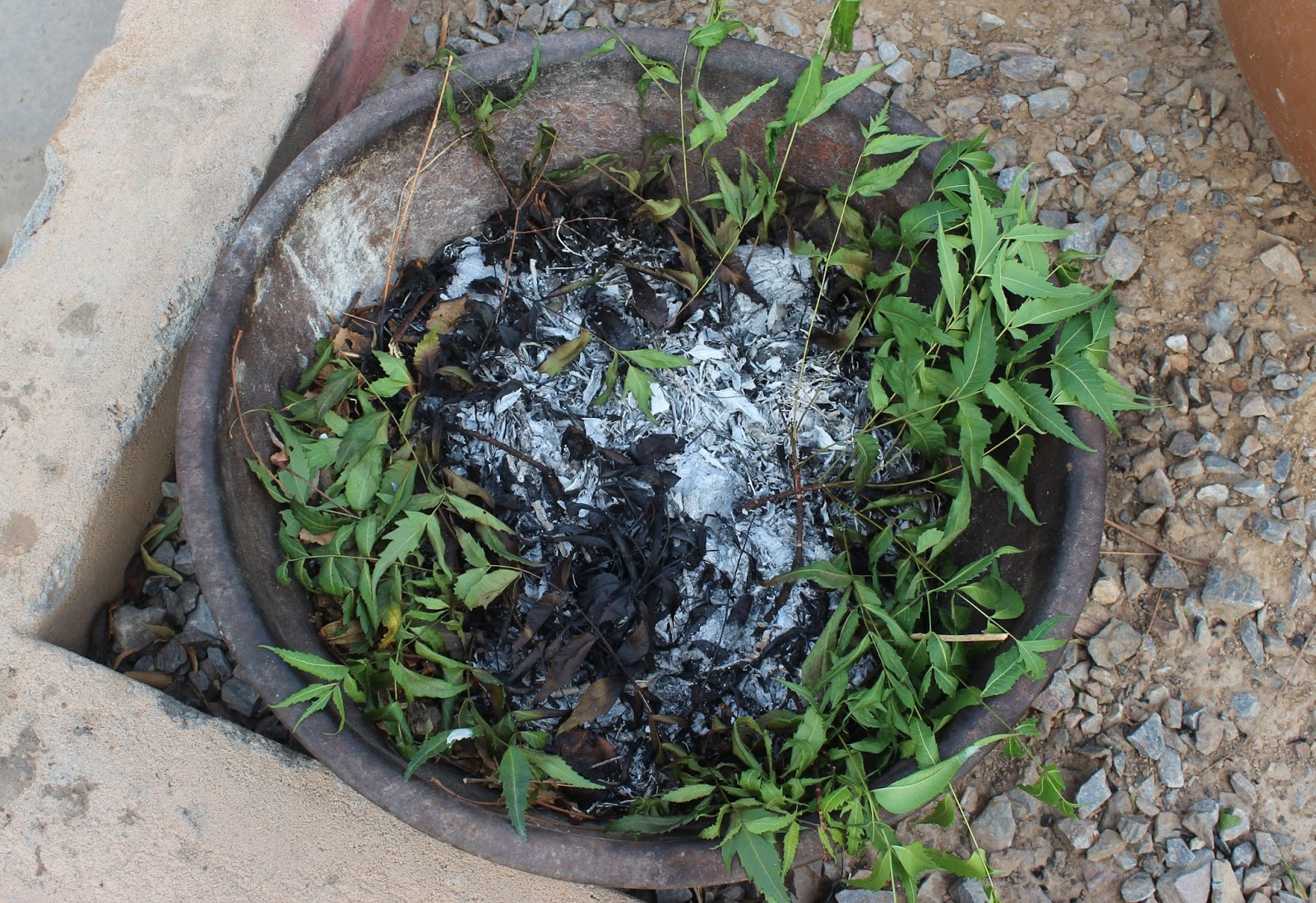
Neem leaves being smoked over charcoal fire to keep away mosquitoes and insects

Tuesday, May 26, 2015

Brahmanical Caves in Ellora

- By Deepa Krishnan

Ellora contains 34 caves adorned by Buddhist, Hindu and Jain art and figures. Caves 14 to 19 belong to the Brahmanical pantheon. Brahmanism is the predecessor of modern day Hinduism; it is primarily Vedic in nature and has several differences with modern Hindu practices.
This panel shows Shiva (large central figure) as the slayer of the demon, Andhaka (you can see the demon, represented in small form, speared on top right). Two hands of Shiva hold up the outstretched skin of the elephant demon Nila, one of Andhaka's allies. You can see the partial elephant head also on the top left corner of the photo. Shiva is in his fierce form as 'Veerabhadra'. In one of his hands, just under Andhaka, there is a cup, it is made of a skull, this is used to catch the blood of Andhaka as it drips (each drop spilt on the ground creates another demon). Parvati sits with her hand on her bosom, conveying either admiration or fear, I am not sure which.

The story goes that one day in a playful mood, Parvati covered Shiva's eyes with her hands. Darkness shrouded the world. From the heat and perspiration of her hands was born a dark child, Andhaka. Andhaka was raised by a demon, Hiranyaksha, who was childless and asked for a child as a boon.

When he grew up, Andhaka terrorized the world. He became the king of Asuras (demons). He tried to acquire or abduct Parvati, which enraged Shiva and led to Andhaka's death. Shiva's wrath is depicted in the panel.

Friday, May 22, 2015

Calico Museum of Textiles in Ahmedabad

The Calico Museum of Textile in Ahmedabad is one of the best textile museums in the world. It was established in 1949, a couple of years after India's independence from the British. 

The Sarabhai family, who founded the Museum, were in the textile business. The family was very involved in the Indian independence movement. They were close to Mahatma Gandhi, and they founded many new educational and research institutions in independent India. The Calico Museum was one of them.

Originally, the Museum was supposed to focus both on traditional hand-made textiles of India, as well as modern industrial textiles. But later, as the collection and research grew, the museum came to focus more and more on the traditional textile crafts of India.

The stature and reputation of the Sarabhais as connoiseurs of the artistic traditions of India attracted the best researchers and scholars. Eminent museum scholars and administrators such as John Irwin, Alfred Bühler, Moti Chandra and Pupul Jayakar have been instrumental in creating a high level of scholarship at the museum. When you visit the museum, what strikes you most is also the technical excellence - the work of designers, lighting experts and craftsmen - which offers a unique viewing experience.

In 1982, the Museum went through a period of serious crisis, as the Calico Textile company ran into losses and could not fund the Museum's activities. It was then brought under the Sarabhai Foundation, and it moved into the Sarabhai Haveli, from where it still operates.

Today the Calico Museum contains what is possibly India's best maintained and best presented collection of traditional fabrics spanning over five centuries. But it is much more than just textiles. There are two display venues in the Museum:
  • The Chauk contains textile-related displays: explanations of techniques (weaving, dyeing, embroidery, block printing etc), costumes, regional embroideries, textiles of the Mughal and provincial courts, and a display of India's textile trade with the world
  • The Haveli contains Jaina works (manuscripts, textiles, woodwork, sacred objects, etc), Indian paintings from the Sarabhai collection, ritual art of the Vallabh tradition, bronzes from South India, etc.
If you are visiting the museum, please note the following important details:

- The Museum is closed on Wednesdays and public holidays.
- There is no entry fee for visiting. 
- Visits are by appointment only; you have to write to them in advance and obtain permission.
- There are 2 guided tours per day: covering the Chauk in the morning and the Haveli in the afternoon. There is no way to see the galleries just wandering around independently.
- Bags, cameras, cell phones are not allowed. Photography is prohibited without prior permission.
- The exhibits are at multiple levels and require some amount of climbing; but it is easy to do. It is not suitable for wheelchairs.

The Museum website https://calicomuseum.org/ is excellent and informative; please go through the rules and do's and don'ts before you visit.

Photo Credit: calicomuseum.org

Wednesday, May 20, 2015

The Lingaraj Temple in Bhubaneshwar

- Aishwarya Javalgekar

Bhubaneshwar is called the city of temples. And rightly so, since it is said to be home to ten million Shiva Lingas! It is one of the most celebrated pilgrimage centers in India.  

The Bramha Purana, a Hindu text refers to Bhubaneshwar as the 'Ekamra Kshetra'. A 13th century inscription by Paramardideva (the Chandela king who ruled Central India), describes Ekamra as a sacred area “...adorned with hundreds of mango-groves, wherein exists a single Devakula [temple] surrounded by numerous temples.”  

The single temple, of course, refers to the Lingaraj temple, which is the largest and most renowned amongst all of Bhubaneshwar's temples. It was first built by Yayati Kesari, a 7th century king, who shifted his capital from Jajpur to Bhubaneshwar. Bhubaneshwar remained the capital of the Kesari kingdom till 10th century CE. 

This temple has a spacious courtyard bounded by fortified walls. Its elaborately carved tower rises up to 180 feet. Built in the Kalinga style of architecture, it has four main components: the vimana (the structure which contains the sanctum), the bhoga-mandapa (the hall of offerings), the natamandira (the festival hall) and the jagamohana (the assembly hall). 
The temple displays impressive carvings of humans and animals. Inscriptions dating back to 13th century, CE of the Kalinga ruler Anangabhima III have been found here. It also houses some important Sanskrit scripts from the 6th and 7th centuries. 

Wednesday, May 13, 2015

Le Plaisir - A haven for foodies in Pune

- By Aishwarya Javalgekar

Tucked away in a small galli near Fergusson College, Pune, is a haven for the not-so-health-conscious foodies. A petite bistro with European cuisine, Le Plaisir has won the hearts of many localites. “I named it (the restaurant) ‘Le Plaisir’ because that is what I want to do here. I want to give people pleasure through food.” says Siddharth Mahadik, owner and head-chef of Le Plaisir.

This cozy little place, with just enough room for 6 tables, is always bustling with life. Sometimes you might have to wait for 5-10 minutes before you get a free table, but the food is worth the wait. Once you are comfortably seated, you can head over to the counter and give your order. The food takes hardly ten minutes to arrive – scrumptious and piping hot. With the first bite, you transcend to a world of culinary bliss.

Priding itself in being a patisserie, Le Plaisir has some of the best desserts in town. From flavoured macaroon to a variety of cheesecakes and pastries, it has something to soothe every sweet tooth.
Le Plaisir has a unique system of customer review. Customers can write their feedback on small colourful cards, which are then stuck to the wall. Some of the cards sing praises of the food, while others suggesr which dishes to try. Words like amazing and orgasmic can be seen on almost every card.
Siddharth has no plans for commercializing this bistro. "I will expand, but I want to retain the coziness and warmth of Le Plaisir."

Update: Looks like the expansion is finally happening! They're moving to a larger place at Prabhat Road, opposite Kelkar Hospital in June 2015.

The Red and White Bridal Bangles of Punjab

- By Mansi Shanbag

It’s not uncommon to come across many stores selling red and white bangles in Amritsar, so much so that the wave of red and white is overwhelming.

The warren of lanes in the Chudi Bazaar, specializing entirely in the sale of bangles, is a hit with locals as well as guests.
Bangles can be traced back to 2600 BC, when a figurine of a dancing girl with bangles on her arm was excavated from the Mohenjo-daro ruins. Apart from this, numerous excavations of Indus Valley sites in Sind, Punjab and Gujarat have yielded bangles of shellac, clay and metal.
In Hindu and Sikh weddings in Punjab, the bride is gifted red-and-white bangles to wear on her wedding day. There is a ceremony, the chuda ceremony, which is on the day before the wedding, or on the actual wedding day itself. Traditionally, 21 bangles are gifted, although these days brides sometimes wear fewer bangles. 

Originally ivory-made, white bangles are now made in plastic. There are few things more picturesque than an Indian bride dressed up to her eyes in the traditional shades of red and white. And the red and white choora (bangles) do much to compliment the bride.
The bride wears the bangles as a sign of being newly married. The bangles are made of delicate materials, so that the bride is exempt from any heavy household chores. After the wedding, the bangles are traditionally worn for a year. In modern times, this too has reduced to 40 days.  Nevertheless, the tradition of bangle-wearing lives on and is quite delightful to behold. 

Sunday, May 10, 2015

Puppet Making in Rajasthan

- By Deepa Krishnan

I was walking in Jaisalmer, when I came upon a man making  string puppets (marionettes).
The puppeteers are Bhats of the Rajasthani Nat community, who are storytellers in the bardic tradition. The Bhats not only make puppets, but also use them to perform folk tales set to music and song.
Rajasthan's puppetry tradition is very old. The Bhats trace their history back to the legendary king Vikramaditya of Ujjain, who is said to have ruled central India in the 1st century BCE. Vikramaditya's famous Throne of Wisdom, called the Sinhasan Battisi, had 32 talking dolls, which (according to this book) are possibly the earliest account of puppets made by this community in India.

In olden times, the Bhats went from village to village with their puppets, enacting much beloved legends. Royalty and noblemen patronised specific Bhat families, and in return, the puppeteers composed ballads in praise of their patrons. In other words, the Bhats were to kings, what PR agencies are to corporates :)

Prithiviraj Chauhan, who ruled Ajmer and Delhi in the 12th century, was a major patron of the Bhats. Ballads celebrating his daring elopement with Samyukta, and his battlefield exploits against Muhammad Ghor, were performed by the Bhats all over north India. Prithviraj was routed, captured and put to death by Ghor, but balladeers and puppeteers went on to construct an elaborate myth about an archery competition, where a blind Prithviraj shoots an arrow unerringly at Ghor and strikes him dead. The legend of Prithviraj Chauhan's revenge on Muhammad Ghor has endured for more than 800 years, and is a widely accepted version of the truth.
Scene from Prithviraj Raso: Samyuka is love-struck by Kama's arrows

The revenge of Prithviraj against Ghor, Phad Painting
Another major patron of the Rajasthani Nat community was Amar Singh Rathore, a hot-headed 17th century nobleman from the house of Marwar (Jodhpur). He was exiled by his father after a fight; and found employment in the Mughal court, where he became the subedar of Nagaur under Shah Jahan. In this new employment, he squabbled with another courtier, and stabbed him right in Shah Jahan's court. In the melee that ensued, he narrowly escaped from Agra Fort with his life, after jumping across the moat on a horse. Later, one of Amar Singh's clansmen inveigled him back to Agra Fort and stabbed him.

I do not see Amar Singh's life as particularly heroic; in fact, I only see a quarrelsome guy with a strong instinct for self presevation! :) :) But that is not how the bards sing it. The puppeteers of Nagaur tell a stirring tale of what a dashing hero he was, and what a martyr his horse was. They sympathetically present his terrible betrayal and stabbing, and tell a grand tale of how his body was rescued from Agra Fort. The puppeteers of Nagaur have made Amar Singh Rathore into a Rajasthani legend. His story is popular in the desert regions of Rajasthan and performed with much dramatic flair at religious fairs even today.
Scene from Shah Jahan's court: Amar Singh Rathore is insulted by Salabat Khan
In spite of the popularity, influence and wide geographical spread of Rajsthani puppet shows, puppetry as a craft is dying today. The reasons are easy to find. Today, there are no royal patrons (in fact, the decline in patronage set in right from Mughal times). With the advent of radio and television, traditional rural performances have competition from modern entertainment channels. The wide availability of mobile phones has brought a lot of new music within the reach of audiences in remote locations. Old themes / folk tales do not appeal as much to the new generation as Bollywood. 

The Bhat community has adapted themselves to modern times. Some performers have incorporated tunes from popular Bollywood movie songs into their repertoire. Instead of long ballads, they have produced short-duration performances aimed at tourists (who typically have very short attention spans).

But many have given up their oral performances, and morphed simply into makers of colourful wood-and-cloth puppets. They are often seen in the bigger cities of Rajasthan, where tourists buy their attractive products. Rajasthani puppets are typically about 2 feet tall, but many are smaller as well. The local word for them is kathputhli. The word kath means wood, and puthli is a doll.
Beautifully decorated kathputli
Puppets are made out of soft wood, usually something like mango wood. While the carving of the wood is usually done by men, women make the decorative fabrics and clothes for the puppets. Puppets used for performances are usually never destroyed; even when they are broken. Instead, they are consigned to the river, to float away.
Puppeteers live in Nagaur, Bikaner, Ajmer, Udaipur and Jaipur, but wander all through Rajasthan performing and selling their dolls. If you are visiting any major city in Rajasthan, you will definitely be able to see a show.  And do stop to buy some of these colourful dolls - they make great souvenirs from Rajasthan to take back home!