Monday, April 7, 2014

Janaki Krishnan's Kothamalli Thogayal

Best with crisp hot dosas!

Ingredients:
  • Fresh coriander leaves 1 bunch
  • 4 dry whole red chillies
  • a pinch of hing (asafoetida)
  • 1 cup urad dal
  • lemon size tamarind
  • small marble size jaggery
  • 1 teaspoon oil
  • salt to taste.
In a tea spoon of oil roast urad dal, chillies and hing on low flame till the dal changes colour a little.

Grind it a little roughly, adding raw tamarind, jaggery and salt.

Once it is ground, then add the coriander leaves roughly chopped, and grind again, just do a quick spin. Ta-da! Done!

If you want a dry powder version of this dish, avoid adding water while grinding. Sprinkle a few drops only. For wetter version add 3 or 4 table spoons of water.

The dry version can be stored in the fridge. I sometimes use it on idlis, coat the idli with oil or ghee and roll in the powder. Good for a moist tasty lunch dabba. This can be used as sandwich spread also.

Some people add fresh grated coconut while grinding, but that gives it a very different flavour, and also in that case, it must be consumed quickly.

Monday, March 31, 2014

Telugu New Year Feasting in Chennai

Ugadi or Telugu New Year was celebrated today. A traditional banana leaf spread with all the yummy festival dishes. Special dishes are made with flavors of sweetness and bitterness to depict the ups and downs of life!


Friday, March 28, 2014

Metcalfe Hall, Kolkata


The Metcalfe Hall, named after Lord Metcalfe, who officiated as Governor General of India from March 1835 to March 1836. The architecture shows clear Greek influences. It was originally conceptualised as library. The annex building of the Asiatic Society is on the ground floor. The Archaeological Survey Of India (ASI) has a small museum on the upper floor.

Photo credit: http://commons.wikimedia.org/wiki/File:Metcalfe_Hall.JPG

Wednesday, March 26, 2014

Lord Shiva's sculpture at Albert Museum in Jaipur

Fine sandstone sculpture of Lord Shiva's head, 8th Century, in the Central Museum Jaipur (Albert Hall Museum). The finely chiseled facial features and the subtle smile show the high artistic and empathetic skills of the time. The third eye is clearly visible and the elaborate hair arrangement is beautiful.

The sculpture is from Baansi, near Udaipur. Bansi (or Baansi) is one of the principalities under the house of Mewar (Udaipur kingdom). It is about 2hrs drive from Udaipur, in Chittorgarh district, and known for its temples. The Shaktawats who ruled Bansi are patrilineal descendants of Prince Mir Shakti Singh, a brother of Maharana Pratap of Mewar dynasty. The area got its name from the many bamboo trees (baans) in the locality. It is primarily a Hindu area with many hills and temples.


Photo source: http://commons.wikimedia.org/wiki/File:JCM-Shiva8Jh-SDIM1345.jpg  

Thursday, March 20, 2014

Shila Mata Temple at Amber Fort, Jaipur

The Shila Mata (Stone Mother or Stone Goddess) temple at Amber Fort is dedicated to the Goddess Kali. Although Jaipur is known for its murtikars (idol carvers), this particular idol was not made in Jaipur, but came to Jaipur from far away Bengal.
Raja Mansingh I of Jaipur (1550 - 1614) was sent to Bengal by the Mughal Emperor Akbar to consolidate Mughal power in Bengal and to crush anyone who resisted Mughal overlordship. The chief opposition to the Mughals came from the Bengal Sultanate (Afghan chiefs who had broken away from the earlier Delhi Sultanate) and the local landed barons of Bengal (collectively called the "Baro Bhuiyan" or the Twelve Chiefs, although there were more than 12). 
Raja Mansingh I successfully quelled all oppposition, and was rewarded with three successive governorships of Bengal. Shila Devi was the patron deity of Kedar Ray, the Raja of Sripur (one of the Baro Bhuiyan). Mansingh carried away the idol from Sripur, brought it to Amer Fort and installed it in a temple. Along with the idol, Bengali priests also were brought to Jaipur, and their descendants continue to officiate at the temple.
Silver-engraved entrance door to the Shila Devi Temple at Amer Fort, photo from Wikipedia
The Shila Mata temple draws in large crowds during the winter Navratri (Festival of Nine Nights). People come not only from Jaipur city, but from the entire countryside around Jaipur. This year Navratri is between 25 Sep 2014 to 03 Oct 2014.
Navratri, or 'Nine Nights' is a widely celebrated Hindu festival. Within a year there are at least 5 different Navratris, but the most popular is the Sharada navratri (or Maha Navratri). It is believed that during these nine days the goddess Durga manifests herself in different forms, and each of these is worshipped. The last day of this Navratri corresponds with the festival of Dussehra. Dussehra has dual significance in Hinduism. While on one hand it is celebrated as the day which godess Durga slays the demon Mahishasura, it also marks the slaying of the demon king Ravana, by Lord Ram. Both events heavily emphasise on the victory of 'good over evil'.
A painting depicting goddess Durga as 'Mahishasurmardini' (The Slayer of the buffalo demon Mahish)
During this festival, Amer is very crowded, as many people offer prayers at Shila Mata temple. Crowds and elephants don't go well together; so there are usually no elephant rides during at Amer Fort during this period.

Tuesday, March 18, 2014

Silver shopping in Mylapore, Chennai

Sukra Jewellery, near Rasi Silks, Mylapore. This is my sister's haul, she was wearing it today and I photographed it. Totally drool-worthy!

If you haven't already seen it, do take a look at the CHENNAI MAGIC SHOPPING GUIDE.

Suba and I have suggested shops for fabrics, jewellery, curios, and all sorts of other things. I'm sure you'll love it! We are updating it every now and then with new items, so please pop in regularly and take a look.

If you have not been to this area of Chennai before, try our Mylapore Walk. It offers a great introduction to this religious and cultural epicenter of the people of Chennai.

During this walk, you will visit the Kapaleeswara temple in the company of our knowledgeable guide. You can also walk through the surrounding areas, where you can see Mylapore in all its crowded chaos. The jewellers, silk merchants, fruit and vegetable sellers and the flower vendors in the bazaars provide a colourful backdrop to the temple. The walk takes you through small lanes with old-style homes, through silk shops, stores selling music and religious memorablia, ‘kutcheri’ auditoriums, etc.

At the end of the tour, we stop at the popular Saravana Bhavan for snacks and coffee. More details here.

Monday, March 10, 2014

Methi na thepla

Methi thelpa in progress... yummy! To be eaten with chunda (sweet and spicy mango relish) or with green chillies and mustard pickle.
How to make: Take whole wheat flour, a spoon of yoghurt, chopped fenugreek leaves, salt, chilli powder, coriander powder, jeera powder. Knead together with water and two spoons of oil to make a non-watery dough. Roll out like chappati, cook on griddle with ghee and serve hot.

Tuesday, March 4, 2014

Beat the Chennai Heat

These can be spotted in almost every street in Chennai. Referred to as "tharbees" by locals, these individual watermelon slices are to be relished to beat the city notorious for its hot weather.


Saturday, March 1, 2014

Sugarcane Juice in Cochin, Kerala

Another can-do statement as Kochi prepares to beat the heat!!

Cane Juice is excellent (just avoid the ice) what with natural sugar and minerals, this drink beats fizzy colas hands-down.

It is considered a must-have for patients recovering from jaundice, physical exhaustion and of course, for those who like the taste.

Ask for it to be made with a dash of ginger if you like the idea of a slight tang in the sweet.

- Shobna Iyer

Sunday, February 23, 2014

Balaji's Antiques, Bangalore

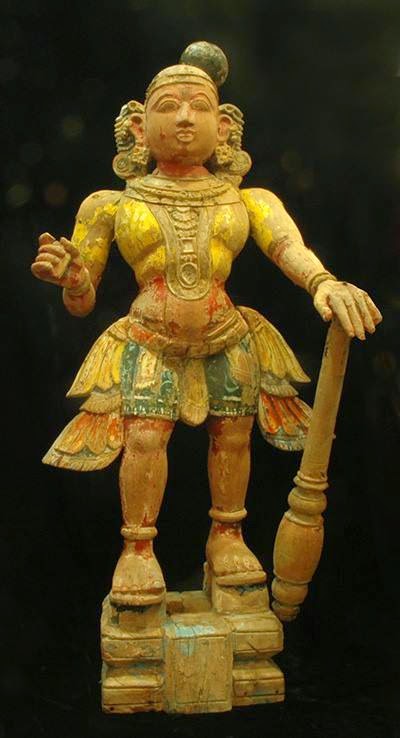
If you want to shop for souveniers in Banglore, Balaji's Antiques is a great place to check out! They have some pretty awesome stuff, collected from all over South India. I loved this door guardian figure that they posted on their website.
The dhoti (loincloth) is vaguely similar to a Roman gladiators skirt, isn't it?
Dwarapalakas (‘Guardian of the door’ traditionally appear in pairs in Hindu architecture outside the temple door or/and sanctum as gatekeepers or guardians of the deity. These guardians are fearsome warriors or giants and are often seen holding a mace, as this one is. This dwarapalaka’s tongue is sticking slightly out which is a warning mudra, ‘be careful I am here.’

Some sources believe that the Dwarapalakas represent a stage in the spiritual progress of the soul. They represent the devotee who can think of only God and no one else.

You can check out their collection here http://balajiantiques.com/ 

Saturday, February 22, 2014

Nine River Goddesses at the Kumbakonam Temple in Tamil Nadu

Photo: One of the Navakannikas, the nine river goddesses, at their famous temple at Kumbakonam. She is represented with her attendants. Look at the beautiful play of texture and colour!!

There is a very major Mahamaham festival that happens once in 12 years at this temple. About 5 million people showed up for the last one in 2004 (!!). It is believed that all the nine goddesses come with Lord Siva to bathe in the temple tank at this time. The next festival is Feb 2016, in case you're planning that far ahead.

Three of Tamil Nadu's outstanding crafts came together to create this simple but dazzlingly stunning visual of a river Goddess. Stone carvers, textile weavers, and bronze artisans, all worked on it. The temple architects designed the layout. The priests expressed their devotion through decoration. Truly, such beauty is divine. Without such aesthetics, the Indian soul would be dead.

Photo credit: Ronni Hendel-Giller

One of the Navakannikas, the nine river goddesses, at their famous temple at Kumbakonam. She is represented with her attendants. Look at the beautiful play of texture and colour!!

There is a very major Mahamaham festival that happens once in 12 years at this temple. About 5 million people showed up for the last one in 2004 (!!). It is believed that all the nine goddesses come with Lord Siva to bathe in the temple tank at this time. The next festival is Feb 2016, in case you're planning that far ahead.

Three of Tamil Nadu's outstanding crafts came together to create this simple but dazzlingly stunning visual of a river Goddess. Stone carvers, textile weavers, and bronze artisans, all worked on it. The temple architects designed the layout. The priests expressed their devotion through decoration. Truly, such beauty is divine. Without such aesthetics, the Indian soul would be dead.

Photo credit: Ronni Hendel-Giller

Tuesday, February 18, 2014

The cave-temple, Govardhana in Banglore

The statue you see, is of Lord Krishna, in the Govardhana Temple at Basavangudi, Bangalore.


The temple falls under the of the Madhava sect of Hinduism. Acharya Madhva (1238-1317) was the founder Philosopher of Tattvavada, more popularly known as the Dvaita School of Vedanta.

The 'cave temple' was built in 2004 by a lady named Dr. Nalini Rao, as a devotional offering. It is built in a unique architectural style to recreate the legendary mountain Govardhana.

It is believed that Lord Krishna once held up the mountain, on his little finger, for seven days to shield his village from torrential rains. Some Vaishnavites even believe that this mountain is an extension of Krishna, thus making it a holy site. The event, popularly known as 'Govardhana-shila' is often represented in religious art, but this temple is a whole different level of devotion!
A watercolour depicting Gowardhan Sila. circa 1640. Source: V&A Museum.
You can wander inside a mountain labyrinth to see beautiful scenes from Krishna's life carved on the walls. Instead of a closed sanctum, this idol of Krishna is at the heart of the temple.

In the background of this photo you can see Krishna conquering the poisonous serpent Kalia who terrorized the people of Brindavan. Krishna merely had to dance on the serpent's head for it to start dying. Legend's about Krishna always have a playful air to them, don't they?

This temple is quite unusual, for more than one reason. Firstly its focus on story-telling is commendable and makes for such an interesting visit. Secondly, how often do we see a modern-day Indian woman financing a whole temple?

Dhurrie Making in Jodhpur

Dhurrie making near Jodhpur. Dhurries are reversible flat-weave rugs or mats. Typical designs are geometric. There is a lot of innovation now in designs.


Monday, February 17, 2014

Thar desert: man and animal in conflict?

At sunset when the Thar desert (Rajasthan) is golden and the colours are surreal. This is a group of female neelgai antelope with young ones. 
We were ooh-ing and aah-ing when our guide explained to us that the neelgai were a major threat to his farm crop (millet and mustard are grown in the Thar, apart from many other things). The negative feeling in his voice was clear: he did not like these animals. His tone made me stop and think about man-animal conflict, and how groups of people who traditionally have coexisted with animals are now losing their tolerance.

Traditionally the neelgai has not been hunted in India because it is believed that this is a type of cow. But attitudes are changing.

I don't blame the farmer. Life is precarious in the desert, and farming is not easy. Once the crop is sown, it must be guarded from being eaten, which is of course, taxing for small farmers (since the labour usually is sourced entirely from the farmer's family).

Unfortunately, there is no systematic, nation-wide approach towards managing man-animal conflict. The root causes of the problem are well known: widespread loss of natural habitat and food sources, changes in land use and cropping patterns, cutting off of wildlife corridors, and so on.

What is to be done? We need comprehensive policies that treat land in a holistic manner irrespective of state boundaries; we need to think about our 'development' model. Most importantly, we need to stop producing more and more Indians!! The huge population needs to stop growing at unsustainable rates.

None of these solutions are easy.

Here's an article that talks about the man-animal conflicts in India.

Sunday, February 16, 2014

Attukal Pongal, the largest congregation of women in the world, Kerala

- By Shobna Iyer

Attukal Pongala at the Attukal Bhagavathy temple in Thiruvananthapuram is the largest congregation of women in the world (it won a Guiness for this!)

The ceremony involves boiling pongala (a mix of rice, jaggery and coconut) till it overflows. The overflow is necessary to appease the wrathful aspect of feminine energy. Once appeased, the goddess is capable of far-reaching changes in human life.

Interesting isn’t it? Once anger leaves us, we understand better, we make our own miracles with solutions. But for anger to leave us we must first give its due, it may demand apology, a reassurance, a kind stroke of understanding or some form of reconciliation. Then, it settles but it will show its face again. Thus a ritual of attentive reassurance comes to be.

Photo credit: http://www.bubblews.com/news/2349820-biggest-religious-women-gathering-in-the-world-attukal-pongala-today-16022014-in-my-city